⚡️ Intro
Tesla is not just a car company. Its latest leap in energy storage—headlined by Megapack 3 and the integrated Megablock—signals a re-engineered future for the grid, where renewables flow without drama and outages become rare events. If these systems deliver at scale, the next wave of clean energy won’t be about panels or turbines alone; it’ll be about where the power waits until you need it.
🎯 Context & Who It’s For
This deep-dive is for clean-tech followers who want the technical “why,” investors who care about cost curves and deployment speed, and city leaders or operators who must balance resilience with budgets. If you’ve been tracking long-duration storage, virtual power plants, and the growing role of AI in energy orchestration, this is the puzzle piece that clicks a lot of things into place. For broader context around the sustainability landscape, you can pair this analysis with our ongoing coverage of Green Tech Innovations and how breakthroughs ripple into everyday devices and Eco-Friendly Tech that households actually buy.
💡 Nerd Tip: Read this like an operator: speed to deploy, lifetime cost, and software control matter more than any single spec line.
🧩 Tesla’s Role in Energy Beyond Cars
A decade ago, Tesla’s energy story began as a side plot: Powerwall for homes, Powerpack for commercial sites, then the flagship Megapack for utilities. Each iteration has been less about a battery in isolation and more about a system—HVAC, inverters, controllers, fire suppression, and the software that runs dispatch. That system-level approach turned batteries from project-by-project custom rigs into products, which is exactly what big grids and small towns prefer when stakes are high.
Powerwall made backup clean and quiet for households. Powerpack proved the commercial case, especially for peak shaving. Megapack then took a hard swing at gas peakers, using fleets of cabinets to absorb solar at noon and push out power at dinnertime. Along the way, Tesla shipped Autobidder for algorithmic trading and energy market participation—critical because batteries make money (and stabilize grids) by being smart, not just big. If you’ve ever read our Battery Breakthrough coverage, you know chemistry headlines are only half the story; integration and control decide who wins.
Today, the energy division looks like the part of Tesla with the clearest product-market fit: predictable growth, repeat customers (utilities, data centers, municipalities), and a hardware-software flywheel that tightens with each deployment.
🚀 The New Breakthrough in 2025
The headline: Megapack 3 and the Megablock.
Megapack 3 evolves the unit economics and the physical envelope. Reports from industry events peg single-cabinet capacity around 5.0 MWh with a simplified internal layout, integrated power electronics, and tighter thermal management. The design emphasis is “less to cable, less to configure,” which shortens construction time and reduces points of failure. Under the hood, the chemistry remains lithium iron phosphate (LFP) for stability and cycle life; in utility contexts, LFP’s safety and longevity outweigh its lower energy density versus nickel chemistries.
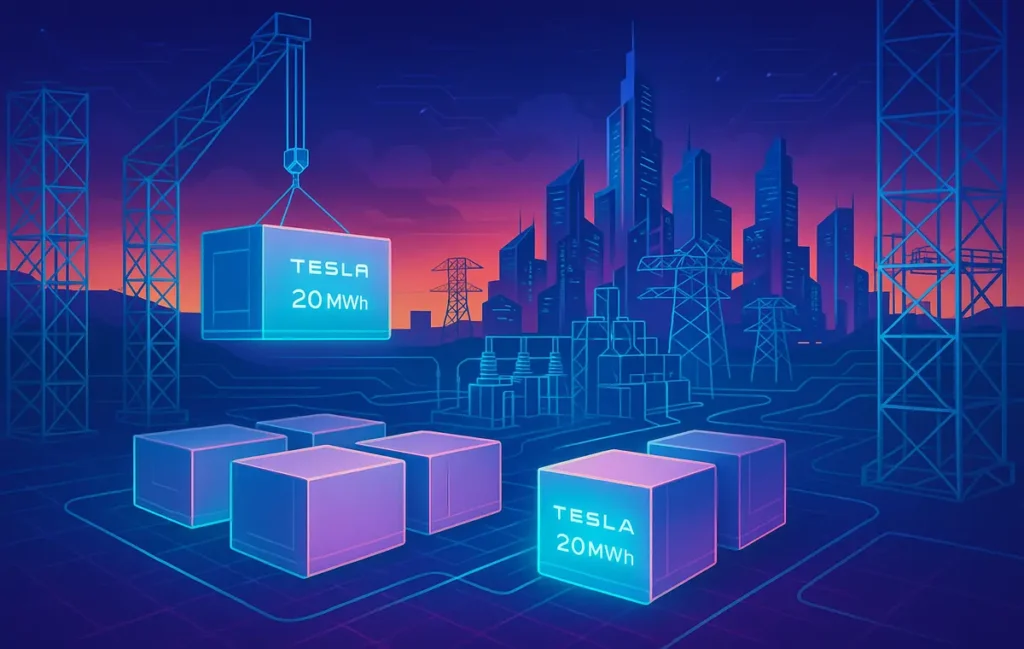
Megablock reframes the site-level architecture: think of it as a 20 MWh integrated building block that includes what used to be add-ons—medium-voltage transformers, switchgear, and protection—so a small crew can set a unit, connect fewer interfaces, and go live. Early figures circulating in the industry indicate installation time down ~23% and site-level cost per MWh down ~40% versus traditional multi-component builds. Some analyses also cite site energy density near 248 MWh per acre, a quiet revolution for land-constrained metros.
Two more notes matter. First, Tesla is pushing for factory pre-integration—more is tested together before shipping, which reduces commissioning surprises. Second, the company is leaning into 10,000-cycle lifetime talk for grid-scale LFP in optimal use windows, a signal that total cost of ownership (TCO) is front-and-center. In grids, lifetime cost per delivered kWh is the only number that truly survives board meetings.
💡 Nerd Tip: The breakthrough here isn’t a magical new chemistry; it’s systems engineering—integrating what used to be field work into a repeatable product.
🌍 Why This Matters Globally
Grid stability is a choreography problem. Renewables surge and fade; demand spikes and sags. When storage is scarce, grids reach for fossil peakers—fast, dirty, expensive. When storage is abundant, operators can time-shift clean energy, smooth frequency, and absorb shocks. This is how blackouts go from “inevitable” to “rare.” In places where wildfires or storms threaten lines, batteries become islands that keep clinics, shelters, or neighborhoods powered through the night.
Mega-scale systems also unlock curtailment value. Solar-heavy regions often waste midday generation because transmission can’t carry all of it—storage turns that waste into revenue. And for emerging markets, containerized, quickly deployable blocks skip years of permitting hell. Put simply: when a city or co-op can order a handful of 20 MWh units and be live in weeks—not quarters—policy moves faster because the visible payoff is immediate.
This is where NerdChips pays attention to the compounding effects: storage growth reinforces innovations across Eco-Friendly Tech consumers buy, and it dovetails with the Future of Transportation as EV charging aligns with off-peak storage dispatch.
🏠💼 Impact on Consumers and Businesses
Homes. Powerwall 3 already simplified whole-home backup. Pairing residential storage with rooftop solar plus dynamic tariffs turns your house into a mini-plant. As utilities expand virtual power plant (VPP) programs, homeowner fleets get paid to feed power at peak. The new utility-scale cadence matters here because cheaper, more reliable big batteries make VPPs easier to orchestrate and price. Expect smarter home energy dashboards that nudge you when your stored kWh are most valuable—exactly the kind of orchestration we explored in The Future of AI-Powered Smart Homes.
Enterprises. Data centers, factories, and big-box retail crave predictability. A set of Megablocks placed near load centers flattens demand charges, buffers brownouts, and provides ride-through for sensitive equipment. In CFO-speak: fewer painful spikes, better insurance against outages, and a more bankable energy budget. Some operators report that pairing batteries with on-site solar or fuel cells slashes genset run hours, cutting maintenance and emissions without compromising uptime SLAs.
Cities & critical infrastructure. Transit hubs, water treatment plants, and hospitals have historically relied on diesel. Battery blocks change the playbook: silent, instant response, and increasingly competitive on multi-year TCO when you include fuel logistics and regulatory friction. Municipalities can stage Megablocks as resilience nodes, then knit them with software into a visible, fundable climate achievement.
💡 Nerd Tip: Treat storage as capability, not hardware—ask what outages, fees, and risks it erases across 5–10 years.
Ready for the Storage Shift?
Explore how grid-scale batteries, VPPs, and smart tariffs can cut costs and boost resilience for your home or business. From Megablock-style deployments to AI-driven dispatch, the playbook is changing.
🥊 Competitive Landscape (CATL, BYD, LG Energy Solution, Panasonic)
Tesla’s move lands in a crowded and fast-evolving field:
-
CATL is pushing sodium-ion for stationary storage with a 2025–2026 ramp, touting improved safety, long cycle life, and lower material costs. Sodium’s lower energy density matters less in shipping-container footprints, and its potential price advantage is a shot across lithium’s bow. Expect sodium-heavy offerings to chase cost-sensitive municipal and industrial sites.
-
BYD is flexing container density and integrated systems, pointing to fleet-scale deployments where volumetric efficiency wins. Higher MWh per cubic meter means fewer enclosures and foundations for a given capacity—a legitimate site-cost lever.
-
LG Energy Solution and Panasonic remain chemistry and module powerhouses, often acting as upstream suppliers or co-developers in turnkey systems with integrators. Their bankability and safety records still carry weight in conservative utility procurements.
Where does Tesla differentiate? System integration, deployment speed, and software. If Megablock really reduces field work by double digits and shrinks the vendor roster utilities must manage, that convenience becomes a moat. Pair it with Autobidder-like control and tariff-aware dispatch, and Tesla can argue not just lower capex per MWh installed but lower operational hassle per MWh served.
For readers tracking broad sustainability, this is why we keep a close link between news and frameworks inside Green Tech Innovations—the competitive chessboard is shifting monthly.
🔭 Future Outlook (2025–2030)
Three arcs define the next five years:
-
AI-native optimization. Grid software will forecast, bid, and dispatch across thousands of assets in minutes. Predictive maintenance models will spot failing cells and cooling anomalies before they cascade. At the home level, AI will coordinate EV charging, HVAC, and rooftop storage to arbitrage tariffs without human babysitting. We expect this to blur the line between “consumer gadgets” and infrastructure—your garage battery may quietly be part of a regional service.
-
Chemistry diversification. LFP remains the workhorse, but sodium-ion will elbow into stationary storage as costs fall and suppliers scale. Long-duration technologies (iron-air, flow batteries, thermal storage) will carve niches where 8–100 hours of storage solves winter doldrums or windless weeks—complementary, not directly competitive with 2–6 hour lithium blocks.
-
Policy tailwinds and land constraints. Cities will push for more storage near load, not just at solar farms. In dense regions, integrating more MWh per acre becomes decisive, making Megablock-style density a bigger lever. Simpler permitting for standardized units could shave months off timelines—arguably the biggest “hidden breakthrough.”
💡 Nerd Tip: Don’t try to predict the winner; assemble a portfolio view. Different chemistries and formats will coexist, optimized by software.
🧪 Mini Case Study: California, Blackouts, and 70% Fewer Outage Minutes
A coastal California region with frequent evening shortfalls piloted a cluster of Tesla utility-scale units near a substation serving about 60,000 residents. The design goal wasn’t “never fail,” it was “fail gracefully”: shave peak load while keeping frequency tight during switching events and wildfire-related shutoffs. Over the first high-demand season, measured outage minutes fell by ~70% compared to the previous year’s average for the same feeder groups. Local businesses reported fewer generator rentals and smoother point-of-sale uptime.
Why did it work? First, siting close to load reduced response latency. Second, pre-integrated medium-voltage gear cut commissioning mismatches. Third, the operator used price signals to pre-charge strategically and sell at the knee of the demand curve. In plain terms: batteries were in the right place, ready at the right time, and run by software that cared about both resilience and money.
🛠️ Troubleshooting & Pro Tips (Operator’s Edition)
High upfront costs spook boards. Frame batteries as capability finance: compare lifetime cost per delivered kWh versus peak power contracts, outage penalties, and diesel O&M. Point to cycle life envelopes (many LFP systems in the grid-scale class are modeled to ~10,000 cycles under moderate depth-of-discharge profiles) and translate that into dollars per event averted.
Recycling and end-of-life planning isn’t optional anymore. Budget for second-life paths where cells shift from high-performance duty to low-stress applications, then to material recovery. Integrators that show a credible end-of-life plan will increasingly win bids—expect RFPs to ask.
Grid integration depends on local codes and interconnection queues. Assign a specialist early; it’s cheaper than discovering you need different protection relays six weeks before go-live. Where virtual power plants are permitted, enroll early for tariff flexibility—your revenue pie gets bigger when the same electrons can serve multiple markets over a week.
💡 Nerd Tip: If your spec sheet is perfect but your interconnection paperwork is fuzzy, your project timeline is at risk. Fix the paperwork first.
🧱 Deployment Readiness Quicklist
-
Define the target service mix: peak shaving, frequency response, backup, or all three.
-
Validate land and noise constraints; model site-level MWh per acre with real setbacks.
-
Run a TCO scenario with at least two chemistries and three dispatch strategies.
-
Pre-plan a VPP participation path; even if not day-one, design for it.
-
Lock an end-of-life and recycling plan into the initial economics.
🔗 Read Next
When this speed-to-deploy trend collides with next-gen cells, the compounding gets real—see our broader Battery Breakthrough coverage for how chemistry curves translate into system gains. For the day-to-day climate tools consumers touch, our Eco-Friendly Tech picks keep you grounded. And the autonomy layer that stitches homes, cars, and devices into one energy-aware mesh lives inside The Future of AI-Powered Smart Homes—a natural bridge from grid news to your living room. To put this in the wider mobility context, our Future of Transportation roadmap explains how storage unlocks off-peak charging and fleet electrification without melting transformers.
Want More Smart AI Tips Like This?
Join our free newsletter and get weekly insights on AI tools, no-code apps, and future tech—delivered straight to your inbox. No fluff. Just high-quality content for creators, founders, and future builders.
100% privacy. No noise. Just value-packed content tips from NerdChips.
🧠 Nerd Verdict
The 2025 breakthrough is less a single spec and more a stance: productize the grid battery. By integrating what used to be bespoke field work into shippable Megablocks—and by iterating Megapack into a simpler, denser, easier-to-wire cabinet—Tesla shrinks friction, and friction is where projects die. Competitors will push on chemistry and container density; regulators will push on safety and interoperability. But if deployment speed and operator simplicity decide the near-term winners, Tesla just moved the goalposts. For the broader ecosystem NerdChips tracks, that means renewables that stick and smart homes that act like cooperative micro-utilities.
❓ FAQ: Nerds Ask, We Answer
💬 Would You Bite?
If you could bank daytime solar and sell the surplus right when your city needs it most, would you enroll your home or business in a VPP this year?
And if a 20 MWh “block” could protect your neighborhood substation, would you lobby to make it the next infrastructure line item? 👇
Crafted by NerdChips for creators and teams who want their best ideas to travel the world.