⏰🌅 Intro: Work With Your Biology, Not Against It
Have you ever noticed how deep-focus work feels effortless at one hour and impossible two hours later—without any obvious change in your environment? That’s not “discipline.” It’s biology. Your body runs on circadian rhythms that influence alertness, creativity, memory, and even risk tolerance across the day. In 2025, the most reliable way to upgrade productivity isn’t downloading another app—it’s aligning your workflow with your chronotype. This guide from NerdChips shows you exactly how to do it, step-by-step, for the four archetypes—Lion, Bear, Wolf, Dolphin—and then scales those insights from solo schedules to remote teams.
💡 Nerd Tip: Stop blaming willpower for what is actually timing. Put the right task at the right circadian hour and most “discipline problems” shrink on their own.
🎯 Context & Who This Is For
If you’re a founder craving more deep work, a student trying to study smarter, a freelancer balancing client work and creative projects, or a remote leader juggling time zones, aligning with your chronotype can produce outsized gains with minimal friction. This is a practical playbook: you’ll learn how to map your energy curve, schedule the right tasks at the right times, and stitch in recovery, nutrition, light, and movement so your day works with—not against—your biology. When you’re ready to zoom into routine architecture and focus mechanics, pair this piece with Morning Routines Backed by Neuroscience, How to Build a Daily Routine That Actually Sticks, Time Blocking vs. Pomodoro, Mastering Focus in the Age of Digital Distractions, and our primer Night Owl vs. Early Bird.
🧭 What Are Chronotypes? (And Why They Matter)
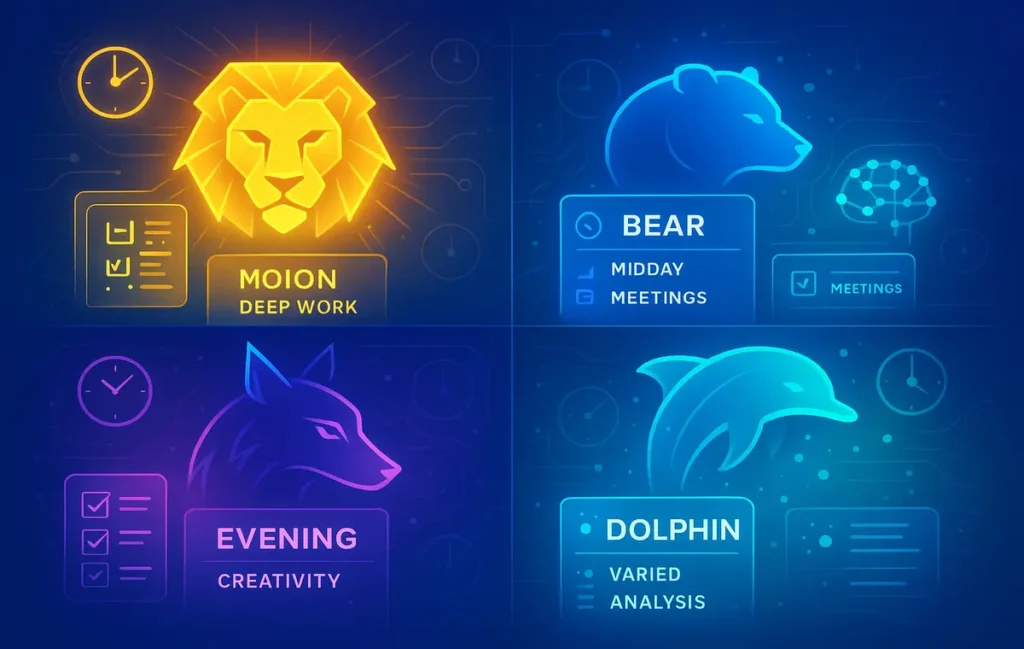
Chronotypes are patterns in your circadian rhythm that determine when you’re naturally alert or drowsy across a 24-hour cycle. Think of them as your biological schedule template. While life stages, light exposure, and lifestyle can shift the pattern, most adults land near one of four profiles:
-
Lion: Early risers with strong morning focus, early energy peak, and an early fade.
-
Bear: Daytime-aligned majority whose energy tracks the sun—best mid-morning to mid-afternoon.
-
Wolf: Night-oriented creatives who warm up late and surge in the evening.
-
Dolphin: Light sleepers with irregular patterns and fragmented sleep; best in focused micro-bursts.
Each chronotype expresses a different cortisol–melatonin curve, affecting alertness, reaction time, and creative fluency. You can work outside your type, but you’ll spend motivation as fuel. Inside-type, the work “pulls” you forward.
💡 Nerd Tip: Chronotype isn’t an identity; it’s a map. Use it to choose routes, not to excuse detours.
🐾 Chronotype Profiles & Best Hacks (Deep, Practical, Biological)
🦁 Lion — Morning Sprinters
Lions wake easily, clear inboxes before others brew coffee, and do their best analytical and decision-heavy work from early morning until late morning. After lunch, energy dips and social mood rises; evenings are best for planning tomorrow and shutting down on time.
Daily arc in practice: Aim for a focus block soon after waking—light exposure, hydration, and a brief mobility session push cortisol to a healthy peak without caffeine overkill. Put your hardest, most cognitively complex task between roughly 07:30–10:30. After lunch, switch to collaborative work or low-stakes admin. Protect a 30–45 minute brake walk or light exercise around 16:00 to avoid the crash. Sleep routine begins earlier than peers; preserve it.
Biology-aligned hacks: Delay caffeine 60–90 minutes to avoid blunting your natural cortisol rise; front-load protein for sustained alertness; use 90-minute ultradian blocks for deep work and disengage guilt-free when the wave ends. Lions often overcommit to long mornings—cap your deep block to avoid burnout.
Scheduling examples: Quarterly planning at 09:00, stakeholder calls late morning, one-on-ones after lunch, inbox zero before logging off. Creative ideation? Early, while internal critics are quiet and prefrontal control is high.
💡 Nerd Tip: Your competitive edge is early clarity. Protect it with a strict “no-meetings until X” rule.
🐻 Bear — Daytime Doers
Bears map to the sun. They wake around a reasonable hour, peak late morning to early afternoon, and fade naturally toward evening. They’re the backbone of most organizations because their rhythm matches school and office hours.
Daily arc in practice: Gentle ramp with daylight and movement, then a prime focus window from 10:00–13:00. After lunch, a lighter-focus block works—reviews, collaborative drafting, code review, content polish—then a final power-hour around 16:00–17:00 for closing loops. Bears often overstuff mornings with meetings—resist the urge; hold that late-morning window sacred.
Biology-aligned hacks: Caffeine works best mid-morning; avoid late-day hits that cannibalize sleep. If food makes you drowsy, push your largest meal to evening and keep lunch lighter with balanced macros. Bears benefit from time blocking: a clear structure keeps them moving through the day without forcing heroics.
Scheduling examples: Data analysis and proposal writing before lunch; standups and stakeholder syncs early afternoon; ops/admin cleanup near day’s end. Exercise best after work; it improves sleep and next-day energy.
💡 Nerd Tip: Your strength is sustained cadence. Lock a repeatable daily template and let small wins accumulate.
🐺 Wolf — Night Creators
Wolves struggle in early mornings and blossom later. They’re disproportionately represented among designers, musicians, developers, and writers who get into flow at twilight. Force them into 07:30 standups and you’ll get bodies in seats but minds in fog.
Daily arc in practice: Keep mornings administrative and mechanical: inbox triage, low-stakes planning, short check-ins after 10:00. A first real focus wave often appears 13:00–15:00; the creative peak lands 20:00–23:00 (sometimes later), when inhibition drops and divergent thinking improves. Wolves need a deliberate shutdown ritual to avoid pushing the night too far.
Biology-aligned hacks: Short morning daylight exposure plus a brisk walk tells your clock “day.” Delay caffeine until mid-morning; use a 15–20 minute nap early afternoon if needed (but never after 15:00). Stack maker work at night: concepting, compositing, long-form writing. Defend two nights weekly for long, uninterrupted creation—and schedule social obligations on non-peak nights.
Scheduling examples: Client calls at 11:00–13:00; drafting and review early afternoon; deep creative after dinner. Co-workers learn to expect your strongest artifacts by the next morning.
💡 Nerd Tip: If your org won’t change mornings, protect one high-creativity night midweek and plan recovery the next morning.
🐬 Dolphin — Light Sleepers, Precision Operators
Dolphins sleep lightly, wake frequently, and struggle with rigid schedules. But when primed, they deliver exceptional precision, pattern spotting, and problem-solving in short, intense bursts. Think researchers, analysts, QA, surgeons, editors.
Daily arc in practice: Avoid early heroics. Use micro-bursts (25–40 minutes) with generous rest to avoid cognitive overheating. Slot precision work 09:30–11:30 and 14:30–16:30, with very gentle mornings and a wind-down buffer at night. Sleep hygiene is non-negotiable; light discipline, consistent bed/wake times, and cool, quiet sleep settings pay enormous dividends.
Biology-aligned hacks: Light and noise are your levers. Use blue-light exposure on waking, blackout curtains at night, and pink noise or a fan for sleep continuity. Caffeine is a scalpel: tiny doses earlier only. Record ideas to offload rumination before bed. Dolphins gain most from task decomposition—smaller units mean more wins and less overwhelm.
Scheduling examples: Code review, editing, auditing, and legal checks in two daily precision blocks; collaboration wedged between to reset attention.
💡 Nerd Tip: Treat your day like an interval sport. Sprint, recover, repeat—and don’t apologize for it.
🧪 How to Identify Your Chronotype (Without Guessing)
Start with a baseline week. For seven days, rise without an alarm when feasible, avoid late caffeine, and log your self-rated alertness every two hours from wake to bedtime. Note when deep focus happens naturally and when creativity feels easiest. Pair this with a short morningness–eveningness questionnaire (many validated versions exist) and your sleep midpoint on free days (the halfway point between sleep and wake when you’re not constrained). If your midpoint is early and you wake energized, you’re likely Lion; if it hovers in the middle, Bear; if it drifts late and you come alive at night, Wolf; if it’s inconsistent with light, choppy sleep, and you do best in bursts, Dolphin.
Two caveats: age shifts your curve (teens tilt late; older adults tilt early) and environment cheats your data (night shifts, heavy screen use at night, social jet lag). That’s fine—just note constraints. Your goal isn’t a perfect label; it’s a workable map.
💡 Nerd Tip: If your job locks your hours, identify one peak and one trough daily—and reassign tasks accordingly. Small re-timings compound.
🧠 Chronotype-Based Productivity Playbook (Scheduling, Fuel, Movement, Sleep)
Scheduling by Biology
Put analysis and high-stakes decisions where cortisol and executive function naturally rise (Lions early morning, Bears late morning, Wolves afternoon, Dolphins precision windows). Reserve creative divergence for your chronotype’s openness window (Lions earlier than you think; Wolves evening; Bears mid-to-late afternoon; Dolphins in short bursts). Use time blocking to reserve these windows and Pomodoro or 90-minute ultradian cycles to structure them—choose based on your chronotype’s endurance.
Nutrition & Caffeine Timing
Caffeine is a phase shifter. Delay your first cup until natural alertness has risen (60–90 minutes post-wake for most). Lions need less and earlier; Wolves benefit from a mid-morning start; Dolphins should micro-dose or skip after noon. Front-load protein and stabilize glucose to avoid post-lunch crashes—especially for Bears.
Workout & Recovery Alignment
Strength or HIIT works best when your nervous system is naturally more aroused: Lions late morning, Bears late afternoon, Wolves evening, Dolphins earlier afternoon with controlled intensity. Movement before deep work primes focus; movement after deep work clears stress.
Sleep Hygiene (Low-Tech, High Yield)
Protect light cues: bright, outdoor light within an hour of waking; dim, warm light two hours before bed. Keep bedrooms cool, quiet, and boring. Cut caffeine 8–10 hours before sleep. For Dolphins, pre-bed mind dump plus breathwork (e.g., 4-7-8) reduces rumination.
💡 Nerd Tip: Don’t fight a post-lunch dip—surf it. Put admin, email, or a walking call there; save your next focus block for your second natural peak.
🔥 Stop Fighting Your Biology
Design your calendar around your chronotype and watch output rise without more effort. Protect peaks, schedule recovery, and let your routine compound.
🧰 Quick-Reference Table — Chronotypes at a Glance
| Chronotype | Peak Deep Work | Best Collaboration | Caffeine Cutoff | Workout Sweet Spot | Wind-Down Cue |
|---|---|---|---|---|---|
| Lion | 7:30–10:30 | 13:30–15:30 | ~13:00 | Early afternoon | Plan tomorrow at 18:00 |
| Bear | 9:30–12:00 | 13:30–15:30 | ~14:00 | Mid-afternoon | Screen dim at 21:00 |
| Wolf | 19:30–23:00 | 13:30–16:00 | ~16:00 (light) | Late afternoon | “Hard stop” alarm 23:00 |
| Dolphin | 2–3 × 45–60 min | Late morning / mid-pm | ~12:00 | Short daily | 30-min pre-sleep routine |
(Use as a compass; n=you.)
🧩 Blending Chronotypes in Teams (Remote & Hybrid)
Mixed chronotypes aren’t a liability—they’re an advantage if you design for them. The pattern that works in 2025:
-
Core collaboration band of 3–4 hours overlapping everyone’s day for standups, decision meetings, and pair work.
-
Protected deep-work windows outside that band, tailored by role and chronotype.
-
Async documentation by default—meeting notes, decisions, and action items posted promptly so Wolves can build at night and Lions ship in the morning.
-
Meeting design that respects cognition: decisions early in people’s peak windows; updates and demos in troughs.
Leaders should collect chronotype preferences the same way they collect PTO policies: publicly documented, opt-out friendly, and revisited quarterly. Culture shifts when the calendar reflects biology. Expect faster turnaround on artifacts and fewer meetings because people use their peaks to produce shippable work.
💡 Nerd Tip: Time zones and chronotypes are cousins. Use both when designing overlap; you’ll win back hours weekly.
🔬 The Science Behind the Hacks (Plain-English)
Your suprachiasmatic nucleus (SCN) in the hypothalamus coordinates circadian timing using light input from your eyes. That master clock aligns peripheral clocks in organs. Morning cortisol helps you wake and focus; melatonin signals sleep as light fades. Across the day you ride ultradian focus cycles—briefly elevated dopamine and norepinephrine that enhance attention, followed by dips that demand recovery. Chronotypes emerge from genetic variations in clock genes and are modulated by age and environment. None of this requires perfection—just directional alignment. Even modest realignments—moving deep work 60 minutes toward your peak—can produce sharper thinking and fewer false starts.
💡 Nerd Tip: Use light like a drug. Morning daylight advances your clock; late-night bright screens delay it.
🔭 Future Outlook: AI That Works Like a Body-Aware Chief of Staff
The next generation of assistants will pull physiological signals (sleep stages, HRV, body temp) and digital signals (keystroke rhythms, calendar, focus apps) to propose when you should do what—and then automate the rescheduling. Imagine your planner nudging, “Your REM rebound suggests later creative work today; moving ideation to 20:00, pushing admin to 14:00.” This is the bridge between the quantified-self wave and practical work automation. If you’re curious about where on-device intelligence is heading, our pieces on the On-Device AI Race and Laptops & Desktops with Neural Engines Onboard explain why smarter scheduling may run privately on your hardware soon.
💡 Nerd Tip: Don’t wait for perfect AI. Your own notes plus one week of simple tracking beat 90% of generic advice.