🎬 Intro — Creativity Wins Hearts, Data Wins Markets
Video marketing is no longer “post, pray, and hope the graph goes up.” In 2025, the teams that win treat video like a product with telemetry: every hook, cut, caption, and CTA is instrumented, measured, and iterated. Data doesn’t replace creativity—it focuses it. When you learn exactly which intros keep viewers past the 5-second cliff, which mid-roll beats convert, and which thumbnails stop the scroll on mobile at 0.8× speed, your creative decisions stop being debates and start being design choices. This NerdChips guide is your umbrella playbook for end-to-end data-driven video campaign optimization—from KPI selection and stack setup to creative, audience, budget, and SEO decisions that compound over months, not days.
If you’re brand new to platform analytics, use YouTube Analytics Explained for orientation. To avoid vanity traps, pair this article with Beyond Views: 5 Metrics That Matter for Video Marketing. When you’re ready to instrument ROI beyond watch time, lean on Top Video Analytics Software to Measure ROI and run structured experiments using A/B Testing Your Video Content. To convert discovery into durable traffic, close the loop with Video SEO: Ranking on YouTube & Beyond.
🎯 Context & Who It’s For
This guide serves three groups: performance marketers who need revenue-proof videos, brand leads who want creative without guesswork, and creators who want repeatable watch-to-action systems. It assumes you can access channel analytics, ad manager data (YouTube, TikTok, Meta), and basic site analytics/CRM. We’ll translate metrics into actions, show how to segment audiences, and align budget with measurable outcomes. You’ll leave with a single source of truth, not five dashboards arguing.
📈 Why Data Matters in Video Marketing
Data isn’t a report; it’s feedback. The physics of modern feeds—short attention windows, personalized distribution, real-time ranking—rewards content that proves its value quickly. Evidence beats opinion. A creative that “feels” right but loses 40% of viewers in the first 3 seconds is a hypothesis, not a winner. Conversely, a rough cut that holds 65% to the first beat and spikes click-through on the end screen might deserve the media dollars.
The second reason is budget gravity. As paid social CPMs wobble and search gets noisier, video becomes the front door to your brand. Finance teams now ask for CAC, payback, and LTV on video just like any performance channel. With the right tracking, you can attribute revenue to watch behaviors and creative patterns, turning editor choices into forecastable ROI. Data converts creative from a cost center into a profit engine.
🧭 Essential Metrics to Track (and How to Use Them)
🎯 Engagement That Predicts Reach
Beyond raw views, impressions-to-view rate (CTR) on thumbnails/titles and average view duration (AVD) are your early signals. Platforms reward videos that satisfy early viewers; a strong AVD plus above-median CTR often triggers wider distribution. Segment CTR by surface (home, search, suggested) because a killer search CTR might still lose on home feed if the title is too niche.
⏱️ Audience Retention & the 5-Second Cliff
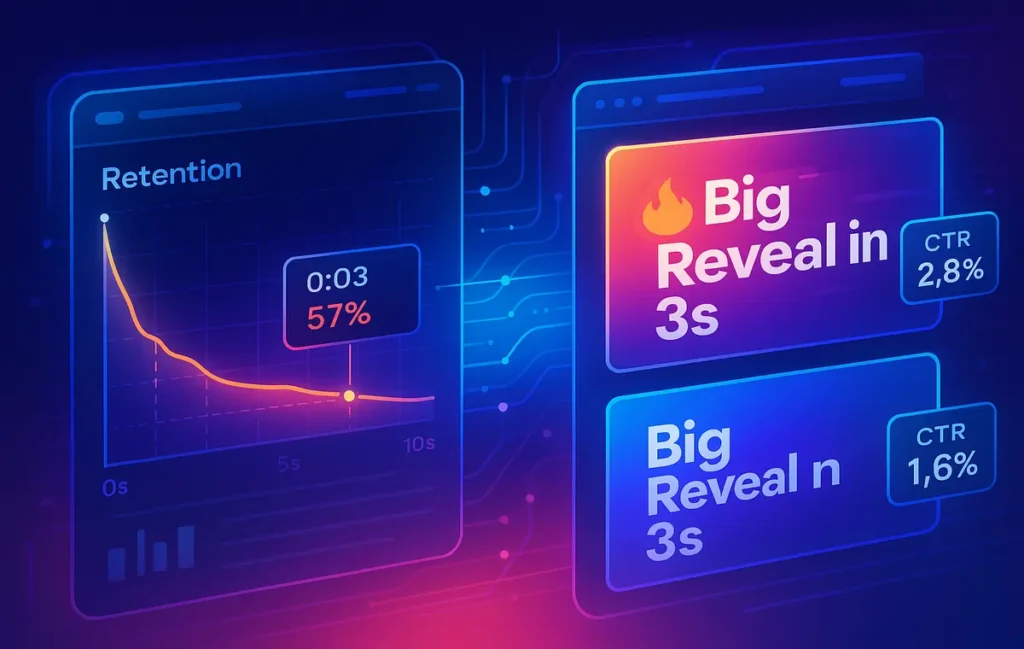
Plot the absolute retention graph for every video. Note the drop at 0–5 seconds and the slope until the first beat (usually 20–35 seconds). Your goal is to flatten the early drop by clarifying the promise, showing the payoff, and cutting dead air. Add relative retention to see how you perform against similar videos of similar length; this normalizes for topic competitiveness.
🛒 Conversion & Post-Click Quality
Conversion rate from video traffic matters more than average. Use UTMs and deep links to measure add-to-cart, checkout start, and first purchase. If video CTR is high but post-click metrics lag, you have a message-market mismatch: great curiosity, weak relevance. Fix by aligning the landing page with the exact visual promise.
💰 ROI Metrics (CAC, LTV Uplift, Payback)
Treat video like a channel in your attribution model. Calculate effective CAC for each creative cohort: total media + production + creator fees ÷ new customers attributed. Then track LTV uplift by cohort: do video-acquired users retain better or buy higher-margin SKUs? If payback is <60–90 days and LTV index >1.1 vs baseline, you’ve earned the right to scale.
🗣️ Sentiment & Narrative Fit
Comments, likes vs. dislikes, and watch-through paired with semantic sentiment help you detect whether viewers believe you. Map sentiment spikes to timestamps; when a claim triggers skepticism, adjust the script, add proof overlays, or move social proof earlier.
💡 Nerd Tip: Pick four primary KPIs for a campaign: CTR, 30-sec retention, cost per completed view (CPCV) or cost per key event, and effective CAC. Everything else is diagnostic—not the North Star.
🧩 Data Sources (and What Each Is Good For)
YouTube Analytics is the control tower for long-form discoverability: impressions, CTR by surface, absolute/relative retention, end-screen clicks, and search terms. If you’re new, start with YouTube Analytics Explained to understand which views are earned versus recommended.
TikTok/Meta Ads Manager tell you how short-form hooks land with cold audiences. Look at thumb-stop rate (1–3 seconds), hold at 25%/50% completion, and view-through conversions under conservative windows. Tie ads to post-purchase surveys to keep the modeling honest.
Video analytics platforms like the ones in Top Video Analytics Software to Measure ROI unify data across channels, connect to your store/CRM, and let you annotate creative changes against outcomes. This helps isolate what actually moved a KPI.
Heatmaps & Interaction Tracking (on landing pages) connect watch behavior to on-page actions. If viewers drop off before your offer appears, test in-video CTAs earlier or add a pinned comment with a custom code. If they scroll but don’t click, your proof is probably too late or too weak.
💡 Nerd Tip: Build a one-sheet “Signal Map” for each video: hook CTR, 30-sec retention, first CTA timestamp, end-screen CTR, and page add-to-cart rate. When something breaks, you’ll know which link in the chain snapped.
🎨 Turning Insights into Action
🖼️ Creative Optimization: Thumbnails, Titles, Hooks
Use retention to rewrite openings. If the first 5 seconds fall off a cliff, start in media res with the payoff visible, then backfill context. Test thumbnails in pairs—one “clear benefit” vs. one “curiosity gap”—and measure CTR by surface. Keep titles literal enough for search intent but emotional enough to win home feed. On shorts, use on-screen text to front-load the promise; many viewers watch muted.
🕰️ Timing & Placement
Study hourly/daily impression sources to schedule for the surfaces that matter. If “home” delivers the bulk, publish when your core region wakes up; if “search” rules, schedule doesn’t matter as much as topic authority and metadata. For paid, align bids with delivery curves to avoid fatigue—scale budgets after a winning hook is confirmed, not before.
👥 Audience Segmentation
Segment by viewer type (subscribers vs. new), device, region, and intent (search vs. suggested). If subscribers watch longer but click less on end-screens, your in-video CTA needs to change for loyal viewers (they trust you but don’t need the full pitch). If mobile drops at 70–80 seconds while desktop holds, restructure mid-roll beats for smaller screens.
💸 Budget Reallocation
Reallocate based on unit economics, not just view curves. A video with lower CTR but higher post-click conversion may earn more revenue. Feed dollars to hooks that survive the 30-second checkpoint and pull higher AOV. Pull budget from high-CPM surfaces that over-index on curiosity clicks.
💡 Nerd Tip: When a video underperforms, change one thing at a time: hook edit, thumbnail/title, CTA timing, or landing page. Otherwise, you’ll never learn which lever worked.
🧠 Advanced Techniques That Compound
🔮 Predictive Analytics for Creative Bet-Sizing
Train lightweight models (even simple regressions) on your last 50 videos using inputs you can control: topic category, opening shot type, promise clarity, hook length, subtitle presence, proof element by the 20-second mark, and CTA timing. Predict retention to 30 seconds and end-screen CTR. Use predictions to bet-size media: high-probability winners get early paid support; long shots get organic tests first.
🤖 AI-Assisted Insights (without hallucinations)
AI can surface patterns (“hooks with a proof overlay by 0:07 reduce early drop-off by 12%”), cluster comments by theme, and suggest cut-down variants. Keep AI on a short leash: ask it to summarize your data, not invent benchmarks. Pair it with the verification habits from A/B Testing Your Video Content to keep experiments honest.
🧪 A/B at Scale
On YouTube, run thumbnail/title tests iteratively; on paid short-form, run hook variations (first 3–5 seconds) and lock creative for the rest of the clip. Standardize your sample size (e.g., 5–10k impressions per variant) and stop early only if the effect size is large and stable. Plug disciplined learnings back into your Video SEO work with Video SEO: Ranking on YouTube & Beyond so winning phrasing lives in your metadata.
💡 Nerd Tip: Keep an “Idea Graveyard” tab. Archive losing hooks with a note on why they failed. Dead ideas become future negative prompts your team avoids.
🎯 Your video isn’t failing—it just needs the right data to tell you what to fix
Install the loop: pick 4 KPIs, instrument UTMs, test the first 5 seconds, and route budget to hooks that beat your channel medians.
🧪 Case Study — Doubling CTR with Two Edits and a Proof Overlay
An ecommerce brand launched a 3-minute product explainer with a smooth but slow open. YouTube Analytics showed a 42% drop by 5 seconds and a CTR that lagged channel median by 28%. They made two surgical changes: (1) swapped the first 7 seconds into a problem-first cold open with the product already in hand, and (2) added a proof overlay (“4.7★ from 3,214 verified buyers”) at 0:08. In parallel, they A/B tested a thumbnail that showed the after state rather than the product itself.
Results over 14 days: CTR nearly doubled (+93%), 30-sec retention rose 11 points, and the end-screen template with two relevant videos netted a 23% higher session watch time. Downstream, traffic from that video produced 18% higher AOV because the proof element attracted shoppers with intent, not casual scrollers. Budget followed the data; the revised cut became the template for the next three launches.
🗺️ Putting It All Together — Your End-to-End Optimization Loop
One-Page Operating System (print this):
-
Define the job: Campaign goal (e.g., product launch), 4 KPIs (CTR, 30-sec retention, CPCV/CPA, CAC).
-
Design the test: Three hooks, two thumbnails, one CTA timing.
-
Instrument: UTMs, end-screen design, pinned comment with code, landing page heatmap.
-
Launch: Publish when your core region peaks; cap paid until a hook clears retention threshold.
-
Read & react (48–72h): If CTR < channel median, swap thumbnail/title. If 5-sec cliff >40%, re-cut open. If post-click weak, fix landing or shift angle.
-
Scale: Increase budget; spin cut-downs; port to Shorts/Ads; replicate hook rules for next asset.
-
Archive learnings: Update your “Hook Library,” “Proof Pack,” and “CTA Timing” rules so future edits start smarter.
💡 Nerd Tip: Give your team a shared Glossary & Benchmarks doc (channel medians, target CTR/AVD ranges, acceptable CAC bands). Shared language accelerates decisions.
🔭 Future Outlook — Real-Time & Multi-Platform Intelligence
Expect real-time creative steering where early viewer cohorts set the trajectory within minutes. Editors will get live haptic/visual cues during post to predict retention impact before export. Unified dashboards will smooth the jagged edges between YouTube, TikTok, and Meta—normalizing metrics and feeding a single creative genome your team reuses across channels. AI will become a copilot, not a decider: suggesting cuts, extracting alt hooks, and forecasting reach with confidence intervals your media buyers can trust. The brands that win won’t post more; they’ll post smarter, with smaller swings and more at-bats that clear the fence.
🧰 Troubleshooting & Pro Tips
When overwhelmed by numbers, zoom in on the few that predict distribution and dollars. A beautiful audience graph doesn’t matter if post-click flops; a high CTR doesn’t matter if viewers bail by 15 seconds. Unify your stack (analytics + store + CRM) so the decision meeting starts with one truth, not five interpretations. If engagement is low, assume the first five seconds are guilty until proven innocent; edit the open to deliver the promise visually, not verbally. If TikTok traffic bounces, adjust creative-to-landing congruence: match the exact headline, imagery, and offer. If YouTube search underperforms, revisit metadata—titles/descriptions that mirror query phrasing, as covered in Video SEO: Ranking on YouTube & Beyond.
💡 Nerd Tip: Protect Wednesdays for iteration. Every Wednesday, you either test a new hook or fix a weak open on a live video. Motion beats perfection.
📬 Want More Smart AI Tips Like This?
Join our free newsletter and get weekly insights on AI tools, no-code apps, and future tech—delivered straight to your inbox. No fluff. Just high-quality content for creators, founders, and future builders.
🔐 100% privacy. No noise. Just value-packed content tips from NerdChips.
🧠 Nerd Verdict
Great video isn’t guesswork; it’s creative informed by evidence. In 2025, the winning motion is a loop: define four KPIs, instrument links and pages, test first-5-second hooks, and scale only what clears your channel medians and unit economics. Use YouTube Analytics for retention truths, short-form ad managers for thumb-stop reality, a unified ROI platform for revenue clarity, and SEO discipline to compound. When you run this loop weekly, your campaigns stop being a series of one-offs and become a system—the NerdChips way.
❓ FAQ: Nerds Ask, We Answer
💬 Would You Bite?
If your next video underperformed, what would you change first: the open (0–5s), the thumbnail/title, or the CTA timing?
Share your channel type and goal 👇
Crafted by NerdChips for creators and teams who want their best ideas to travel the world.