🌍🧠 Intro
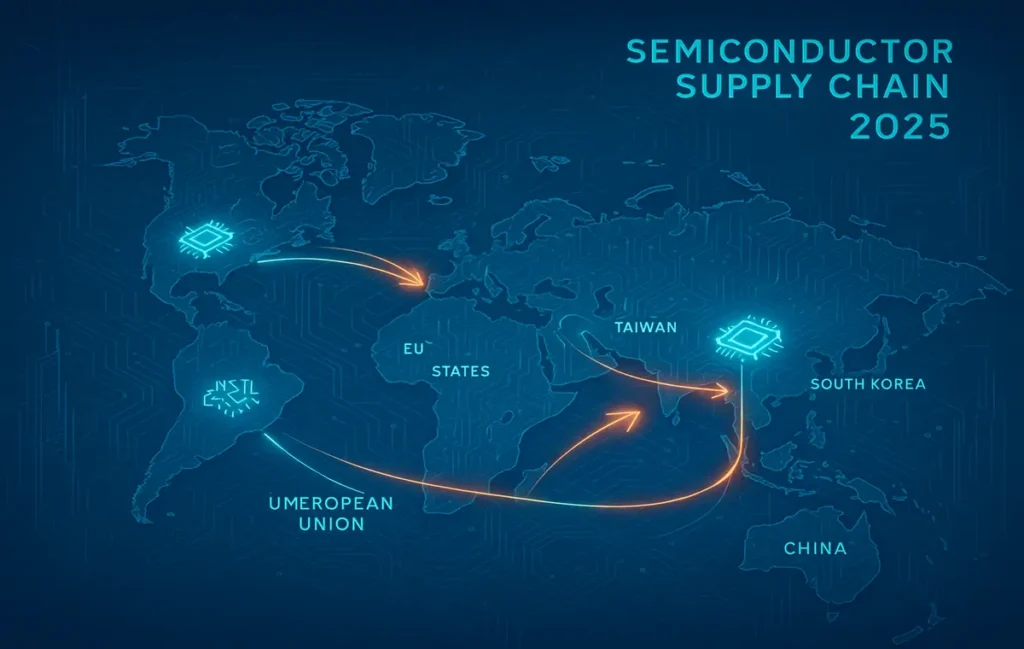
Semiconductors are the invisible infrastructure behind modern life—AI inference at the edge, flagship smartphones, EV drivetrains, flight control systems, medical imaging, even the cashier-less checkout down the street. The 2020–2023 crunch exposed just how delicately the world balanced its appetite for compute on a few islands of expertise and a handful of materials chokepoints. In 2025, the picture hasn’t snapped back to a simple “back to normal.” It looks more like a rewiring: new fabs coming online, old dependencies re-emerging in subtler forms, and a whole lot of risk pushed from “shortage” into “optionality cost.”
If you’ve followed our earlier market-focused coverage—like the nuanced debate in Global Chip Shortage Update: Are Supply Chains Back to Normal? and the cyclical lens in From Chip Shortage to Chip Surge—this deep dive is different by design. Here we zoom in on supply-chain dynamics: the geography of manufacturing, the geopolitics of export controls, the plumbing of gases and rare materials, the freight math, and the resilience strategies leaders are actually deploying. Along the way we’ll connect the dots to near-term product cycles (yes, GPUs) and medium-term architectural shifts (RISC-V, chiplets, advanced packaging).
💡 Nerd Tip: As you read, map each risk to a practical action you can take—second-source plans, buffer-stock policy, or switching costs you’re willing to absorb.
🔧🏭 Key Manufacturing Hubs: Concentration vs. Capacity Hedging
Taiwan (still the precision center of gravity).
Taiwan’s leadership—especially at the most advanced logic nodes—remains the beating heart of global compute. That dominance is not just about nanometers on a slide; it’s about yield learning curves and ecosystem density (materials suppliers, tool-service know-how, veteran shift leads who’ve debugged a thousand edge-cases). Even as new capacity ramps elsewhere, many design houses still anchor their PPA (power–performance–area) roadmaps on Taiwan-based foundry roadmaps. The irony: every new “risk mitigation” order placed outside Taiwan tends to increase short-run scheduling pressure within Taiwan, because reference lots, reticle validation, and early high-mix runs still anchor there.
South Korea (memory leadership and logic ambition).
Korean champions continue to rule DRAM and NAND in volume and cost discipline, while gradually extending their logic aspirations. Memory pricing feels more predictable in 2025 than during the whiplash of 2021–2022, but “predictable” doesn’t mean “flat”—it means managed volatility, with capex throttles and inventory guidance more tightly aligned to AI server build-outs and handset seasonality. Korea’s ecosystem strength shows in time-to-recover metrics: when a sub-supplier hiccups, Korean fabs tend to flex qualified alternates faster than peers, a capability honed by hard lessons over the past five years.
United States (industrial policy becomes actual silicon).
Industrial policy has moved from headlines to tool-install schedules. Several flagship fabs are deep into equipment move-in, and a growing number of advanced packaging lines are co-locating with logic facilities to reduce cross-border interposers/HSIO headaches. While skeptics point to cost deltas, the calculus many U.S. customers run is not a simple wafer-price comparison—it’s total landed compute: tariff exposure, export-control risk, logistics lead-time, and the “option value” of domestic contingency. This is less about replacing Asia and more about raising the floor on resilience.
Europe (critical tools, specialty nodes, and sovereignty).
Europe’s most strategic leverage is still the tools and subsystems stack (think lithography, metrology, vacuum, and motion). That choke-point quietly defines what nodes the world can realistically ship. Europe also doubles down on power electronics and automotive-grade semiconductors—where reliability, temperature tolerance, and longevity matter more than bleeding-edge nodes. The near-term goal is not to out-pace top logic nodes but to de-risk strategic industries (EVs, grid, industrial) with regional supply where it moves the safety needle.
China (localization push and mid-node scale).
Despite headwinds from restrictions on advanced tools and certain accelerators, China has channeled massive capital into mature and mid-nodes, power devices, image sensors, and packaging. The thesis is pragmatic: flood the base layers (where global demand is giant and stable), learn fast, and compress the quality gap through iteration. In parallel, domestic alternatives for EDA, controllers, and memory are improving. The rest of the world should read this as a sustained capacity rebalancing: more of the world’s “boring but essential” silicon will be made inside China, even if the cutting-edge remains constrained.
💡 Nerd Tip: When you assess “geo risk,” think in product-line portfolios. Some SKUs can be China-heavy without strategic pain; others warrant Taiwan/Korea+US or EU duals.
| Hub | Distinct Strength | 2025 Reality Check | Resilience Angle |
|---|---|---|---|
| Taiwan | Advanced logic yields, ecosystem density | Top nodes still anchored here | Map alternate packages + test outside island |
| South Korea | Memory cost & discipline | Managed volatility, quick recovery | Use Korean memory as “anchor stability” |
| United States | Policy-backed re-shoring | Tool install to early ramp | Calculate “total landed compute,” not wafer price |
| Europe | Toolchain choke-points; auto-grade | Sovereignty for critical sectors | Secure tool/service SLAs; power electronics |
| China | Scale at mature nodes; packaging | Localization drive accelerates | Allocate mature-node SKUs where feasible |
🧪🔋 Raw Materials & Logistics: Gases, Metals, and Freight That Quietly Decide Lead Times
Gases are not “commodities” in practice.
Neon, argon, helium, and specialty process gases aren’t interchangeable line items; they’re purity-grade dependencies bound to specific tool recipes. Post-2022, many fabs diversified gas suppliers and invested in on-site recovery units. That move does two things: reduces vulnerability to regional disruptions and moderates cost spikes. The residual risk? When new fabs ramp together, demand for ultra-high-purity grades jumps, and logistics of ultra-clean transport become the pinch, not raw production.
Metals and wafers: fewer headlines, same stakes.
Silicon wafers, photoresists, high-k dielectrics, and copper foils for packaging substrates form a tightly interlocked market. Capacity for ABF substrates remains a swing variable for advanced packaging throughput; the best teams now treat substrate vendors as strategic partners, sharing forecasts earlier and locking volumes longer, even if it means higher carrying cost.
Freight math changed—and stayed changed.
Remember when air freight became the default emergency lever? In 2025, most procurement leaders won’t rely on heroic airlifts as plan A. Integrated port strategies, bonded warehousing, and time-buffered routings are now built into the baseline, with air reserved for golden lots or product-launch-critical SKUs. The upside: fewer panic premiums. The hidden cost: more cash in motion and tighter S&OP discipline.
💡 Nerd Tip: Tie gas purity and substrate allocation to product-release gates. If the material plan isn’t greenlit, the launch date isn’t real.
🌐⚖️ Geopolitics & Controls: Fragmentation Without a Clean Break
US–China tech rivalry is now a system property.
Export controls on advanced accelerators and certain manufacturing tools formalized what markets already intuited: compute is strategic. For supply chains, that means dual product matrices—one bill of materials, firmware path, and performance ceiling for restricted markets, and another for the rest. The challenge isn’t just compliance; it’s engineering governance to prevent accidental cross-pollination.
The Taiwan Strait remains the macro risk that cannot be hedged away entirely.
Even with diversified packaging/test and mirrored tooling elsewhere, a severe disruption in the Strait would ripple across substrates, EDA timelines, and verification sequences worldwide. The realistic play is not a fantasy of zero exposure; it’s impact reduction: mirrored masks, second-source packaging, and prioritized SKU lists for “fast restart” if allocations go live.
Alliances are operational, not just diplomatic.
Beyond press releases, tri-lateral and regional frameworks (think US–Japan–Korea or EU–Japan tool cooperation) materialize as export-licensing rhythms, joint R&D, and service corridors for field engineers. If you run supply, think of alliances as service-level assumptions you can actually plan around: where you’ll get a field tech in 48 hours vs. 14 days.
A mid-sized fab ops lead put it bluntly on X this summer:
“We don’t plan for stability anymore; we plan for recoverability. The KPI is days-to-normal after a shock.”
💡 Nerd Tip: Add “days-to-normal” as a board-level KPI. It reframes cost debates around real business continuity.
🧩📦 Advanced Packaging, Chiplets, and RISC-V: Architecture as a Supply Strategy
Advanced packaging is the new yield frontier.
2.5D/3D integration and high-density interconnects move performance bottlenecks from pure lithography to thermals, interposer design, and substrate availability. Practically, this creates new bottlenecks—but also new levers. If you can validate multiple packaging partners and keep substrate options live, you gain scheduling agility even when front-end nodes are tight.
Chiplets change risk distribution.
With chiplets, you can qualify different process nodes for different functions (I/O at mature nodes, compute at advanced nodes), spreading exposure. You also open a menu of mix-and-match sourcing strategies—though the integration stack demands world-class validation. In 2025 roadmaps, many teams quietly accept slightly sub-optimal PPA in exchange for massively better supply optionality.
RISC-V’s momentum matters in supply terms.
Beyond ideology, RISC-V is a pragmatic hedge: core IP modularity helps teams avoid single-licensor bottlenecks and create region-specific variants with fewer licensing knots. If you haven’t kept tabs on the real deployments, skim our snapshot on RISC-V Momentum—the story is less about replacing incumbents overnight and more about carving out “good enough” edge/embedded wins that scale quietly.
💡 Nerd Tip: Treat chiplet partitioning as a supply-risk design problem first, performance optimization second.
📈🚚 AI for Supply Chains: Forecasting, Allocation, and the Human-in-the-Loop
AI is no longer just for vision models inside your product. The sharpest supply teams now run AI-assisted forecast stacks that blend design win pipelines, distributor POS signals, cloud-compute build-outs, and freight capacity indices. In internal post-mortems we’ve seen, teams report 10–15% lower forecast error after six months of disciplined adoption, with expedite costs dropping a couple of points as a byproduct. The trick isn’t the model; it’s feature governance (clean, timely inputs) and override policies so humans can throttle noise during hype cycles.
One veteran planner on X put it with a chuckle:
“AI gets us to the right answer faster—then we spend the saved time arguing about the assumptions.”
Translation: make the assumptions explicit, and you keep the win.
💡 Nerd Tip: Start simple—feed the model three truthy streams (confirmed bookings, lead-time histories, and top-customer build plans). Fancy can wait.
⚡ Ready to De-Risk Your Next Build?
Explore AI-assisted planning, supply dashboards, and packaging partners to stabilize lead times before launch crunch. Build optionality into your roadmap.
🧯🧰 Resilience Playbook: What Leading Teams Are Actually Doing
1) Onshoring & nearshoring with a spreadsheet, not a slogan.
Winners don’t chase politics; they price optionality. They run scenarios where yield drift, tariff shocks, and export-control shifts are treated like random variables. The output is a tiered placement plan: A-class SKUs qualify dual sites; B-class get mirrored test; C-class stick to lowest-cost lanes with buffer inventory.
2) Multi-sourcing without “fake” second sources.
A second source that cannot hit your DPPM or test-time envelope under real schedule pressure is not a source. Leaders run sprint lots quarterly to keep alternates warm—and pay for the privilege. It’s cheaper than a launch slip.
3) Materials as a first-class constraint.
ABF substrates and neon aren’t “procurement”; they’re program-gating. Teams set green-yellow-red material gates and freeze product calendars accordingly. It feels conservative—until your “aggressive” competitor misses a quarter.
4) Buffer stocks that don’t become junk.
Smart buffers are SKU-specific and time-bounded. The target is a buffer that expires into planned demand, not a warehouse museum of obsolete controllers.
5) Supplier intimacy as a moat.
The word is overused, but real intimacy looks like shared dashboards, forecast escrow, and joint failure analysis sprints. When something breaks, you already have the Slack channel and the playbook.
💡 Nerd Tip: Schedule quarterly “fire drills”—pick a critical input and run a 72-hour loss simulation. Measure recovery, fix bottlenecks.
🧠🎮 Market Impact (2025–2026): Stable-ish, Until It Isn’t
GPUs & AI accelerators.
Availability in 2025 is markedly better than the 2023 frenzy, but the distribution still skews toward hyperscalers and large integrators. If you’re tracking consumer-facing graphics, our ongoing coverage of NVIDIA RTX 50 Series details how product cadence interacts with packaging capacity and memory allocations. The headline: retail pricing is more predictable, but peaks can return when a new inference workload (or game engine tech) floods demand.
Auto & industrial silicon.
Automotive-grade controllers, MCUs, and power electronics feel healthier than peak crunch, with better line-of-sight into allocations. However, when a single Tier-1 announces a new ADAS platform win, ripple effects still hit the long tail of medium-volume buyers. Smart planners keep design-flex SKUs in the bill where possible.
Consumer devices.
Smartphones and PCs show mild cyclicality with less panic ordering. The real swing factor for 2026 is how much on-device AI becomes table stakes versus nice-to-have. If OEMs lock in local LLM features as default, expect high-bin SoC and LPDDR races that tighten certain lanes again.
💡 Nerd Tip: If your 2026 bet hinges on edge-AI features, pre-negotiate memory and substrate windows now. Those are the silent limiters.
🧭📚 What to Do Next (Reader Playbook)
If you’re a hardware startup, a procurement lead, or a product manager feeling the whiplash fatigue, here’s the pragmatic stack we see working:
-
Map your SKU portfolio to geo-exposure and materials dependencies. One page. No poetry.
-
Define “days-to-normal.” Publish it. Incentivize it. Argue less about abstract “resilience,” more about quantifiable recovery.
-
Qualify one alternate that hurts a little. Pay the NRE. Keep it warm with small, frequent runs.
-
Instrument your forecast with three truths. Bookings, historical lead times, and top customer plans. This single step typically reduces emergency expediting.
-
Treat advanced packaging as the critical path. If packaging isn’t secured, node access won’t save you.
As we say at NerdChips, resilience isn’t about fear—it’s about freedom to ship when others can’t.
📬 Want More Smart AI + Hardware Supply Insights?
Join our free newsletter for weekly takes on AI hardware, chip supply dynamics, and automation playbooks—built for builders and ops leaders.
🔐 100% privacy. No noise. Just value-packed insights from NerdChips.
🧭🔗 Read Next
If you want a macro pulse on how “shortage” turned into “surge” pockets and where the baseline sits now, our explainer in From Chip Shortage to Chip Surge puts the cycles in plain English. For a focused status check on lead times vs. launch windows, circle back to Global Chip Shortage Update. And for the architecture angle that will influence sourcing choices through 2027, read RISC-V Momentum.
Planning a consumer GPU or workstation rollout? Keep one eye on cadence, bins, and memory availability in our NVIDIA RTX 50 Series tracker. If your roadmap leans into edge inference or acceleration, the strategic backdrop in The AI Chip Wars will help you stress-test assumptions about supply priority and control regimes.
🧠 Nerd Verdict
The era of “just in time” for silicon has been replaced by “just in case—but quantified.” In 2025, the decisive edge isn’t being the cheapest buyer or the loudest customer; it’s being the most prepared: design partitions that give you sourcing moves, packaging partners you can call at 2 a.m., and an S&OP process that treats gases and substrates like first-class citizens. The companies who ship during the next shock won’t be the ones who predicted it; they’ll be the ones who practiced recovering from it.
❓ FAQ: Nerds Ask, We Answer
💬 Would You Bite?
If you had to cut lead-time risk by 20% before your next launch, which lever would you pull first—packaging partners, materials gating, or AI-assisted forecasting?
Tell us your plan in the comments, and we’ll share a real-world checklist in a follow-up post. 👇
Crafted by NerdChips for creators and teams who want their best ideas to travel the world.