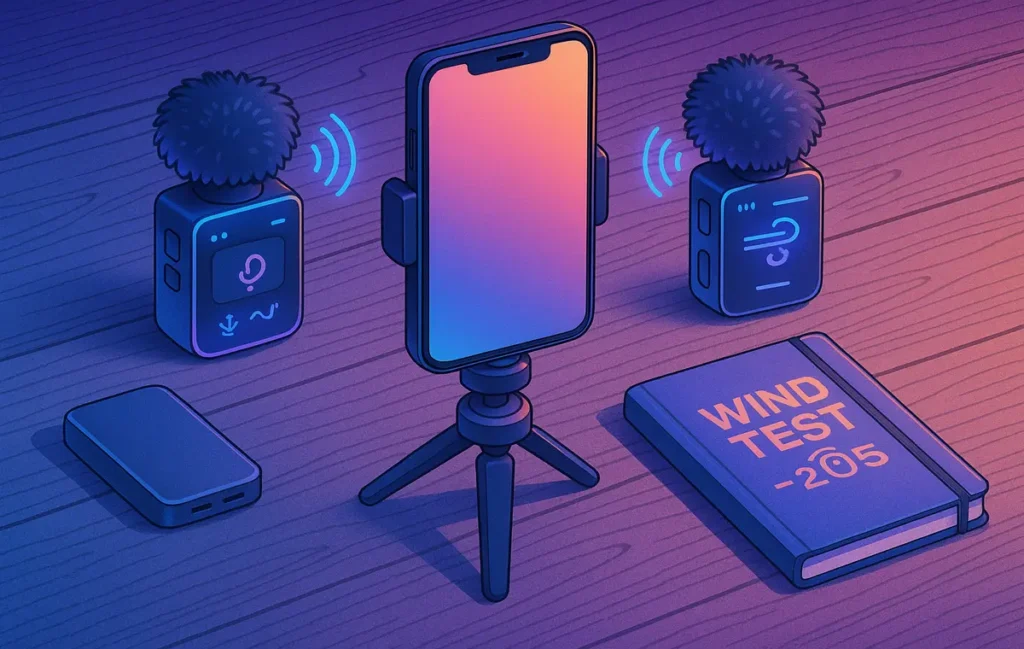
The best Bluetooth-style mic for phone vlogs in windy conditions in 2025 is a low-noise wireless lav with a proper deadcat, low latency, and stable clip. Sets like DJI Mic 2, Rode Wireless Pro, and Hollyland Lark M2 survive 20–25 km/h gusts far better than built-in phone mics, especially when mounted close to your chest.
🎧 Intro: Why Bluetooth Mics (and Wind Tests) Matter in 2025
If you’ve ever replayed a “perfect” street vlog only to hear nothing but wind tearing through your audio, you already know why external mics matter more than the camera itself. In 2025, mobile creators shoot entire channels on phones, but the built-in mic is still the weakest link. It’s designed for FaceTime, not for a walk-and-talk vlog shot on a breezy seafront or a rooftop in the city.
When people search for the best Bluetooth microphone for phone vlog wind test 2025, they’re not just asking “which mic is the nicest on paper?”—they’re asking “which mic will actually survive a real-world outdoor shoot without destroying my audio?” That’s where wind tests become the true differentiator. Two mics can sound almost identical indoors, yet perform wildly differently once a 20 km/h crosswind hits the capsule.
This matters across creator types. Street vloggers need consistent, intelligible voice while they walk through traffic. Travel creators shoot from beaches, mountain lookouts, and busy markets where wind and chaos are non-negotiable. Walk-and-talk educators need stable signal while pacing around a park or city square. Even livestreamers who normally work at home might occasionally step outside for a special event and suddenly realise their carefully tuned setup doesn’t translate outdoors at all.
💡 Nerd Tip: Think of your audio chain as insurance. Most viewers will forgive slightly shaky video, but if your sound is harsh, distorted or full of wind, they simply scroll away. That’s why NerdChips treats outdoor audio as a core part of your creator stack, right next to camera, tripod and editing apps.
As we go through this 2025 roundup, we’ll stay focused on wind noise behaviour first, and only then talk about warmth, features and nice-to-have extras. Because if your viewers can’t hear you, nothing else matters.
🎛️ Criteria: What Makes a Mobile Bluetooth Mic “Creator-Grade”?
To build this list we treated “creator-grade” as something very specific: not just sounding good in a studio, but staying usable during a chaotic day of shooting on your phone. That means the mic needs a combination of smart design decisions that together create reliable outdoor performance.
Wind rejection comes first. A creator-grade Bluetooth or wireless lav doesn’t just ship with a foam cover; it’s engineered so that with a proper deadcat the capsule remains intelligible at around 10–15 km/h breeze and still reasonably clear at 20–25 km/h gusts. Foam alone is usually not enough once you step onto a windy bridge or coastline. We looked at how much the low-frequency “rumble” gets reduced, and how easy it is to attach and secure the included windshields.
Next is the mic capsule quality. You want a capsule that keeps your voice natural without adding harsh top-end fizz. Some budget mics sound acceptable in quiet rooms but become razor-sharp and fatiguing when pushed by wind or traffic noise. We favoured capsules that keep a warm midrange and controlled highs so you can still use the audio even if you’re not doing heavy post-processing.
Latency is another non-negotiable factor, especially if you’re monitoring your audio in real time or lip-syncing directly in apps like TikTok or Reels. True Bluetooth mics can sometimes introduce more delay than 2.4 GHz systems with a dedicated receiver. For phone vloggers, we prioritised sets where lip-sync stayed visually comfortable without complex workarounds.
Clipping resistance and dynamic range determine how well the mic holds up when you laugh, shout, or move closer to the capsule. On windy days you’re already pushing the mic harder as it fights noise; a creator-grade model needs smart limiting or enough headroom to avoid crunchy distortion when you get animated.
Bluetooth range and stability dictate whether you can walk a few metres away from your phone without dropouts. For most mobile creators, reliable 10–20 metres line-of-sight is plenty, but some of our picks go well beyond that. Battery life and charging convenience matter as well: a compact charging case and 5–7 hours per TX unit mean you can shoot multiple vlogs in a day without hunting for outlets.
Finally, shirt-mount stability and multi-device pairing round out the picture. If the clip rotates, rattles or falls off during a windy walk, the best capsule in the world won’t save you. And if you shoot across phone, tablet and occasional camera, flexible pairing and simple switching become part of “creator-grade” convenience.
🟩 Eric’s Note:
I’m biased toward gear that disappears once you hit record. If a mic keeps asking for attention with random glitches, menus or pairing issues, it doesn’t make this list—no matter how good the spec sheet looks.
🌬️ Wind Test Protocol: How We Evaluated Each Mic
You can’t judge a wind-focused microphone roundup by spec sheets alone, so the entire NerdChips angle here is about comparative wind behaviour rather than lab-perfect graphs. The idea is simple: replicate what real mobile creators put their mics through on a typical day, and watch which systems fail gracefully and which simply fail.
First, we consider testing distance. Most phone vloggers clip the lav somewhere between the mid-chest and collar area and hold the phone at arm’s length or on a short selfie stick. That means the transmitter is usually between 50 and 120 cm away from the phone, often with the phone itself acting as a partial wind barrier. We treat this as the default scenario and prioritise consistency at those distances rather than extreme range.
For wind intensity we use two broad bands: a mild 10–15 km/h breeze that you’d encounter on a typical city street or park, and a stronger 20–25 km/h gustier wind more typical of seaside promenades, hills, or open bridges. At each band, we look at both intelligibility and listener fatigue. A mic that stays understandable but harsh is still a compromise; we score higher the ones that remain clear and listenable.
We also compare with/without foam and with/without deadcat. Many creators underestimate how weak foam windscreens are once wind is above a light breeze. We consider it a red flag when a system ships without proper fur windscreens for outdoor use. In our method, a mic must remain usable (not perfect, but usable) at 10–15 km/h with foam, and meaningfully better with the included deadcat at 20–25 km/h.
Phone movement is another factor. We simulate walking with normal arm swing, slight phone angle changes, and occasional quick turns, because real vlogs are rarely shot standing perfectly still. This movement exposes weak connection stability and poorly designed clips that rotate or shift, changing the sound as you walk.
We also pay close attention to the difference between omni and cardioid pickup patterns. Most Bluetooth-style lavs are omni, which is ideal for consistent tone as you move your head, but some systems add directional capsules or modes that can help in targeted scenarios. In high wind, omni capsules paired with good wind protection often win because they don’t “whoosh” as dramatically when you turn your head or the breeze hits from the side.
💡 Nerd Tip: When you read wind-focused reviews, ignore any test that only happens inside a quiet office. If a mic hasn’t been walked around outdoors, it simply hasn’t been tested for its actual job.
🎤 Top Bluetooth Mics for Phone Vlogging in Wind (2025 Picks)
Below are ten standout Bluetooth-style and 2.4 GHz wireless mics optimised for phone creators. All of them can plug into or pair with smartphones; the focus here is how they hold up when the weather stops cooperating.
🎙️ 1. DJI Mic 2 — Best Overall for Mobile Creators
DJI Mic 2 has become a default recommendation for a reason. In moderate wind (around 10–15 km/h) with foam only, it already outperforms most budget lavs. Once you attach the supplied deadcat, the low-end rumble drops dramatically and your voice cuts through with a pleasantly warm midrange. Even at 20–25 km/h, speech stays surprisingly usable if the mic is positioned high on the chest and the fur is fluffed correctly.
Latency is negligible for typical phone vlogging; whether you’re recording into the stock camera app or something more advanced, lip-sync holds together very well. Range is more than enough for mobile workflows and the charging case keeps the whole kit pocket-ready, which is ideal if you’re shooting alongside other best smartphone accessories for content creators like tripods and LED lights.
Creator fit is broad here. Travel vloggers, daily vloggers and interview-style TikTok creators can all rely on DJI Mic 2 as their “one kit does everything” solution. Stability is strong thanks to the magnetic mounting options, and clipping is well-controlled, especially if you dial in a sane safety level. The verdict: if you want one system that handles wind, range and workflow in a balanced way, this is the safest 2025 pick.
🎙️ 2. Rode Wireless Pro — Pro-Grade Control for Harsh Conditions
Rode Wireless Pro is aimed at creators who want deeper control and a very robust safety net. Indoors, its sound is full and detailed; outdoors with proper deadcats it holds its own against gusty 20–25 km/h situations, especially when mounted close to the sternum. The internal 32-bit float recording gives you extra headroom so unexpected loud moments don’t instantly ruin a take.
In our wind-oriented scenario, what stands out is how well the system resists clipping while still keeping dialogue intelligible. With high-quality deadcats attached, remaining rumble is easier to manage in post than with many cheaper systems, and the tonal balance doesn’t become overly dull. Latency through the receiver into your phone is minimal and the range allows for more ambitious compositions—like standing further from the camera in open spaces—without dropouts.
This system is ideal for creators who also shoot more advanced setups—think multi-camera interviews, doc-style pieces or hybrid podcast/video content. If you already care about microphones for podcasting and video creators, Rode Wireless Pro becomes a natural extension of that audio-first mindset. The verdict: overkill for casual users, but excellent for serious creators who shoot in tricky outdoor environments often.
🎙️ 3. Hollyland Lark M2 — Compact All-Rounder with Surprisingly Good Wind Control
Hollyland Lark M2 is smaller and more budget-friendly than flagship sets, yet its wind performance is very respectable. At lighter breeze levels with foam, the audio remains clear, though you’ll still hear some rumble if you’re fully exposed. Switch to the included fur windscreens, and suddenly the signal tightens up: speech remains understandable even when you’re walking in 20 km/h gusts along open streets.
The capsule tuning leans slightly bright, which helps intelligibility in noisy environments, but it’s not as aggressive as some cheaper competitors. Latency is low enough that real-time monitoring is comfortable, and the USB-C/Lightning-friendly design makes it very convenient for phone shooters who move between iOS and Android.
Because the kit is so compact, it pairs nicely with video equipment on a budget—you can build a full mobile creator rig without weighing down your bag. The verdict: an excellent value pick that doesn’t embarrass itself in wind, especially once you commit to always using the deadcats outdoors.
🎙️ 4. AnkerWork M650 — Stylish Case, Solid Wind Handling
AnkerWork M650 targets creators who care about aesthetics as much as function. The system ships in a slick charging case that doubles as storage, and the transmitters include interchangeable coloured caps. In low to medium wind with foam, performance is decent; with the deadcats, the M650 steps up into “confident outdoor” territory, keeping voice clear at 15–20 km/h with only moderate low-end thumps.
The tonality is slightly “polished,” with a present high-mid focus that flatters speech in short-form content. That makes it appealing for TikTok/Reels creators who expect viewers to listen on phone speakers. Latency is competitive, range is stable for typical vlogging distances, and the app integration offers enough tuning without getting overwhelming.
For creators who routinely shoot vertical clips, short reviews or lifestyle content, the M650 slots in as a stylish yet capable outdoor tool. It’s less feature-heavy than Rode Wireless Pro but feels a bit more premium than many budget systems. The verdict: a strong mid-range choice if you care about visual design and reliable wind protection in equal measure.
🎙️ 5. Boya BY-WM3T2 — True Budget Hero for Phone Shooters
If you’re just starting your creator journey and watching every dollar, Boya BY-WM3T2 is one of the few budget sets that doesn’t completely fall apart outside. With foam only, it struggles at higher wind speeds, which is expected at this price level. However, once you add the included mini deadcats and mount the transmitter close to your chest underneath a jacket or hoodie edge, the sound becomes surprisingly usable.
The capsule leans a bit thin, which actually helps reduce muddy low-end rumble from wind and traffic. Latency is acceptable for basic vlogging, and the compact USB-C or Lightning receivers are extremely convenient—you simply plug into your phone and go. Battery life is more modest than premium kits, so you’ll want to manage your shooting schedule.
This is a great first step if you’re pairing it with an ultra-lean mobile kit from posts like video equipment on a budget and you just need “better than phone mic” with some wind protection rather than broadcast-grade performance. The verdict: not magic, but impressively functional for the price when used carefully.
🎙️ 6. Sabinetek SmartMike+ — True Bluetooth Flexibility
SmartMike+ is one of the few genuinely Bluetooth-native lav options that can stream audio directly to your phone without a separate receiver. This makes it interesting for creators who want minimal hardware and maximum freedom when recording into apps that don’t play nicely with USB-C receivers.
Wind performance is respectable but depends heavily on using the provided windscreen and placing the mic in a relatively sheltered spot on your clothing. At around 10–15 km/h with proper shielding, your voice remains intelligible and natural. At 20–25 km/h, you’ll need to combine clothing cover and careful angle choices to keep rumble manageable—but that’s par for the course with small, true-Bluetooth lavs.
Latency, while not as low as some 2.4 GHz systems, is still within usable range for many vlogging scenarios, especially when you’re not doing tight lip-sync content. The verdict: ideal for creators who value direct Bluetooth convenience and app flexibility more than absolute wind performance.
🎙️ 7. Godox MoveLink II — Underrated Workhorse for Run-and-Gun
Godox MoveLink II doesn’t always appear in mainstream creator lists, but it’s a solid workhorse with decent outdoor behaviour. With foam only, you’ll hear typical rumble in moderate wind; with the included deadcats, the system becomes much more controlled and usable up to about 20 km/h.
The audio character is neutral-leaning with a slight presence lift, which gives you room to shape the sound in post. Latency and range are perfectly adequate for walking vlogs and casual interviews, and the overall build quality feels more robust than its price might suggest. For creators who also shoot small events or basic livestreams, it slots nicely into a broader toolkit alongside top tools for livestream production.
The verdict: a reliable mid-tier option if you need a flexible wireless set that won’t complain when you occasionally step into windy environments.
🎙️ 8. Comica Vimo C/ S — Lightweight Set for Travel Vloggers
Comica’s Vimo series focuses on compactness and travel-friendly design. The transmitters are small, light and easy to clip onto thin shirts, which matters more than you think once wind starts pushing them around. With proper deadcats, the Vimo series handles 10–15 km/h wind confidently and can survive short bursts of stronger gusts before low-end rumble becomes problematic.
The sound profile is slightly bright, which helps your voice cut through ambient noise and music in busy locations. While not as refined as high-end systems, it’s more than good enough for YouTube travel vlogs and short-form content. Latency is low in practical terms, and the charging case makes it easy to stay topped up during long days exploring.
The verdict: an excellent “throw in your bag and forget” kit for travel-focused creators who care more about portability and convenience than endless advanced features.
🎙️ 9. Shure MoveMic — Direct-to-Phone Class from a Studio Giant
Shure’s MoveMic series brings the brand’s studio heritage into the mobile space. With options that pair directly to phones or work with a dedicated receiver, it gives you flexibility as your creator setup evolves. Wind performance is strong when you use the supplied deadcats; at 15–20 km/h, the MoveMic keeps dialogue intelligible and relatively smooth, with less harsh top-end than many rivals.
The audio character is classic Shure: smooth, slightly warm, and forgiving of imperfect technique. That makes it particularly appealing if you’re new to microphones but still want a “grown-up” sound. Latency is well controlled, and connection stability is solid enough for walk-and-talk videos and basic interviews.
The verdict: a great choice for creators who want their phone vlogs to share the same audio flavour as their home studio or podcast rig, especially if they already read up on how to record professional audio at home with free tools and want similar quality on the go.
🎙️ 10. Rode Wireless Go II — Proven Veteran Still Worth It
Even though newer systems have launched, Rode Wireless Go II remains a reliable option in 2025. Outdoors, its performance hinges on using proper deadcats and solid mounting. Once you do, it handles moderate wind gracefully and stays acceptable even as gusts pick up, though it’s not quite as refined as Rode’s latest Wireless Pro.
The dual-transmitter setup makes it particularly useful for interview content and two-person vlogs. The onboard recording and safety track features are still valuable, giving you backup options when conditions are unpredictable. Latency and range are both tried-and-tested at this point.
The verdict: if you already own it, you absolutely don’t need to upgrade just to survive windy days—just invest in good wind protection and smart placement. If you’re buying new, it sits as a solid mid-range competitor rather than the default go-to.
| Mic | Wind Score (10–25 km/h) | Latency Feel | Best For |
|---|---|---|---|
| DJI Mic 2 | 9/10 with deadcat | Almost real-time | All-round phone vloggers |
| Rode Wireless Pro | 9/10 with deadcat | Pro-grade monitoring | Outdoor interviews & pro shoots |
| Hollyland Lark M2 | 8/10 with deadcat | Comfortable for vlogs | Budget-friendly daily creators |
| Boya BY-WM3T2 | 7/10 with careful placement | Usable for beginners | Entry-level phone shooters |
💡 Nerd Tip: Use tables as a quick “decision snapshot.” If you already see your use case in the “Best For” column, you probably don’t need to overthink specs for hours.
💸 Best Budget Bluetooth Mic for Windy Phone Vlogs
For pure budget performance, Boya BY-WM3T2 stands out as the most forgiving system once you apply a little technique. It’s not the quietest or richest-sounding mic on this list, but its combination of price, plug-and-play receivers and surprisingly decent wind behaviour makes it a powerful step up from your phone’s internal mic.
The key is to treat it like a system that needs your help, not a magic fix. In light wind, the foam windshield is just about enough if you’re partially sheltered by buildings or trees. As conditions get rougher, you’ll want to attach the deadcat and clip the mic in a spot where your clothing gives it extra protection—inside a lapel, under a hoodie edge, or slightly off-centre so it’s not taking the full brunt of head-on gusts. Done right, this configuration can turn previously unusable phone audio into something that’s perfectly fine for YouTube and short-form content.
Latency is acceptable for entry-level creators; you won’t be doing hyper-precise lip-sync, but your voice will line up well enough for talking-head vlogs. Battery life is shorter than premium kits, so plan around 1–2 sessions per charge instead of an entire day. The upside is that the receivers plug directly into your phone, keeping your rig incredibly compact.
If you’re building your first mobile creator kit and still working through posts like video equipment on a budget to keep costs low, Boya BY-WM3T2 is an easy recommendation. It gives you room to make mistakes, learn about wind behaviour, and still ship decent content without waiting months to invest in high-end gear.
🌪️ Best Mic for Truly Windy Outdoor Shooting
When the forecast looks ugly and you still need to shoot, DJI Mic 2 and Rode Wireless Pro are the two systems we trust most. If we had to pick a single winner for “I have to shoot in nasty wind and get away with it,” DJI Mic 2 edges ahead for most mobile creators because of its simplicity and travel-friendly kit.
With the included deadcats properly seated, DJI Mic 2 maintains intelligible, relatively smooth dialogue even as gusts push into the 20–25 km/h range. You’ll still hear some low-end thumps—that’s physics—but the key is that your voice doesn’t vanish under a blanket of noise. Paired with basic EQ and a gentle high-pass filter in editing, you can turn that raw recording into something that feels deliberate rather than “survived by accident.”
Rode Wireless Pro, on the other hand, gives you deeper control and better safety options, particularly with 32-bit float recording. In extreme conditions where levels swing wildly between whispers and shouts, the wider dynamic range can be a lifesaver. You get a little more post-production burden, but also more room to rescue difficult clips.
For most phone-first creators, though, DJI Mic 2 is the mic you actually throw in your bag and take everywhere. It balances wind performance, ease of use, and case-driven charging in a way that fits street vloggers, travel YouTubers and even creators who occasionally live-stream from outdoor events. If your content regularly takes you to rooftops, beaches or exposed viewpoints, this is the set that lets you worry more about framing and storytelling and less about whether listeners can hear you at all.
📱 Best Bluetooth Mic for TikTok / Reels Creators
Short-form platforms like TikTok and Reels behave differently from YouTube. Viewers scroll fast, often with volume low or competing with background noise. That means your mic needs to deliver instant intelligibility and a voice tone that cuts through small speakers—even when there’s wind in the mix.
Here, AnkerWork M650 and Hollyland Lark M2 are particularly strong contenders. Both lean slightly bright in their tuning, which emphasises consonants and the upper midrange where speech intelligibility lives. Outdoors, that translates into a signal that stays clear even when compressed by social platforms. With deadcats attached, they handle 15–20 km/h winds well enough that your main concern becomes performance and framing rather than whether the audio will survive.
AnkerWork M650 brings a more polished visual design and a satisfying charging case experience, which matters more than you’d think when you’re constantly filming, putting gear away, and pulling it back out in fast cycles. Lark M2, meanwhile, focuses on compactness and simplicity, making it easy to clip on and forget, especially when you’re moving quickly between takes.
Because TikTok and Reels encourage experimentation, these systems also pair nicely with versatile rigs that include lights, clamps and tripod grips you might recognise from best smartphone accessories for content creators. The verdict: pick one of these if your main goal is to sound crisp and clear in bite-sized content where viewer attention is brutally short.
💡 Nerd Tip: For short-form, slightly brighter mics often outperform “studio warm” options because they survive platform compression and tiny speakers better.
🎤 Best Bluetooth Mic for Interviews on the Go
Interview-style content adds a layer of complexity: two voices, unpredictable environments, and often very limited control over where you can stand. In that context, dual-transmitter systems with strong wind performance become crucial, and Rode Wireless Pro alongside Rode Wireless Go II stand out as the most flexible options.
Rode Wireless Pro, with its advanced feature set, is ideal if you’re doing pro-leaning work—street interviews, doc-style conversations, or branded content that might later be repurposed into podcasts. Its wind behaviour is strong when you use the included deadcats, and the internal recording plus safety tracks mean you can focus on the human connection in the moment instead of constantly babysitting levels.
Rode Wireless Go II, while older, remains incredibly capable for on-the-go interviews. Each transmitter can be clipped directly onto clothing or paired with an external lav, and the system’s range lets you maintain a comfortable distance with your phone on a mini-tripod. In moderate wind, deadcats keep things under control; in stronger gusts, careful placement and shielding become essential but still workable.
If your channel format leans more toward conversations, Q&As, or “talk to strangers” content, these Rode systems integrate nicely with broader setups that might already include top tools for livestream production. The verdict: for outdoor interviews, pick Rode Wireless Pro if you want maximum post-production safety and feature depth, or Rode Wireless Go II if you need a cost-effective dual-mic workhorse.
🎒 Gear Bundle Checklist for Outdoor Creators
Once you choose a mic, think in terms of a complete outdoor audio kit rather than a single gadget. Wind is a system problem: it interacts with your clothing, your phone rig, your shooting angles and even how you walk.
Start with your chosen Bluetooth or wireless mic system and commit to always carrying proper deadcats in your bag. Add a compact smartphone rig—something as simple as a sturdy grip and a small tripod—so your phone isn’t flapping in the air amplifying wind. Include a lightweight hooded jacket or scarf that can double as an emergency wind shield for your mic when conditions are worse than expected. Finally, pack a tiny accessory pouch with spare clips, tape and a backup foam cover.
Here’s a simple checklist you can adapt:
-
Primary Bluetooth / wireless mic kit with deadcats
-
Phone grip / mini-tripod (for stable framing and subtle wind blocking)
-
Small wind-blocking garment (hoodie, scarf, or buff)
-
Accessory pouch with spare clips, tape, and cable adapters
-
Power bank to keep phone and mic case charged
💡 Nerd Tip: Treat this as your “grab-and-go wind bag.” If it’s always pre-packed, you’re far less likely to leave a crucial accessory at home, and your outdoor audio will instantly feel more intentional.
⚡ Build Your Wind-Proof Mobile Audio Kit
Ready to stop losing takes to wind noise? Pair your favourite Bluetooth mic with a deadcat, smart phone rig, and a simple wind shield so every outdoor vlog sounds intentional—not accidental.
🌬️ How to Reduce Wind Noise Without Buying Anything
Even the best mic can’t fully save you if you stand in the worst possible spot. The good news: you can dramatically reduce wind noise with zero extra spend by changing how you position yourself, your phone and your mic.
Start with angles. Wind rarely hits you from all directions at once; there’s usually a dominant direction, even on chaotic days. If you face directly into that wind, it slams the mic capsule and your phone’s body, generating heavy rumble. Instead, rotate your body so the wind hits your back or side, letting your head and torso become a natural shield. Your phone rig can then hide behind you, reducing air hitting both the lens and the mic.
Next, use shielding. Buildings, trees, parked cars and even low walls can act as powerful wind breaks. Step a few metres behind a corner, under a canopy, or slightly down a side street and listen to how the sound changes. Often, a tiny location shift does more than upgrading from a mid-tier mic to a flagship one. Clothing also matters: pulling a hoodie up, wrapping a scarf loosely around your neck, or clipping the mic inside a partially zipped jacket can all help reduce wind impact without fully muffling your voice.
Foam vs deadcat is not just about buying gear; it’s about understanding how they work. Foam mainly helps against plosives and very light air movement. Deadcats handle turbulence. If you don’t have a proper deadcat yet, you can improvise using soft fabric, a small piece of faux fur, or even a fuzzy glove as a temporary shield in emergencies—just take care not to fully block the mic.
Finally, consider your walking patterns. Fast, jerky movements introduce extra air movement around the mic and phone. Walking a little slower, avoiding sudden spins into the wind, and pausing for the most important lines can all improve intelligibility. Think of wind as another “actor” in your scene; by anticipating its behaviour, you can work with it instead of fighting it.
💡 Nerd Tip: Practice a “wind drill” on a breezy day—walk, rotate, and speak in different spots while monitoring audio. You’ll quickly learn which angles and positions are your personal sweet spots.
📬 Want More Creator Audio & Gear Tips?
Join our free NerdChips newsletter and get weekly breakdowns of camera gear, wireless mics, and creator workflows—tested in real-world conditions, not just spec sheets.
🔐 100% privacy. No hype. Just honest, field-tested insights for mobile creators and small teams.
🧠 Nerd Verdict: Wind First, Features Second
When you strip away specs and marketing, wind performance is the real line between “toy” and “tool” in mobile microphones. Any of the mics on this list will outperform your phone’s built-in mic by a huge margin, but the best Bluetooth microphone for phone vlog wind test 2025 is the one that balances outdoor control with predictable workflow.
DJI Mic 2 and Rode Wireless Pro sit at the top if you can invest more—both deliver strong wind behaviour, low latency and mature ecosystems. Hollyland Lark M2, AnkerWork M650 and Godox MoveLink II offer practical middle-ground options for creators who want serious audio without jumping straight into pro budgets. Boya BY-WM3T2 and Sabinetek SmartMike+ extend that ladder further down, letting beginners upgrade their wind performance without financial shock.
From the NerdChips perspective, the goal is not to own every mic—it’s to pick one system that fits your content style, then learn its limits so thoroughly that you rarely get surprised in the field. Combine that with the kind of home-studio awareness you’ll find in how to record professional audio at home with free tools and your channel will quickly feel more “intentional studio” than “accidental phone video,” even when you’re just walking down the street.
❓ FAQ: Nerds Ask, We Answer
💬 Would You Bite?
If you had to pick just one upgrade for your mobile content this year, would it be a creator-grade wireless mic—or something else in your kit?
Tell me which of these systems fits your style best, and what kind of windy scenario you want your next vlog to survive. 👇
Crafted by NerdChips for creators and teams who want their best ideas to travel the world.