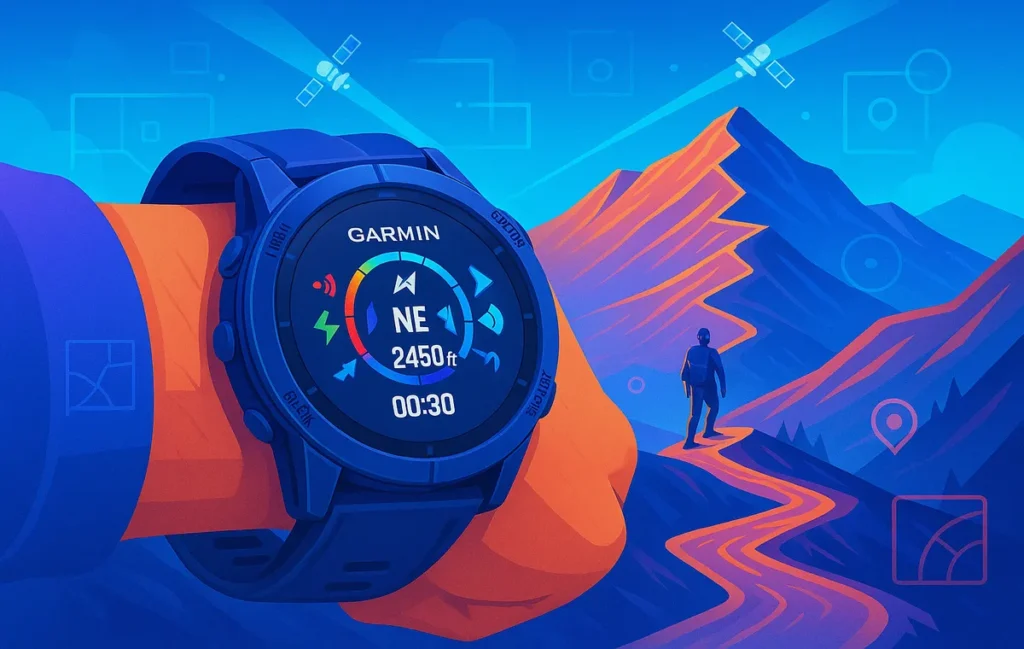
The Garmin Fenix 8 Pro is a satellite-ready adventure watch that combines LTE-M, InReach messaging, a 4500-nit MicroLED option, and up to 27 days of battery life. It’s overkill for casual users, but for people who push beyond cell coverage, it’s less a gadget and more a safety system you wear on your wrist.
⛰️ First Look: Garmin’s Boldest Adventure Smartwatch Yet
Garmin has never really chased the “lifestyle smartwatch” crowd. The Fenix line has always been for people who live outside the city grid: endurance athletes, climbers, backcountry skiers, expedition leaders. With the Fenix 8 Pro, Garmin is basically saying: you expect your watch to be there when your phone can’t be.
The headline change is not just another sensor or a slightly sharper display. It’s that the Fenix 8 Pro goes truly off-grid with a combination of LTE-M cellular and InReach satellite connectivity baked into the watch itself. Add a new MicroLED display option that hits 4500 nits, and you get a smartwatch that looks almost unreal in sunlight and keeps talking to the world when your phone gives up.
In typical Garmin fashion, this is not a minimalist or budget-friendly wearable. It’s heavy-duty, expensive, and unapologetically aimed at people who measure days in vertical meters, not step counts. But if you’re the type of person who reads gear reviews for fun, the Fenix 8 Pro is one of those rare launches that actually shifts what a “smartwatch” can be.
🛰️ Real Off-Grid Connectivity: LTE-M + InReach Satellite
The thing that makes the Fenix 8 Pro more than a “better Fenix” is its dual connectivity strategy. Garmin combines:
-
LTE-M cellular for low-power, always-on data
-
InReach satellite for true off-grid communication
Rather than trying to turn the watch into a full phone replacement, Garmin focuses on the moments that actually matter when you’re far from home.
With LTE-M, you can send 30-second voice clips, share your real-time location via LiveTrack, and pull down critical info like weather updates. This is designed for athletes and adventurers moving through areas with patchy coverage but still on the grid most of the time.
When coverage disappears completely, InReach satellite picks up the slack. You can:
-
Send and receive short text-style messages
-
Share GPS locations with contacts
-
Trigger an SOS that connects to Garmin Response, their 24/7 global emergency center
You don’t get traditional phone calls or SMS here. That might sound like a limitation at first, but for expedition teams and serious adventure athletes, what matters most is reliable, low-bandwidth communication that works when everything else fails, not endlessly mirroring your smartphone notifications.
💡 Nerd Tip: Think of the Fenix 8 Pro as a messaging and safety device first, and a notification mirror second. If you want Instagram on your wrist, this is not your watch. If you care about getting a signal out when you’re 50 km beyond the trailhead, it suddenly makes perfect sense.
Both LTE-M and InReach require subscriptions that start around $7.99/month, with Garmin offering a 30-day free trial and waived activation for first-time InReach users. It’s not free, but compared to the cost of a single rescue operation—or the cost of not being able to call for one—it’s not hard to justify.
🔆 MicroLED Brilliance: 4500 Nits in Harsh Sunlight
The other major headline is the MicroLED display option on the 51mm Fenix 8 Pro. While most premium OLED smartwatches top out at around 2000 nits, Garmin’s MicroLED variant pushes a mind-bending 4500 nits of peak brightness.
That jump is not just a spec-sheet flex. It fundamentally changes how the watch feels outdoors:
-
Snow glare at noon on a glacier
-
Blinding desert sun at 3PM
-
Quick glances mid-climb when you’re hanging on one hand
In all these scenarios, clarity is safety, not just comfort. If you’ve ever struggled to read your map or pace data because the screen washed out, you already know why this matters.
Of course, brightness is never free. That MicroLED power comes with a significant trade-off in battery life. While the OLED versions of the Fenix 8 Pro can stretch up to 27 days, the MicroLED model lands closer to 10 days—which is still competitive, but clearly tuned for people who prioritize visibility over maximum runtime.
📊 Fenix 8 Pro Models: Sizes, Displays, and Battery Life
To keep things flexible, Garmin splits the Fenix 8 Pro lineup into a few key variants:
| Model | Size | Display | Peak Brightness | Battery (Up to) | Approx. Price | Best For |
|---|---|---|---|---|---|---|
| Fenix 8 Pro OLED (47mm) | 47mm | OLED | ~2000 nits | 27 days | $1,199.99 | Everyday athletes & smaller wrists |
| Fenix 8 Pro OLED (51mm) | 51mm | OLED | ~2000 nits | 27 days | $1,299.99 | Big-wristed users, larger map view |
| Fenix 8 Pro MicroLED (51mm) | 51mm | MicroLED | 4500 nits | 10 days | $1,999.99 | Extreme sunlight, high-altitude, snow & desert missions |
💡 Nerd Tip: If you’re debating models, start from your longest typical trip without charging. If your adventures rarely go beyond a week, the MicroLED’s 10 days may be more than enough—especially if you value instant screen legibility in brutal light conditions.
This is not a mass-market pricing strategy. At nearly $2,000 for the high-end MicroLED version, the Fenix 8 Pro sits closer to professional gear than consumer gadgets. But that’s the point: Garmin is targeting users who see this as part of their safety kit, not just a smartwatch.
💬 Garmin Messenger: A Tiny, Private Comms Network on Your Wrist
To make all this connectivity practical, Garmin leans heavily on the Garmin Messenger app. Instead of trying to replicate WhatsApp or iMessage on your wrist, Messenger focuses on reliable, low-friction communication tailored for outdoor use.
Through the Fenix 8 Pro and Garmin Messenger, you can:
-
Send and receive text-based messages via satellite
-
Share GPS locations with friends, family, or team members
-
Send voice snippets up to 30 seconds when LTE-M is available
There is one important caveat: the best experience is when you communicate with other people inside the same ecosystem—either other Garmin Messenger users or teammates using Fenix 8 Pro and similar InReach-enabled devices.
For casual consumers this might feel restrictive; for expedition teams, ultra-running crews, or guiding companies, it’s actually a feature. It turns Garmin’s ecosystem into a closed, focused comms network that doesn’t depend on social media platforms or messaging apps that assume stable 5G coverage.
❤️ Daily Life: Health, Training, and Recovery Metrics
Garmin knows that even serious adventurers spend most of their time not summiting volcanoes. The Fenix 8 Pro still has to be a competent daily wearable, and it does not dial back on standard health and training features.
You get the full modern Garmin stack:
-
Continuous heart rate monitoring
-
SpO2 / Pulse Ox tracking
-
Sleep and sleep-stage tracking
-
Stress and body battery metrics
-
Advanced performance analytics: VO2 Max, training load, training readiness, and recovery time
-
Sport profiles for everything from trail running and mountaineering to open-water swimming and gravel riding
What makes Garmin interesting is not just the raw data, but how the ecosystem layers coaching logic on top of it. Over a few weeks, the watch starts to offer training suggestions and recovery windows that feel surprisingly aligned with how your body actually feels—especially if you’re not constantly overriding them.
This is also where the Fenix 8 Pro feels very different from something like an Oura Ring 4 Review: The Future of Sleep Tracking, which leans more into passive health insights. Oura is phenomenal at telling you how you’re doing; Fenix is designed to tell you what to do next.
💡 Nerd Tip: If you’re already overwhelmed by health data, focus on just three metrics for the first month—sleep score, training readiness, and recovery time. Let those guide when to push and when to back off instead of staring at every tiny metric.
Where the Fenix 8 Pro really pulls away from mainstream wearables is navigation and safety. This is not just a ring of icons and a pretty workout screen—it’s a full-blown outdoor toolset:
-
Multi-band GNSS for more accurate GPS, especially in canyons, forests, or cities with tall buildings
-
Topo maps, ski maps, and turn-by-turn navigation
-
Climbs, elevation profiles, and route planning
-
LiveTrack so people at home can follow your route in real time
Tie that together with Garmin Response—the company’s always-on emergency monitoring center—and the watch becomes a layer in your risk-management system. If you trigger an SOS, your signal goes to a team trained to coordinate with local emergency services and search & rescue teams, while also pinging your personal emergency contacts.
Eric’s Note: I don’t think any smartwatch makes risk disappear, but I take devices like the Fenix seriously because they shorten the distance between “something went wrong” and “someone knows and is responding.” That gap is often where outcomes are decided.
💰 Pricing, Value, and the “Is It Worth It?” Question
On paper, the Fenix 8 Pro is one of the most expensive smartwatches you can buy:
-
47mm OLED: $1,199.99
-
51mm OLED: $1,299.99
-
51mm MicroLED: $1,999.99
And that’s before you add a monthly subscription for LTE-M and InReach services.
If you mostly run in city parks, commute by bike, and like the idea of closing rings, this is clearly overkill. You’re paying for features you will almost never use. You’d likely be happier—and far better integrated—with something like the Apple Watch Ultra 3, which leans into iOS integration, advanced health sensors, and a polished app ecosystem.
But if your reality includes remote ridgelines, solo multi-day runs, or off-grid expeditions, the pricing equation shifts dramatically. In that context, the Fenix 8 Pro is less about luxury and more about:
-
Reducing friction in route-finding
-
Making communication possible when phones fail
-
Giving friends and family a real-time window into your location
You’re not paying for “another screen.” You’re paying for redundancy, resilience, and peace of mind.
If you’re considering the MicroLED model, check current Fenix 8 Pro pricing on Amazon before you lock in a size and display.
🌍 Ready to Gear Up for Real Adventure?
Before you pick a Fenix 8 Pro model, compare MicroLED vs OLED battery trade-offs, sizes, and strap options. The right choice depends less on specs and more on how far from the grid you actually go.
🆚 Fenix 8 Pro vs Apple Watch Ultra 3
Comparing the Fenix 8 Pro to the Apple Watch Ultra 3 is less about which is “better” and more about what kind of life you live.
Apple dominates in:
-
Ecosystem integration: iMessage, Apple Fitness, Apple Pay, App Store apps
-
Daily UX polish: smooth animations, app quality, watch faces, notifications
-
Health features: strong sensor stack, deep Health app integration, ECG, advanced heart insights
Garmin dominates in:
-
Battery life: days to weeks instead of days to hours
-
Off-grid capability: InReach satellite, topo maps, expedition tools
-
Outdoor-first design: physical buttons, rugged build, safer in extreme conditions
Where Apple pushes toward being the ultimate lifestyle companion, Garmin pushes toward being the ultimate expedition device. One is built to make everyday life smoother; the other is built to keep working when your day is anything but normal.
If your calendar is full of office hours, gym sessions, and urban runs, the Watch Ultra 3 probably feels more “alive” day-to-day. If your calendar includes hut-to-hut traverses, ski tours, and remote trail races, the Fenix 8 Pro starts to feel like the logical choice.
🆚 Fenix 8 Pro vs Galaxy Watch 7 Ultra and Other Wearables
On the Android side, Garmin’s closest competitor is the Samsung Galaxy Watch 7 Ultra. It brings a bold design, rugged housing, and deeper integration with Galaxy phones.
Samsung leans into:
-
Tight integration with Galaxy devices
-
A more familiar Wear OS ecosystem with apps and notifications
-
A price tag closer to $650, significantly below Garmin’s flagship
But it still behaves like a “smartwatch first, adventure tool second.” Battery life lasts a few days instead of weeks, and there’s no true satellite trust layer like InReach. For everyday users, that’s a great trade. For people planning multi-day missions far from power and cell service, it’s a compromise.
If you zoom out further, you get an entire wearable spectrum:
-
Rings like the Oura Ring 4 focus on recovery and sleep.
-
Glasses like the best smart glasses of 2025 add subtle heads-up notifications and AI assistance.
-
Watches like the Fenix stand at the far end: not subtle at all, but absolutely reliable when conditions get rough.
💡 Nerd Tip: You don’t need every wearable. If you’re serious about long days outside, prioritize one device that truly fits your use case instead of stacking multiple half-used gadgets.
And if long battery life is one of your non-negotiables, it’s worth browsing through Best Smartwatches with Long Battery Life to see how the Fenix 8 Pro compares to other endurance-focused options.
🧪 Real-World Use Cases: Who Is Fenix 8 Pro Really For?
Reading spec sheets is one thing; imagining actual trips is another. The Fenix 8 Pro shines when you put it into real scenarios:
-
Ultra-marathons and stage races: You can track multi-day events without stressing over nightly charges, while friends monitor your location and progress remotely.
-
Alpine missions: Bright MicroLED visibility matters when you’re dealing with glare, goggles, and high-risk decisions. Routes, storm alerts, and SOS are all on your wrist.
-
Bikepacking and thru-hikes: Long stretches between towns make power and coverage unpredictable. Pairing solar panels with days-long battery and satellite messaging can completely change the logistics of your trip.
In all of those cases, the Fenix 8 Pro behaves less like a “fitness gadget” and more like a multi-function navigation and safety platform that happens to count your steps and track your heart rate.
For city-only runners and gym-goers, that’s honestly more than you need. But for people who look at a map and instinctively choose the longest route, this is the kind of device that fits their identity as much as their needs.
📬 Want More Adventure-Ready Gear Breakdowns?
Join our free NerdChips newsletter and get weekly deep dives on rugged wearables, smart travel gear, and future-facing gadgets—curated for people who actually use their tech beyond city limits.
🔐 100% privacy. No noise. Just field-tested gadget insights from NerdChips.
🧠 Nerd Verdict: A Survival Tool Disguised as a Smartwatch
The Garmin Fenix 8 Pro does not try to win everyone. It doesn’t chase ultra-sleek design, app count bragging rights, or social media integrations. Instead, it takes the Fenix DNA—endurance, mapping, durability—and adds something game-changing: native satellite and low-power cellular connectivity.
If you strip the marketing away, what you’re left with is a very clear value proposition:
-
If your life is mostly on-grid, there are cheaper, friendlier, and more integrated options.
-
If your life regularly slips outside that grid, into mountains, deserts, forests, and oceans, the Fenix 8 Pro becomes one of the few devices that feels appropriately serious for what you’re doing.
It’s expensive, heavy, and unapologetically specialized. But for the right user, it promises something no notification-focused smartwatch can: a fighting chance of being heard when it matters most.
❓ FAQ: Nerds Ask, We Answer
💬 Would You Bite?
Would you invest in a satellite-ready smartwatch like the Fenix 8 Pro if it meant always having a way to call for help off-grid—
or do you think a “good enough” lifestyle watch with great apps is still the smarter choice for your everyday reality? 👇
Crafted by NerdChips for explorers and endurance nerds who want their gear to work wherever the trail actually ends.
Updated Dec 2025