🚀 Why 2026 Might Be a Turning Point for Tech Listings
After two cautious years, the public markets finally look ready to entertain growth again—just not the break-even kind that defined peak‐cycle exuberance. Investor appetite has returned for companies that can demonstrate resilient demand, disciplined acquisition costs, and a credible path to durable free cash flow. That shift is exactly why 2026 is shaping up as a pivotal year: a backlog of late-stage tech companies has matured inside the private markets, the cost of capital has stabilized, and comps in software and fintech have recalibrated to more rational multiples. It’s not a rewind to 2021; it’s a filtered, more sober reopening.
In this NerdChips outlook, you’ll get a focused read on which tech companies are most likely to list in 2026, why the timing finally makes sense, where valuations could land, and the main risks that could delay or derail a debut. Unlike generic “mega-list” round-ups, we zero in on names with credible public signals and late-stage readiness. Along the way, we’ll connect the dots to market themes—from AI infrastructure and enterprise SaaS to global consumer marketplaces—so you can see how a single blockbuster filing changes sentiment for an entire sector.
If you want to understand how hiring and headcount factors into IPO timing, you’ll also find our analysis of market conditions useful in Are Layoffs Over or Just Beginning? and the broader context on reshuffling talent flows in Global Tech Layoffs & Hiring Trends. For the policy headwinds that can make or break international listings, keep an eye on AI Regulation on the Rise: Understanding the EU AI Act and More and our explainer on Big Tech Antitrust: What It Means for the Future of Tech Giants—thematic pressure from these files often shows up as extra “risk factor” pages in S-1s.
💡 Nerd Tip: The next cycle of listings won’t reward top-line growth alone. What the market is actually buying is unit economics clarity and cash flow conversion under constraint. If an S-1 can demonstrate both, valuation tension breaks in the company’s favor.
📈 Why 2026 Could Reopen the Window for Tech IPOs
The “why now?” boils down to three intersecting forces. First, multiple compression that started in 2022 has largely run its course for quality names; the spread between best-in-class SaaS and the rest has widened, but leaders are again trading at premiums that make a public listing attractive. Second, rate visibility—even if not outright cuts—gives CFOs confidence that the market will value forward revenue without punishing duration risk as brutally as before. Third, private market fatigue means late-stage investors want liquidity; secondary transactions can only go so far without a public price anchor.
On the tech side, AI infrastructure continues to command attention, not just for model vendors but also the data and orchestration layers that make AI useful in production. Expect names that sit at the crossroads of data engineering, vectorized analytics, and governance to attract a public audience. In parallel, fintech remains an evergreen, but the premium will accrue to companies that monetize payments plus adjacent software, not payments alone. Enterprise SaaS will be selective—vendors with net retention resilience, modular pricing, and AI-assisted workflows built into the product stand out.
What must still happen? A functioning window needs healthy first-week trading for early movers, and a couple of “beats and raises” quarters from 2025/early-2026 IPOs to validate pricing. Companies must present profitable growth or a near-term path backed by cohort math; they need regulatory clarity in payments, data, and AI safety; and they must show investor-friendly governance (fewer surprises with multi-class voting and related-party arrangements).
💡 Nerd Tip: Watch the underwriter mix and lock-up language in early 2026 filings. Bulge brackets signal a deep institutional book; tighter lock-ups and structured greenshoes often appear when bankers anticipate heavy day-1 demand.
🧭 IPO Candidates to Watch in 2026 (Selected)
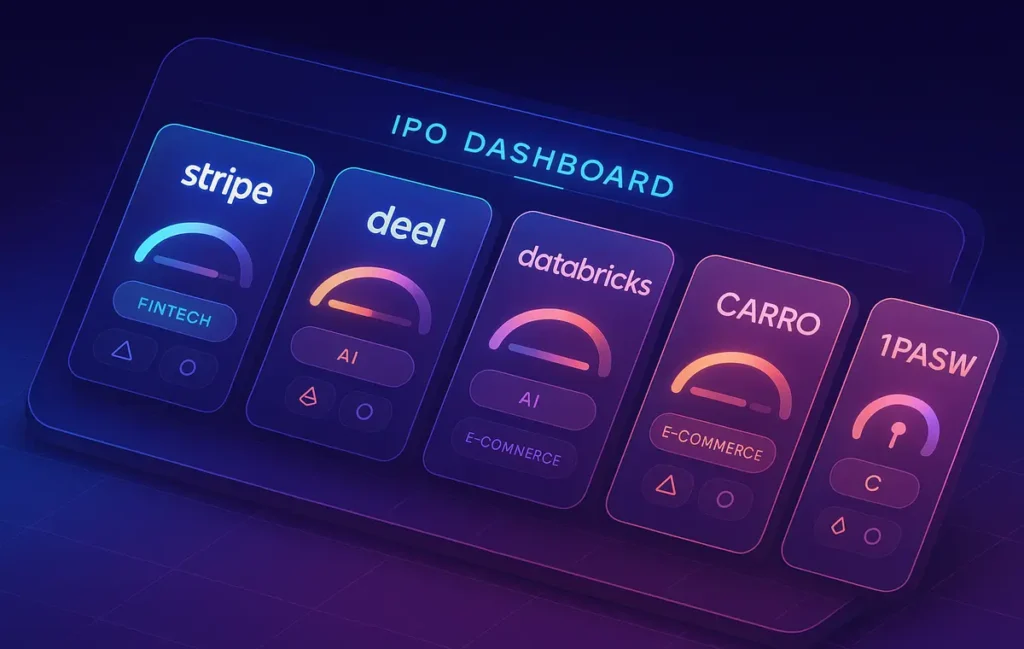
We’re intentionally selective here: five companies with distinct sector positions and credible 2026 timing signals. For each, we unpack the profile, what would make the IPO work, and the traps that could spoil the debut.
💳 Stripe — Payments Core, Software Edges, and the Price of Scale
Profile & Positioning: Stripe powers internet payments and adjacent financial tooling for millions of businesses. The core is payment acceptance, but the growth story is the software halo—billing, tax, fraud, and increasingly monetized financial primitives (billing logic, invoicing, revenue recognition).
Why 2026 Fits: Stripe has the scale, the brand, and the maturity. The differentiator now is not “payments TAM” but bundled software attach that lifts gross margin and makes revenue stickier. If the 2026 market window rewards profitable growth over raw GMV narratives, Stripe can lean into efficiency gains, attach rates, and enterprise migration to justify premium software-like multiples on a blended business.
Valuation Lens: The market will triangulate between payments comps and rule-of-40 SaaS comps. A credible case for blended gross margin expansion and durable net retention pushes the multiple toward the diversified fintech peer set rather than pure payments processors.
Risks & Conditions: Regulation across regions, interchange dynamics, and competitive pricing pressure from platforms that bundle payments at near-cost. Execution risk lives in enterprise adoption where procurement cycles elongate; any evidence of downshift in attach would tug down the multiple. The S-1 needs to tell a cohort profitability story, not just volume growth.
🌍 Deel — Global Hiring OS and the Compliance Moat
Profile & Positioning: Deel operates as a global workforce platform, enabling companies to hire, pay, and manage contractors or employees across jurisdictions. The sticky part is the compliance moat—localized payroll, taxation, and employer-of-record complexity wrapped in software.
Why 2026 Fits: With a reported revenue run-rate in the high hundreds of millions, the business shows scale across macro cycles where hiring sentiment whipsawed. The IPO pitch is that Deel isn’t simply “HR software”; it’s an operational platform for international expansion. In a world where remote and hybrid persist, CFOs will pay for fewer compliance surprises.
Valuation Lens: Investors will compare Deel to verticalized fintech-SaaS names—software revenues with payments/payout monetization layered on top. If gross margins hold and churn remains low in a mixed hiring environment, public buyers will underwrite a durable net retention engine with optionality in perks, benefits, and tax automation.
Risks & Conditions: Sensitivity to global hiring cycles and start-stop demand from startups. Any headline compliance failure in a major jurisdiction hurts trust. Deel must highlight unit economics by segment (SMB vs. mid-market vs. enterprise) and prove that geographic expansion improves—not dilutes—cohort returns.
🧠 Databricks — Data+AI Platform at the Heart of the Stack
Profile & Positioning: Databricks sits at the intersection of data engineering, analytics, and machine learning, with the lakehouse vision tying storage and compute to collaborative tooling. The AI wave gave the company a second engine: vectorized data, feature stores, governance, and “AI in production” workflows.
Why 2026 Fits: If 2025 was the year of pilots, 2026 is the year of integration. Enterprises are moving from “one LLM demo” to repeatable AI-assisted processes that depend on reliable data plumbing. That places Databricks in the “shovel seller” bucket of the AI rush. Public markets understand this story when it comes with land-and-expand telemetry (workload growth per customer, AI SKU attach, and governance adoption).
Valuation Lens: Expect a premium data-platform multiple if the company shows broad-based growth across industries and healthy gross margins even with compute-intensive workloads. The market will also test for AI revenue quality—is it truly incremental, with visibility, or just reshuffled analytics spend?
Risks & Conditions: Competitive heat from cloud hyperscalers and data-warehouse peers; pricing complexity when customers blend storage, compute, and AI SKUs. The S-1 must demonstrate that governance, lineage, and cost control aren’t optional—they’re the reason customers standardize.
🚗 Carro — ASEAN Auto Marketplace Meets Fintech
Profile & Positioning: Carro is a Southeast Asia used-car platform that blends marketplace dynamics with inspection, financing, and after-sales services. The tech layer touches pricing algorithms, risk scoring for loans, and platform tools for dealers and consumers.
Why 2026 Fits: The U.S. market has appetite for high-growth APAC consumer platforms when the story includes fintech monetization and operational rigor. Carro’s pitch at IPO would emphasize take-rate stability, financing yields adjusted for risk, and the operational advantage of an integrated reconditioning and logistics stack.
Valuation Lens: U.S. investors will anchor on marketplace comps adjusted for fintech attach. If the company can show improving contribution margins per unit and disciplined loan performance, the blended multiple looks far more attractive than a pure classifieds platform.
Risks & Conditions: Macro sensitivity in auto demand, credit risk as rates normalize, and cross-border listing governance scrutiny. The S-1 must educate U.S. funds on ASEAN market structure and unit economics at the cohort level to secure durable interest beyond IPO week.
🔐 1Password — Security You Actually Use
Profile & Positioning: 1Password is a consumer-plus-teams password manager evolving toward a broader human-centric security platform: secrets management, SSO complements, and admin controls that make security habits stick for non-experts.
Why 2026 Fits: With identity and access management still top-of-mind, 1Password’s brand gives it a bridge to SMB/teams while retaining consumer distribution advantages. The IPO narrative works if the company demonstrates workspace expansion, ARPU lift through add-ons, and low churn in cohorts exposed to passkeys and federated login.
Valuation Lens: Security is rich with comps, but 1Password’s edge is adoption and UX rather than deep network security. Expect public buyers to test gross margin durability and willingness to pay for premium plans as passkey adoption grows.
Risks & Conditions: Competitive pressure from platform bundles, consumer price sensitivity, and the need to extend beyond “passwords” without losing simplicity. The S-1 must show that team-level features drive both stickiness and security outcomes—not just feature checklists.
🧩 Sector & Valuation Themes for 2026
The common thread across these names is software-led monetization with operational moats. Fintech valuations are healthier when software attach (billing, reconciliation, tax) compounds over raw payment volume. Enterprise data and AI platforms earn premiums when they show cost governance and security/integrations embedded in the product. And global consumer/marketplace listings are more palatable when they plug in risk-priced financing with tight loss control.
Geographically, expect APAC and ASEAN entrants to seek U.S. listings to access deeper liquidity and analyst coverage. That trend reinforces the globalization of tech listings—inviting more scrutiny on cross-border accounting, data localization, and governance structures. From a macro lens, valuations will remain policy-sensitive: interest-rate expectations, election cycles, and ongoing digital competition cases can all compress the multiple stack in a hurry.
💡 Nerd Tip: Multiples don’t move in isolation. Track sector ETFs and the first three tech IPOs of 2026; if they beat and guide cleanly, the window widens and pricing power improves for everyone waiting in the pipeline.
🔍 What to Monitor for Each Prospective Filing
You don’t need insider access to feel the tempo of an IPO. Public signals tell you plenty. Watch filing velocity (confidential drafts to public S-1), the underwriter syndicate, and any pre-IPO convertible rounds that hint at valuation expectations. Pay attention to the mix of recurring vs. transaction revenue in the narrative—especially for fintech and marketplaces—because that mix dictates margin stability and the market’s willingness to pay up.
Financially, revenue growth is table stakes; the harder test is a clear path to free cash flow that doesn’t assume heroic pricing or perfect macro. When you read an S-1, go straight to cohort tables and retention disclosures, then match them against sales efficiency (payback periods) and R&D leverage (how productivity scales per dollar). For timing, track whether comparable IPOs are trading above their offer price after a quarter in market; healthy comps reduce the penalty for being next.
If valuation chatter looks too generous, remember that private round marks often reflect structure and preferences that don’t translate 1:1 into a clean public multiple. Public investors will haircut where necessary. The best defense against disappointment is valuation realism unambiguously supported by the numbers.
🛡️ Risk Factors & Pitfalls (And How They Derail a 2026 Debut)
The obvious risk is a softening window—if early-2026 listings break issue and trade down, boards will prefer delay over adverse pricing. Another is over-valuation: even great companies can stumble if the offer range bakes in perfect execution. There’s also execution risk once public; day-one visibility ushers in quarter-to-quarter discipline, and companies accustomed to flexible private reporting rhythms can struggle to meet predictable beats.
Regulatory headwinds loom larger than headlines suggest. Payments companies must navigate shifting KYC/AML standards and interchange focus; AI-adjacent platforms will need clean data governance and model accountability to pass institutional muster. If your thesis depends on cross-border growth or U.S. listing from abroad, add geopolitical listing risk to the stack. For a deeper read on how policy tilts sentiment, see our explainers on AI Regulation on the Rise and Big Tech Antitrust—the connection to IPOs shows up in required disclosures and risk premia.
💡 Nerd Tip: If a name you’re tracking suddenly ramps paid marketing in the quarter before a rumored filing, dig into sales efficiency. A forced growth sprint can mask cohort decay that will surface post-IPO.
📊 Quick View: 2026 IPO Watchlist Snapshot
| Company | Core Thesis | What Bulls Need | Key Risks | Valuation Lens |
|---|---|---|---|---|
| Stripe | Payments core with high-margin software attach | Attach rates rising, enterprise traction, steady take rates | Interchange/regulatory pressure, pricing competition | Blended fintech/SaaS multiple |
| Deel | Global hiring OS with compliance moat | Stable cohorts, margin resilience across cycles | Hiring cyclicality, jurisdictional compliance events | Fintech-SaaS hybrid comps |
| Databricks | Data+AI platform driving production workloads | AI SKU attach, governance adoption, land-and-expand | Cloud-vendor competition, pricing complexity | Premium data platform comps |
| Carro | ASEAN auto marketplace with fintech monetization | Unit economics per car, disciplined credit performance | Macro auto demand, credit risk, cross-border scrutiny | Marketplace + fintech blended |
| 1Password | Human-centric identity & secrets for teams/consumers | ARPU lift, team adoption, sticky cohorts | Platform bundles, passkey transition optics | Security SaaS with UX edge |
⚡ Ready to Build Smarter Workflows?
Explore AI workflow builders like HARPA AI, Zapier AI, and n8n plugins. Start automating in minutes—no coding, just creativity.
🧭 How to Read the S-1 (When It Drops)
When the filings arrive, ignore the glossy growth charts and head straight for the unit economics and retention math. In fintech, isolate take rate trends and any incentives tucked into gross margin. In SaaS and data platforms, look for net revenue retention, customer count by spend tier, and AI-related revenue disclosed as incremental, not just repackaged legacy modules. In global marketplaces, scrutinize contribution margin per unit, financing loss ratios, and how logistics scale without crushing cash conversion.
Your next stop is cash flow: are they funding growth out of operations, or leaning on raises and vendor terms? Healthy companies can show operating leverage even as they invest. Finally, check governance—board independence, voting classes, and any lock-up quirks. Strong governance isn’t just optics; it predicts fewer surprises when the first post-IPO hiccup inevitably arrives.
If you’re mapping an investing or career move to the IPO cycle, match what you read with labor signals. Posts like Global Tech Layoffs & Hiring Trends can help you infer where companies are tightening ops versus opening new engines—both of which alter the shape of the S-1.
🧪 Conditions for a Successful 2026 Tech IPO
Three conditions will separate the hits from the “we’ll come back later” cohort. First, market validation via a few early winners that price within range and trade well into the first earnings call. Second, profit discipline that doesn’t read as austerity—investors want proof of efficient growth, not starvation. Third, regulatory predictability in payments and AI; uncertainty here creeps into valuation discounts and can force late-stage repricing.
From the company side, the differentiator is clarity: how money moves through the model, which cohorts fund which bets, and which AI features are actually monetized. The more a company can demonstrate automation-driven margin gains and product-led expansion, the easier it is to earn a premium multiple without overpromising.
💡 Nerd Tip: The best S-1s feel like operator’s field notes, not marketing brochures. If the filing reads like a working plan you could hand to a CFO, you probably have a durable IPO.
💡 Practical Next Steps for Readers (Investors, Operators, Candidates)
If you’re an investor, build a simple one-pager per watchlist name with three numbers you’ll track post-IPO: net retention (or take rate), free cash flow margin, and a segment-specific efficiency metric (e.g., sales payback months or contribution margin per unit). If you’re an operator, map how public discipline will shape your function: finance will demand cleaner cohort reporting, product will be nudged toward monetizable AI, and go-to-market will face tighter CAC payback targets. If you’re a candidate eyeing an IPO-bound company, watch for hiring posture—selective growth in finance, data, and compliance is a good signal that leadership is preparing to live in the public lights. Our pieces Are Layoffs Over or Just Beginning? and Global Tech Layoffs & Hiring Trends can help you read those signals with more nuance.
📬 Want More Smart AI Tips Like This?
Join our free newsletter and get weekly insights on AI tools, no-code apps, and future tech—delivered straight to your inbox. No fluff. Just high-quality content for creators, founders, and future builders.
🔐 100% privacy. No noise. Just value-packed content tips from NerdChips.
🧠 Nerd Verdict
If 2024–2025 was the cleanup phase, 2026 is the curation phase. The market will favor companies that turn systems complexity into clean economics—payments plus software attach, AI plus governance, marketplaces plus disciplined credit. Among the most credible watchlist names, Databricks best captures the enterprise AI operating thesis, Stripe can command a premium if it proves software attach at scale, Deel earns its place by making cross-border compliance feel like software rather than legal chaos, Carro shows how ASEAN operators can package marketplace and fintech for U.S. investors, and 1Password is a litmus test for human-centric security that people actually use.
For readers of NerdChips, the takeaway is simple: don’t over-index to hype or to yesterday’s multiples. Read the filings like an operator, price them like a disciplined investor, and remember that the public markets are a marathon of credibility, not a sprint of headlines.
❓ FAQ: Nerds Ask, We Answer
💬 Would You Bite?
If you could only underwrite one metric before buying a 2026 IPO, would you choose net retention, free cash flow margin, or contribution margin per unit?
Tell us your pick—and why. 👇
Crafted by NerdChips for creators and teams who want their best ideas to travel the world.