🚀🌌 Intro
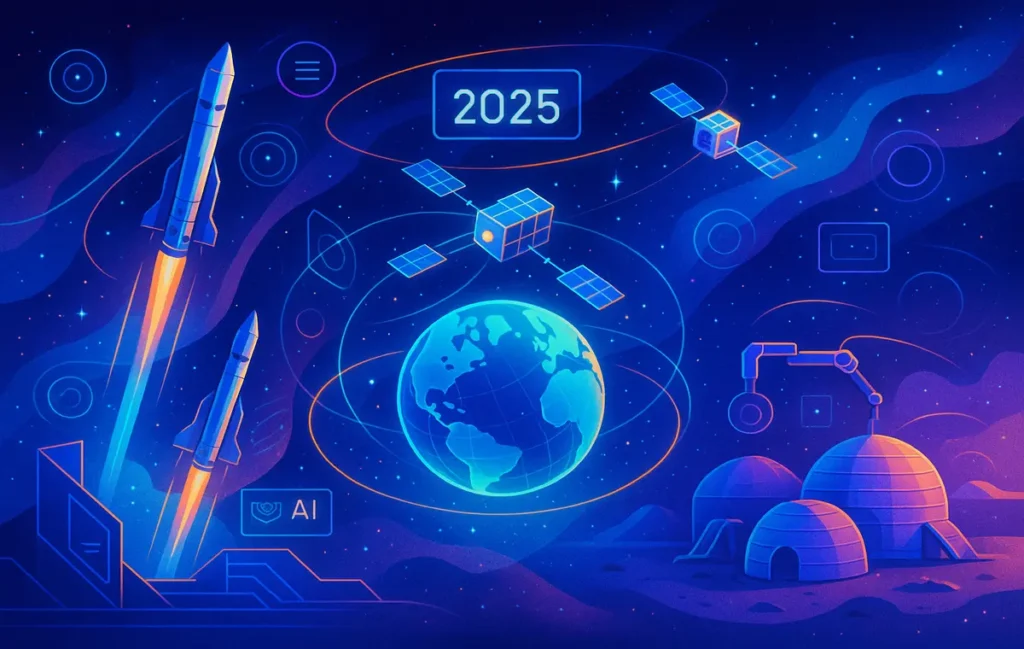
2025 is shaping up to be a historic year for space technology. What was once confined to science labs and billion-dollar government programs has now matured into practical, scalable industries. From reusable rockets that slash launch costs, to AI-enhanced satellites orbiting Earth, and the dawn of lunar mining projects, space is no longer a distant frontier—it is becoming a powerful economic driver right here on Earth.
👩🚀 Context & Who It’s For
This deep-dive is for space enthusiasts, tech analysts, investors, and anyone curious about how space technologies will influence industries on Earth. If you’ve been following the Space Race 2.0, you know that private companies have transformed space from a government monopoly into a multi-billion-dollar innovation hub. But 2025 marks a turning point: breakthroughs in satellites, rockets, and in-orbit manufacturing are changing not just space exploration, but also the way we live and work every day.
🚀 Reusable Rockets Evolve Further
One of the most dramatic shifts in the space economy has been the evolution of reusable rockets. SpaceX has pushed reusability to new levels, routinely landing boosters and flying them multiple times with improved turnaround times. Blue Origin is following closely, and Rocket Lab has introduced recovery systems that make even smaller launches affordable.
The result? Launch costs are hitting record lows, enabling startups and universities to send satellites into orbit at a fraction of historical prices. Just as container shipping once democratized global trade, reusable rockets are democratizing access to space. This is not only fueling commercial missions but also government-backed lunar programs and private exploratory projects.
💡 Nerd Tip: Think of reusable rockets as the “low-cost airline” of space. Once access becomes cheap, industries you never expected will start building business models around orbit.
🛰️ Next-Gen Satellites: Small, Smart, and Everywhere
Satellites are undergoing a revolution. The days of massive, billion-dollar satellites are being replaced by constellations of smallsats, each equipped with advanced AI. These satellites can provide real-time monitoring of climate patterns, enable precision agriculture, and deliver mobile internet access in places previously unconnected.
The rise of AI-powered monitoring in orbit ties directly into global challenges like the AI vs Climate Crisis conversation. Satellites now predict hurricanes, monitor droughts, and even guide disaster response teams within minutes of an event. Meanwhile, companies like SpaceX are expanding Starlink Mobile Plans to deliver broadband-level internet to remote villages, airplanes, and even maritime fleets.
🤖 AI in Space Missions
Artificial intelligence isn’t just for Earth anymore. Onboard AI now powers autonomous navigation, predictive maintenance of spacecraft, and anomaly detection during deep space missions. For example, AI systems can identify malfunctions before astronauts even notice them, preventing catastrophic failures.
NASA and private firms are experimenting with machine learning models that optimize spacecraft energy usage, while predictive AI ensures satellites adjust their orbits to avoid collisions. As with Quantum Computing Breakthroughs, the goal is to process vast datasets in real time—critical when signals take minutes to travel between Earth and Mars.
💡 Nerd Tip: AI in space isn’t about replacing astronauts—it’s about reducing risks and making missions scalable without sending a thousand engineers to orbit.
🌙 Lunar Exploration & the Moon Economy
The Moon is back in the spotlight. NASA’s Artemis program is preparing for sustainable lunar exploration, while private companies are racing to offer lunar lander services. Beyond the science, the real driver is economic: mining lunar regolith for rare metals and even water, which can be converted into rocket fuel.
Private lunar missions are becoming more feasible thanks to lighter spacecraft, modular landers, and international collaboration. Investors now see the Moon as the first step toward a space-based economy that could rival industries on Earth.
⚡ Ready to Explore the Future of Space Tech?
From reusable rockets to AI-powered satellites, the space industry is booming in 2025. Don’t just watch—stay informed and get ahead of the curve.
🏭 Space Manufacturing & 3D Printing
Launching everything from Earth is inefficient. That’s why space manufacturing is a game-changer. 3D printing in orbit reduces payload dependency, allowing structures like satellite frames, solar arrays, and even parts for future space stations to be built in zero gravity. This not only saves cost but also enables designs that would be impossible under Earth’s gravity.
Startups are experimenting with producing fiber-optic cables and pharmaceuticals in microgravity—materials that are purer and more efficient than anything produced on Earth. Just as Green Tech Innovations reshape sustainability on the ground, space manufacturing is reshaping what we can produce above it.
🛡️ Defense & Security Dimension
Space is also a battlefield. Anti-satellite technologies, orbital traffic management systems, and cyber-defense of space infrastructure are now central to national security. With thousands of satellites crowding Earth’s orbit, preventing collisions and cyberattacks has become as important as the missions themselves. Governments are working with private companies to regulate orbital lanes and protect assets from interference.
🌍 Impact on Earth Industries
The ripple effects of these innovations are massive. Farmers in Africa can access precision agriculture data. Shipping companies can track vessels in real time. Disaster management teams receive live images within minutes of floods or wildfires. Financial markets rely on satellite-based timing and data relay.
Space technology has shifted from “science fiction” to a backbone of global trade, communication, and safety. And in 2025, its influence is only accelerating.
📊 Mini Case Study: Nanosatellites and Agriculture
A wave of nanosatellite startups has transformed agriculture by offering affordable, high-frequency climate and soil data. Farmers in developing countries now optimize planting schedules and water usage with satellite-driven insights. This has not only boosted crop yields but also reduced resource waste—a powerful example of how space tech creates tangible benefits on Earth.
🔧 Troubleshooting & Pro Tips
One of the biggest challenges remains space debris. Innovative cleanup satellites are being designed to capture and deorbit junk. Another issue is cost, but joint collaborations between governments and startups are making launches more accessible. For companies looking to leverage satellite data, the tip is simple: focus on integration. Raw data is everywhere, but competitive advantage comes from interpreting it within your business workflow.
Want More Smart AI & Tech Insights?
Join our free newsletter and get weekly updates on AI, future tech, and space innovations—straight to your inbox. No fluff. Just high-quality insights from NerdChips.
100% privacy. No spam. Only value-packed future tech updates.
🧠 Nerd Verdict
Space innovations in 2025 prove that the cosmos is not just a destination—it’s an active engine of change for industries on Earth. From satellites that fight climate change to rockets that make space accessible, the transformation is here, and it’s only getting started.
❓ FAQ: Nerds Ask, We Answer
💬 Would You Bite?
If you had the chance to invest in a space startup, would you bet on the future of satellites or on lunar exploration?
Crafted by NerdChips for creators, analysts, and dreamers who want to understand the industries shaping our future.