🚀 Intro:
For years, “true” wireless power felt like sci-fi teaser reels—cool demos, slow rollouts, and lots of caveats. 2025 is different. Between next-gen Qi2 fast wireless, room-scale power delivery pilots, and multi-device magnetic docks hitting retail, we’re finally crossing from pad-bound trickle charge to practical, distance-aware wireless energy. This is a news-driven, analysis-first brief on what changed, why it matters, and how soon you’ll feel the difference at home, at work, and in your bag. NerdChips style: plain English, zero hype, actionable takeaways. Recent standards updates and deployments point to a near future where your phone, earbuds, wearables, and low-power sensors sip power all day—no cables, no juggling.
👥 Context & Who It’s For
If you’re a regular user tired of cable clutter, a smart-home tinkerer planning your next upgrade, or a product manager eyeing the post-USB world, this explainer will help you separate ready-now from almost-there. We’ll unpack the headline breakthrough, then place it in a practical roadmap: what you can buy today, what’s piloting in the field, and what’s still lab-only. Along the way we’ll point to helpful deep dives like Pro Tips for Maximizing Your Smartphone’s Battery Life, Best Portable Power Banks with Fast Charging, Best Smart Home Gadgets Under $100, and our perspective piece Battery Breakthrough for chemistry-side advances.
🆕 What’s New in This Breakthrough?
The 2025 story is really three breakthroughs converging:
-
Qi2 goes from logo to lived reality. The Wireless Power Consortium’s Qi2 spec—built around magnetic alignment—moved from 15W “good alignment” pads to Qi2 25W profiles, improving speed and efficiency while reducing heat and charge-position fuss. Accessory makers are shipping multi-device magnetic docks that deliver full-speed phone charging alongside watch and buds, a quality-of-life bump you feel every day.
-
Room-scale power gets real deployments. Long-range (far-field) systems that deliver several watts across room distances—enough for smart displays, sensors, tags, and certain handhelds—are moving beyond pilots. Infrared and RF approaches secured funding, partnerships, and commercial rollouts in targeted venues like retail, hospitality, and offices. Think autonomous trickle charging for the devices that die when you need them most.
-
Academic & regulatory tailwinds. Research into auto-tuned resonant rectifiers and adaptive control improved conversion efficiency and robustness—important for variable distances and orientations—while regulatory bodies continued clarifying over-the-air power limits. In parallel, key RF systems secured U.S. approvals that removed legacy distance caps, opening the door for broader trials.
In short: near-field got faster and smarter, far-field left the lab, and the policy/efficiency pieces are snapping in. That’s a real step change.
🔬 How It Works (Plain-English Edition)
Near-field wireless—what your phone already uses—relies on magnetic induction/resonance: two coils (pad and device) couple magnetically to transfer power efficiently at close range. Qi2 adds a magnetic alignment ring so the coils line up perfectly, bumping efficiency and reliability at higher power. The result: less heat, more speed, fewer misalignments, and smarter multi-device layouts on a single stand.
Far-field wireless delivers power across meters, not millimeters, using infrared beams or radio waves. These systems locate a receiver (a tiny photovoltaic or RF harvesting chip) and steer power safely as devices move. Power levels are lower than near-field fast chargers but high enough to top up wearables, badges, sensors, or signage without any user action. Think: your smart sensors never need battery swaps, your low-power gadgets auto-drink from the room. Commercial examples include IR-based systems with several-watt room-distance delivery and RF systems cleared by regulators for operation beyond the old 1-meter limits.
A third leg—resonant innovation—sits in between: researchers are improving the power electronics that auto-tune on the fly, maintaining high efficiency as distances and orientations shift. Expect these smarts to propagate into both pad-based and room-scale products over the next cycles.
📱 Why It Matters for Consumers
This is the first year an average user can feel stacked convenience gains. Desk and bedside chargers jump to 25W magnetic Qi2, cutting charge time and hot-spot frustration. Three-in-one docks streamline your nightstand and travel kit. Meanwhile, as far-field rolls out in offices and stores, expect ambient trickle charging for badges, sensors, and certain accessories—devices that used to die at the worst moments. Your day becomes passively powered: charge happens in the background as you move through spaces designed to keep gadgets topped up. For homes, it’s a step toward cable-lite rooms where your essentials find power the way Wi-Fi finds your phone.
This also intersects with sustainability and safety. Better alignment and standards mean less waste heat and fewer junk accessories. Ambient charging for IoT reduces battery swaps and maintenance trips. And the new approvals and safety frameworks are helping the industry converge on consumer-appropriate power levels with defined exposure rules—a prerequisite for mainstream adoption.
💡 Nerd Tip: First upgrade? Replace your pad with a Qi2 magnetic stand and pick a 3-in-1 dock so every daily-carry device has a parking spot. The best workflow is the one you actually use.
🧱 Challenges Still Ahead
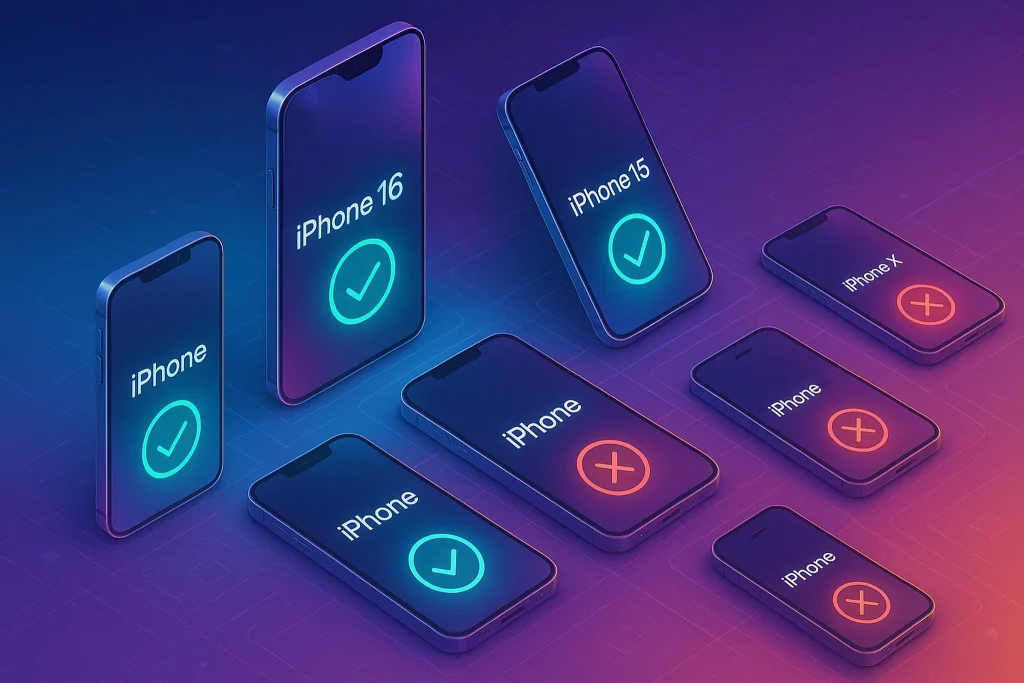
Standardization. Qi2 creates a clean baseline for phones and accessories, but ecosystem quirks remain across brands and watches. Multi-device docks can advertise 25W only when paired with Qi2.2-capable phones, and watch/buds charging still travels in proprietary lanes depending on the brand. Expect the WPC to keep pushing alignment on power profiles across vendors through 2025–26.
Safety & regulation. Far-field systems must thread a needle: useful power at a distance within exposure limits, with beam-steering and failsafes. Regulators have already granted notable approvals removing earlier distance caps for certain systems, but venue-class deployments (retail, offices) will likely precede full home-grade emitter products. Patience pays here; better to ship safe and reliable than rush.
Cost & adoption. Room-scale power needs infrastructure—emitters on ceilings or walls, receivers in devices. Early wins will focus on high-ROI sites (e.g., stores eliminating battery maintenance) before mass-market home kits arrive. Meanwhile, Qi2 adoption depends on device makers enabling the full spec and accessory makers dialing thermals and magnets with care. Still, momentum is clearly up and to the right.
💡 Nerd Tip: When you buy, look for the exact Qi2 version and wattage claim on the box, not just “MagSafe-style” phrasing. Specs matter at the 25W tier.
🧭 Industry Players Driving the Shift
On the near-field side, the Wireless Power Consortium and mainstream brands are pushing Qi2 15–25W onto phones and docks. Accessory leaders are already shipping 3-in-1 magnetic stations with full-speed phone charging—an important proof point that the spec is more than press releases. Expect more foldable travel versions and desktop stands through the holidays.
In far-field, companies using infrared and RF have turned corner cases into deployments. Infrared systems tout several-watt room-distance delivery with commercial installs and new capital to scale, while RF pioneers secured broad FCC authorizations that allow operation without the old distance limit, critical for real-world use. These aren’t phone-fast chargers; they’re perpetual-power layers for the small stuff that keeps smart spaces smart.
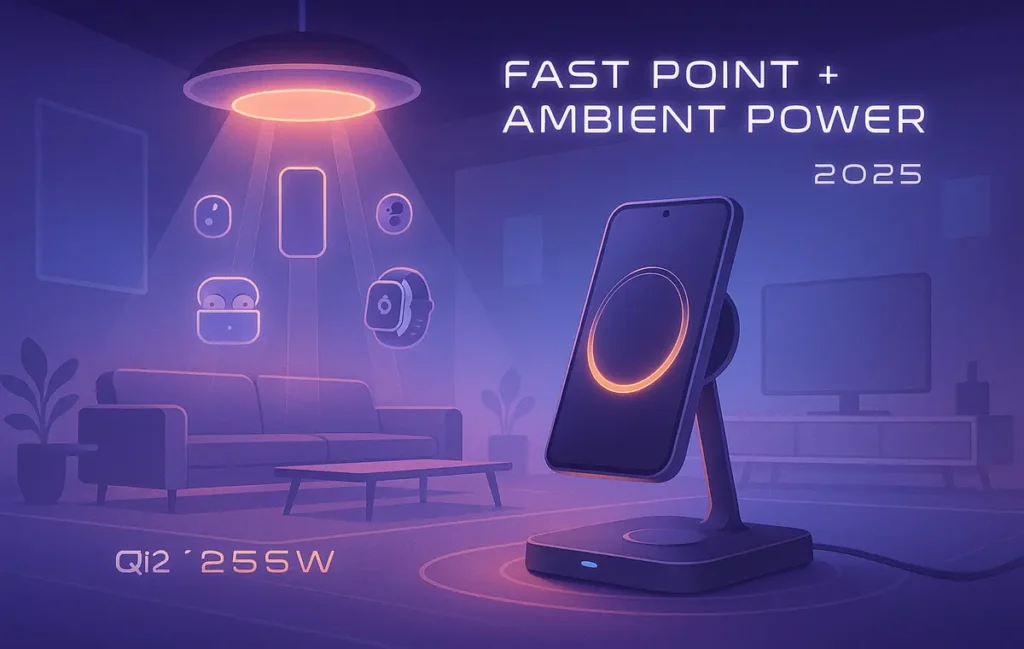
💡 Nerd Tip: Watch for hybrid spaces: Qi2 pads where you sit + far-field in the ceiling. Sit down and you get fast charge; move around and your accessories quietly top up.
🛣️ The Road Ahead: 2025 and Beyond
By late 2025, the default premium setup at home will likely be Qi2 25W stands and docks for phones/earbuds/watches, with multi-device magnetic alignment and cleaner thermal behavior. In offices and retail, far-field trials expand, powering digital signage, sensors, and wearables so maintenance crews stop swapping coin cells all day. If the current pace holds, we could see consumer-friendly room emitters for specific categories (e.g., smart remotes, peripherals) entering early-adopter channels in 2026. The endpoint is obvious: your devices choose power the way they choose networks—automatically.
For context on how this intersects with screens, materials, and charging behavior, pair this with The Future of Displays and Pro Tips for Maximizing Your Smartphone’s Battery Life. Better displays and smarter power habits compound the benefit of these charging advances.
⚡ Ready to Build Smarter Workflows?
Level up now with Qi2 25W stands and compact 3-in-1 docks, then plan room-scale power for your sensors and displays. Start simple, scale smart.
⚖️ Quick Reality Check
| Wireless Power Mode | Realistic 2025 Use | Power Level | Distance | Buyer Advice |
|---|---|---|---|---|
| Qi2 near-field | Daily phone/watch/buds charging | Up to 25W phone-class | Millimeters (magnetic align) | Great now: upgrade pads to Qi2 |
| Far-field IR/RF | Sensors, signage, small accessories | Several watts (IR), mW–low W (RF variants) | Meters/room | Watch pilots; venue installs first |
| Resonant R&D | Efficiency improvements | Better conversion across offsets | Near/short range | Tech will fold into consumer gear |
🧪 Mini Case Study: A Cable-Light Office With a Central Wireless Hub
A mid-size startup retrofitted a conference floor: ceiling emitters feed tabletop sensors and status displays, while desks got Qi2 25W stands. Result: no more dead meeting panels or lost remotes, employee phones top up between calls, and facilities stopped weekly battery swap-runs. Even though laptops still rely on cables for fast top-ups, the annoying 20% battery moments vanished. The economics worked because the far-field layer removed recurring labor and the Qi2 layer boosted everyday convenience. That blend—ambient trickle + point-fast—is what we’ll see win repeatedly.
🛠️ Troubleshooting & Pro Tips
If your current wireless setup feels slow or hot, it’s likely an alignment or spec issue. Upgrade to Qi2 hardware for tighter coil placement and cooler operation; you’ll feel the difference immediately at 25W. If multi-device docks charge your phone fast but watch/buds slow, that’s not a bug—watch standards remain brand-specific. Choose docks with explicit watch support rather than generic “3-in-1” claims. For compatibility, look for Qi2 logos and device-specific certifications (especially for watches). If you’re designing a smart space, consider hybrid chargers: a desk-level magnetic stand for fast bursts and a room emitter to keep low-power accessories topped off.
💡 Nerd Tip: Do a one-week power audit: where do devices routinely die? Solve those first with Qi2 stands (desks/bedside) and plan ambient power for sensors later.
🧭 Comparison Notes
This is a news + strategy piece about the wireless charging breakthrough—speed, distance, and multi-device. If you’re optimizing day-to-day runtime, hop to Pro Tips for Maximizing Your Smartphone’s Battery Life. If you need mobility backups, check Best Portable Power Banks with Fast Charging. For house upgrades that play nicely with always-powered sensors, see Best Smart Home Gadgets Under $100. And for the chemistry side of the equation, Battery Breakthrough gives the materials context that will pair with these power delivery advances.
📬 Want More Smart AI Tips Like This?
Join our free newsletter and get weekly insights on AI tools, no-code apps, and future tech—delivered straight to your inbox. No fluff. Just high-quality content for creators, founders, and future builders.
🔐 100% privacy. No noise. Just value-packed content tips from NerdChips.
🧠 Nerd Verdict
2025 is the year wireless power stops being a niche convenience and starts becoming infrastructure. Qi2’s 25W momentum cleans up daily charging, while far-field pilots prove that rooms can quietly keep the little things alive. The winning pattern is a layered ecosystem: fast point charging where you sit, ambient power where you move. Do that well, and “low battery” becomes a rare event—exactly the kind of calm tech we want at NerdChips.
❓ FAQ: Nerds Ask, We Answer
💬 Would You Bite?
If you could only change one thing this month, would you upgrade to a Qi2 25W dock at your desk—or pilot an ambient power zone in your living room for remotes, sensors, and small displays?
Crafted by NerdChips for creators and teams who want their best ideas to travel the world.