🎥 Intro
If you’ve ever launched a video campaign that “felt” good but died in the first 48 hours, odds are the problem wasn’t your offer, funnel, or targeting. It was the hook.
Across different ad accounts, media buyers consistently see the same pattern: 60–80% of campaign underperformance can be traced back to a weak first 3 seconds—scroll-stopping power is either there or it isn’t. And yet most brands still test hooks the expensive way: full campaigns, full budgets, weeks of waiting.
5-second poll ads flip this logic.
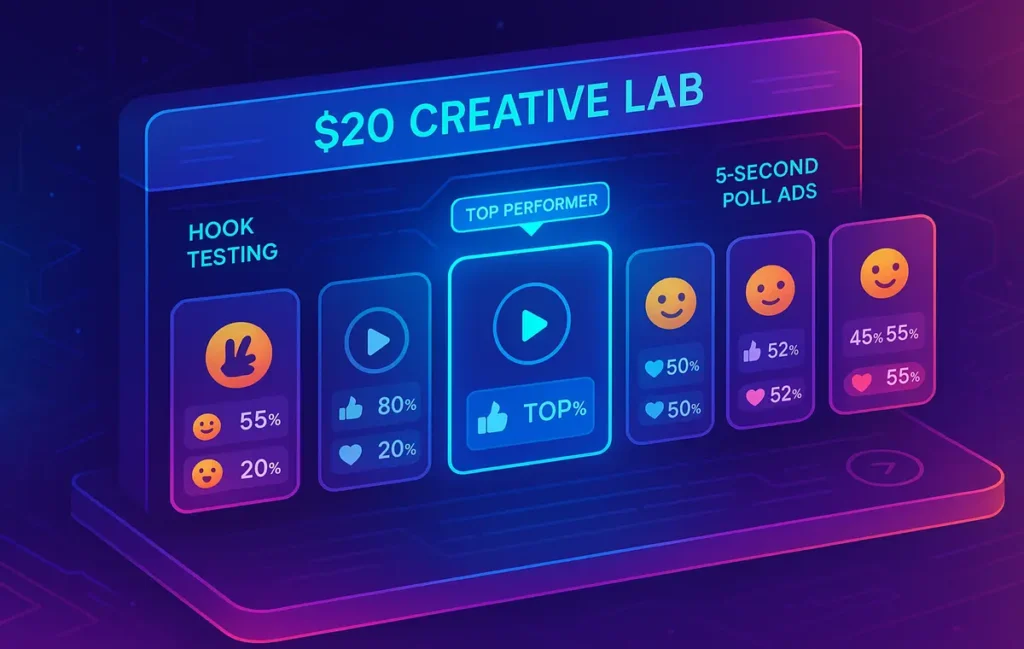
Instead of paying for full views and conversions just to discover that your hooks are trash, you use cheap, fast micro-tests to compare hooks side by side. With about $20, you can run a clean poll ad, test 3–5 hooks, and walk away with a clear winner you can confidently build your full video around.
In this playbook, we’ll walk step-by-step through a low-budget, data-first creative testing workflow you can plug into your video marketing system—something you can easily layer on top of your existing video funnel and A/B tests. By the end, you’ll know exactly how to:
-
Design 5-second hooks that are testable
-
Turn them into poll ads on Meta/TikTok/YouTube
-
Read the signals beyond just CTR
-
Pick a dominant hook and scale it into your main video
Along the way, we’ll also connect this with your broader testing stack—things like classic A/B testing for full videos and using AI to optimize your hooks so your whole system stays coherent, not random.
💡 Nerd Tip: Treat poll ads as your creative lab, not your final battleground. You’re buying clarity, not conversion.
🎯 Why 5-Second Poll Testing Works (And Why It’s Better Than Traditional A/B)
Traditional creative testing goes like this: build two or three full videos, launch A/B tests, wait for enough spend to get statistically safe, and then draw conclusions. It’s powerful, but it’s also slow and expensive. You’re using heavy artillery just to figure out which first sentence your audience prefers.
Poll ads collapse this process into a lightweight simulation.
Instead of paying for full impressions optimized for conversions, you’re asking a focused question:
“Which of these hooks makes you most curious to watch the rest?”
In a 5-second poll ad, your audience isn’t watching a whole video. They’re seeing the first 3–5 seconds—your hook snippet—and then answering a simple poll. That lets you measure perception-based signals instead of waiting on outcome-based signals like purchases.
Perception-based signals answer questions like:
-
“Which hook sounds most relevant to me?”
-
“Which framing feels more trustworthy or exciting?”
-
“Which promise cuts through the feed noise right away?”
A/B testing full videos still matters. It tells you about hook + body + CTA as a system. But hook resonance—that instant “this is for me” moment—is often best isolated and tested in a vacuum. By separating hook resonance from hook performance, you can fix the biggest problem first and let everything downstream work with a stronger starting point.
Another reason this works so well on a $20 budget: the metric you care about isn’t conversions, it’s preference. You don’t need thousands of impressions to sense a clear winner. When one hook gets 45–60% of votes in a poll while others hover at 10–20%, that gap is often enough to justify building your main video around it and then validating it with a more standard A/B test of your full video content.
On NerdChips we love blending this method with classic experimentation frameworks—if you’re already running structured tests and comparing creatives, adding a 5-second poll layer gives you cleaner inputs before you hit “publish” on a full-funnel campaign.
💡 Nerd Tip: Use poll ads to narrow from 10 ideas → 3 hooks → 1 hero, then use your normal A/B testing to refine the full video.
🧠 What You Need Before Running the Test
You don’t need a polished campaign to start testing hooks. You need ingredients.
First, draft 3–5 hook variations that express different angles of the same offer. One might be pain-driven (“You’re wasting 70% of your ad budget on the first 3 seconds”), another aspirational (“Turn $20 into a six-figure ad learning machine”), another curiosity-driven (“Most brands skip this $20 test and regret it later”). The point is to encode different emotional and strategic angles into your tests, not small wording tweaks.
You also don’t need full videos. For poll ads, a 5-second snippet is enough. That can be a tight crop of your face talking directly to camera, a bold text animation, or a quick pattern-break visual that includes your main line. Think of it as a trailer for your hook, not the movie.
Next, think about your audience choice. For hook testing, broad cold audiences usually beat ultra-narrow targeting. You want to understand: “Among people who could theoretically buy from me, which message wakes them up?” For some brands that means broad demographic + one or two interests. If your niche is tighter, you can set what we’ll call Layer 1 Interest Targeting: one main interest or behavior that defines your market, not a stack of five.
When choosing your campaign objective, pick Engagement or Poll (where available) rather than conversions. You want the algorithm to find people who interact with your creative, respond to questions, and give feedback quickly. Conversion-optimized campaigns are great once you know your winning hook, but for this early stage they’ll just slow down your learning and make your test more expensive.
Finally, avoid two common mistakes:
-
Overcomplicating the creative – fancy edits, transitions, and B-roll are not the point. The clearer and simpler the hook snippet, the easier it is to compare.
-
Using warm or custom audiences for hook tests – retargeting pools, lookalikes based on loyal customers, or past buyers will produce biased results. They already know you. Hook tests should reflect how cold people react when they have zero context.
If you already use AI to refine your hooks, you can plug that in here too. Tools that help you optimize video hooks with AI can give you dozens of phrasing options; your job is to select a handful that make sense strategically, then validate them with real users.
⚙️ Step 1 – Prepare Your Hooks for Testing (The 5-Second Rule)
The 5-second rule in this context is simple: if your hook doesn’t create curiosity, tension, or clarity in 5 seconds, it’s not ready.
Start by writing hooks as plain sentences before thinking about visuals. You want each hook to feel like a strong opening line on its own. Ask:
-
Does this expose a painful truth?
-
Does it clearly promise a valuable outcome?
-
Does it plant a question that the viewer wants answered?
From there, compress each hook into a 5-second delivery. That usually means one sentence, maybe a micro add-on like a number or a timeframe. You can record it as a face-to-camera clip, or overlay it as bold text over simple footage.
A practical workflow many growth teams use:
-
Brainstorm 15–20 raw hooks based on different angles: pain, desire, curiosity, pattern-break, contrarian take.
-
Use AI tools to polish and expand those raw lines into variations—this is where an AI hook generator can help you turn one idea into multiple clean options in seconds.
-
Choose the best 3–5 based on strategic fit, not just cleverness.
If you’re already experimenting with AI to optimize hooks, this is where it shines. You can ask your AI stack to transform a single idea into different emotional tones and reading levels, then pick the ones that best match your target customer’s mindset.
💡 Nerd Tip: Your goal is not “5 hooks that sound cool.” Your goal is “5 hooks that each represent a different mental door into the same offer.”
Once you’ve picked your finalists, create quick clips for each:
-
One 5-second shot per hook
-
Clear text on screen reinforcing the line
-
Obvious visual contrast between hooks (different framing, background, or motion) so they feel distinct inside the poll
Keep your production friction low. Done and testable beats perfect.
⚙️ Step 2 – Create the Poll Ad (Platform-by-Platform Walkthrough)
Now that you’ve got your hooks, it’s time to turn them into a poll ad. The logic is similar across platforms, even if the UI is different.
🟦 Meta (Facebook & Instagram)
On Meta, you’ll usually create a campaign with an Engagement objective and then choose a Post Engagement or Poll-style format where available (this changes slightly as Meta updates the interface, but the core is the same).
You’ll upload your short video creative—your 5-second snippet—and then configure a poll overlay with 3–5 answer options. Each option is simply the text of your hook, or a short label that clearly maps to it. The viewer sees the video, then the poll choices, and taps on the one that resonates most.
Budget-wise, you can assign $20 total to this test ad set, running over 1–2 days. That’s often enough to collect a few hundred impressions and a meaningful set of poll responses. You’re not chasing perfect statistical significance, you’re looking for a clear trend.
🎵 TikTok Poll Ads
TikTok supports interactive poll-style overlays as well. The logic is similar: upload your 5-second snippet (or a slightly longer clip with the hook front-loaded), add a poll sticker with your hook options, and deploy with an engagement-oriented campaign.
TikTok’s feed is even more brutal than Meta, so hook testing here can be especially valuable. The platform rewards immediate watch time and strong opening moments, so seeing which hook gets people to stop and tap is a powerful early signal.
▶️ YouTube Shorts Workaround
YouTube doesn’t always give you a clean “poll in video ad” format depending on region and ad type, but you can still test hooks with a two-part workaround:
-
Run a short ad or organic Short with your 5-second hook at the start.
-
Pair it with a community poll or post-level poll asking which version viewers would watch.
It’s less integrated than Meta or TikTok, but if YouTube is your primary channel, this still gives you a way to compare hook resonance before you pour budget into full pre-roll ads.
Whatever platform you choose, remember: format and size should be vertical (9:16) by default for mobile feeds. Keep your text legible, avoid clutter, and ensure your poll buttons are easy to tap.
💡 Nerd Tip: Think of the poll as the “focus group form” built right into the creative. Make it stupidly simple to answer.
⚙️ Step 3 – Choose the Right Audience for Testing
Your hook test is only as good as the people who see it.
For most brands, cold broad will be your best friend here. That doesn’t mean no targeting; it means minimal but meaningful targeting. Set your location(s), language, and a broad age range that matches your market. If you must add an interest, add one or two that clearly define your category, not ten.
If your market is niche—say you’re targeting agency owners, SaaS founders, or e-commerce marketers—build a Layer 1 Interest Audience. That might look like “business owners” plus a key platform interest such as “Shopify” or “Facebook Page admins.” The goal is to keep your audience pool large enough for the algorithm to find different profiles that might resonate with different hooks.
What you should avoid:
-
Over-stacking interests (e.g., 7 different behavior filters) that make your audience tiny and weird.
-
Using Custom Audiences, such as past buyers or website visitors. These people already like you; their behavior won’t tell you how cold strangers react.
-
Narrowing by too many demographics at once unless your offer truly demands it.
Hook tests are not granular targeting experiments. They are message clarity experiments. You want to know which hook works in a realistic, future campaign environment, not which hook your warmest fans pick when they’re being nice.
If you’ve already built a full video funnel—top-of-funnel hooks, mid-funnel explainer content, bottom-of-funnel retargeting—this test simply feeds that machine. The winning hook from your poll becomes the front door of your funnel, while your other campaigns keep doing their job.
💡 Nerd Tip: If your poll results only look good for a tiny, over-engineered audience, you didn’t test a hook—you tested a corner case.
⚙️ Step 4 – Run the Poll Ad and Collect Data (Read Signals, Not CTR)
Once your poll is live, it’s tempting to stare at CTR and CPM like you would for a normal campaign. Don’t. For hook tests, your primary KPIs are poll-driven:
-
Poll Vote Share (%) – how many people choose each hook?
-
Decision Speed – how quickly do people respond after seeing the hook?
-
Negative Signals – skips, swipes, or short watch time that suggest “this doesn’t land.”
Imagine you spend $20 and get 300 poll interactions. Your results might look like this:
-
Hook A: 14%
-
Hook B: 18%
-
Hook C: 52%
-
Hook D: 16%
On paper that’s not a massive sample, but in practice, a 3x gap between Hook C and the others is a very strong signal. When you combine that with fast decision times—people vote immediately after seeing the clip—you’re seeing a hook that clearly resonates.
At this stage, think in terms of 3 decision criteria:
-
Clarity of Winner – Is there a hook with at least ~15–20 percentage points more vote share than the next best?
-
Consistency Over Time – As your poll gathers more data over a few hours, does the ranking stay stable?
-
No Red Flags in Behavior – Are people watching long enough to answer? Are you seeing engagement that feels organic, not driven by clickbait confusion?
In many tests, you’ll see a dominant hook within 6–12 hours of spend. You don’t need to wait until every cent is spent to start taking notes. Once a pattern emerges and stabilizes, you can earmark that hook as your leading candidate.
This is where it helps to have a foundation in A/B testing your video content more broadly. If you already know how to interpret experimental results, you’ll feel more comfortable trusting a small, focused poll test as a directional guide.
💡 Nerd Tip: The goal isn’t perfect math; it’s eliminating obvious losers before they burn $2,000 in your conversion campaigns.
⚡ Ready to Build Smarter Creative Workflows?
Explore AI workflow builders and automation tools that help you systemize hook testing, reporting, and content ideation—so your next $20 poll ad feeds a whole library of winning videos.
📊 How to Pick the Winning Hook (Decision Framework)
When the poll is done, you’ll usually have one of three outcomes:
-
One hook clearly dominates.
-
Two hooks are close, with a small edge for one.
-
Everything is clustered and inconclusive.
A simple way to think about your decision is through a 70/20/10 model:
-
70% of your future spend should go behind the Dominant Hook—the one that clearly won the poll.
-
20% of your spend can go behind a Runner-Up Hook that’s strategically different but still promising.
-
10% is your experimental budget for new hooks that weren’t part of this round or for small variations of the winner.
The Dominant Hook is the one with the clearest margin in your poll results and no behavioral red flags. That’s your main hero. You script your full video around it, design your opening visuals to match it, and make it the first line people see and hear.
Sometimes you’ll want a Hybrid Hook for longer-form videos—especially for YouTube. That means blending elements of two successful hooks. For example, you might combine the urgency of a pain-based hook with the aspirational promise of a desire-based hook. Your poll helps you understand which themes to mix:
“Most brands burn thousands on dead creatives. Here’s how to use a $20 poll ad to find your one winning hook before you spend real money.”
Finally, be ready to re-test periodically. Markets change, fatigue sets in, and what works today might fade in a few months. The beauty of a $20 test is that it’s cheap enough to run as a recurring practice, especially when you’re launching a new offer or entering a new market.
If your poll results are clustered with no clear winner, treat that as feedback: your hooks are too similar. Go back to your ideation step and stretch the angles more aggressively.
💡 Nerd Tip: The worst outcome isn’t “the audience picked the wrong hook.” It’s “the audience couldn’t tell the difference between your hooks at all.”
🔄 Real Workflow Example ($20 → Winner → Final Ad)
Let’s put this into a concrete example so you can almost copy-paste the process into your own workflow.
Imagine you’re promoting a course on video marketing for small brands. You come up with four hooks for a short ad:
-
“You’re wasting most of your ad budget in the first 3 seconds.”
-
“What if a $20 poll ad told you exactly which video hook to scale?”
-
“Stop guessing your video hooks—crowdsource the winner in one night.”
-
“Your next six-figure campaign starts with a 5-second test, not a 5-figure spend.”
You turn each into a 5-second clip, set up a Meta poll ad, and assign a $20 budget over 24 hours.
After spending $18, your poll looks like this:
-
Hook 1: 16%
-
Hook 2: 49%
-
Hook 3: 21%
-
Hook 4: 14%
Hook 2 clearly dominates. People love the idea of a tiny spend guiding a big decision.
You then:
-
Script a 30–45 second ad built around Hook 2. It opens with that line, shows a quick visual of the poll results, and then briefly explains the method.
-
Use your existing video marketing funnel structure to place this ad at the top of your funnel: cold traffic, optimized for conversions.
-
Keep Hook 3 as a retargeting angle in case you want variety later.
In many real accounts, tests like this result in noticeable CPM and CTR improvements when the winner moves into full campaigns. Even modest gains—say 10–20% better CTR and longer watch times—can compound across your funnel, making all your later optimization efforts more efficient.
This is also where having a good toolbox helps. If you’re already using top video marketing tools for brands—things like advanced editors, analytics dashboards, and AI copy assistants—you can plug poll-based insights into everything from your thumbnails to your video scripts.
💡 Nerd Tip: Screenshot your poll results and keep them in a “Creative Learnings” doc. Over time, you’ll see patterns in what your market consistently chooses.
🚀 PRO Mode: Automate Your Hook Testing with AI
Once you’ve run this process manually a few times, you’ll start to see where automation can remove friction.
First, on the ideation side: AI can help you generate dozens of hook variants based on one offer. You can feed it your best-performing hooks so far and ask for new versions that keep the same spine but approach the problem with different metaphors, numbers, or tones. We’ve seen teams use AI to reduce hook ideation time by 30–50%, then run poll ads to filter out the noise.
Second, on the analysis side: if you’re pulling poll results into sheets or dashboards, you can use AI to summarize sentiment and performance patterns. For example, your model can learn that “hooks with specific numbers and short timeframes consistently win polls,” and then recommend that style when you launch new offers.
You can even automate parts of the workflow with no-code and automation tools. For instance:
-
Use a browser automation assistant to export poll data.
-
Pipe results into a sheet via tools like Make or Zapier.
-
Have an AI layer generate a short “hook insights” summary after every test.
If you’d like a deeper dive on the AI side of things, the way you use AI to optimize video hooks—from raw line generation to real-time refinement—can sit directly on top of this poll-based method. Polls give you the ground truth; AI helps you generate and sharpen candidates faster.
💡 Nerd Tip: Don’t let AI pick winners. Let real humans vote. Use AI to propose, compress, and summarize—people still decide what resonates.
🟩 Eric’s Note
I don’t believe in magic bullets, but I do believe in cheap clarity. A $20 poll ad won’t fix a broken offer—but it can stop you from wasting a month pushing the wrong hook uphill.
🧩 Connecting Poll Ads to Your Bigger Video Strategy
The power of this method really shows when you plug it into your wider strategy instead of treating it as a one-off hack.
If you’re already comparing different creatives and studying what works in A/B tests for your video content, think of poll ads as the layer that feeds that system. Instead of guessing which hook to put at the front of your best-performing video, you’re bringing in a hook that a real audience already voted for.
Similarly, if you’re building out a structured video marketing funnel, poll-tested hooks become your top-of-funnel entry points. You can categorize hooks into cold awareness, problem agitation, and solution promise angles, then decide where each belongs in your funnel.
The same logic stretches into discoverability. A hook that wins your poll might also inform your titles, descriptions, and even how you approach video SEO beyond YouTube. When you know which phrasing your audience picks in a poll, you’ve got language that’s likely to perform in search, social, and thumbnails too.
💡 Nerd Tip: Once a hook wins, don’t just rebuild the video. Update titles, descriptions, and even landing page copy to echo it.
📬 Want More Smart Creative Testing Playbooks?
Join our free newsletter and get weekly breakdowns on AI-assisted video hooks, low-budget testing frameworks, and high-leverage tools—curated for modern creators and lean teams.
🔐 100% privacy. No noise. Just battle-tested insights from NerdChips.
🧠 Nerd Verdict
If you’re serious about video marketing, a $20 poll ad should be part of your standard operating system, not an occasional experiment. It’s a simple, repeatable practice that upgrades everything built on top of it: your funnels, your full video tests, even how you brief AI tools.
On NerdChips, we see hook testing as the bridge between human intuition and data. Your gut tells you which ideas feel powerful. Poll ads let you ask a few hundred strangers if they agree—before you send real money into the battlefield.
Once you combine poll-based hook testing with systematic A/B testing for your video content, a solid video marketing tech stack, and smart AI-assisted ideation, you’re no longer “hoping” your hooks work. You’re running a creative lab—one that just happens to cost $20 a round.
As you turn this into part of your own system, remember you’re not just testing lines—you’re training your future self to think in hooks, structure, and feedback loops. That’s the mindset NerdChips was built for.
❓ FAQ: Nerds Ask, We Answer
💬 Would You Bite?
If you ran a $20 poll ad this week, which offer, product, or channel would you test first—your main evergreen offer or a risky new idea you’ve been sitting on?
And when that winning hook shows up in your dashboard, are you ready to rebuild your next video around it? 👇
Crafted by NerdChips for creators and teams who want their sharpest hooks to earn the views they deserve.