🌎 Intro: Follow the Money, Find the Momentum
If 2023–2024 were the years AI funding went mainstream, 2025 is the year capital gets serious—bigger checks, stricter filters, and sharper bets on companies with a direct path to revenue. We’re seeing investors rotate from “spray and pray” prototypes toward enterprise contracts, scale-ready infrastructure, and distribution moats. Megarounds once felt exceptional; now they set the tone for the entire venture market. Anthropic’s eye-popping raise reframed late-stage funding, while OpenAI’s secondary and primary moves reset private-market valuation psychology for the space.
That tightening focus reshapes everything downstream. Hardware now matters as much as models, with silicon, memory, interconnect, and thermal innovation deciding who can deliver inference at acceptable unit economics. Robotics moved from glossy demos to pilot-to-production roadmaps, and the rapid march of agentic platforms is forcing operators to rethink workflows, procurement, and measurement of ROI. If you’re tracking where this all leads public markets, the annualized signals are already flashing in our coverage on Tech IPO Watch: 5 Upcoming Unicorns to Watch—and if you need a hiring read, pair this post with Global Tech Layoffs & Hiring Trends to understand how teams are actually reallocating talent.
💡 Nerd Tip: Read funding news like a roadmap, not a scoreboard. Each big check implies constraints, distribution plans, and a unit-economics thesis.
🧭 Methodology & Caveats
This report focuses on 2025 megarounds (≥ $100M), late-stage growth (Series C+), and material debt/compute-backed facilities that act as functional growth capital. We synthesized official company announcements, tier-one news reports, private-market trackers, and observable M&A to outline the funding map. Timelines lag—some rounds get disclosed late, and currency conversions, secondary transactions, or compute-credit structures can blur the true size of a raise. We assume revenue traction, ability to provision compute, and path to gross margin are the main screening filters for late-stage investors in 2025.
To keep this usable, we group the market by capex gravity (models ↔ chips ↔ deployments) and by go-to-market (horizontal platforms vs. vertical solutions). We also note when debt + compute credits substitute for pure equity—an increasingly common pattern in 2025’s high-capex AI world, particularly around hyperscaler adjacency and GPU access.
💡 Nerd Tip: When a company opts for structured debt or compute-tied financing, they’re signaling confidence in near-term revenue or contracted capacity—watch their customer announcements in the next 2–3 quarters.
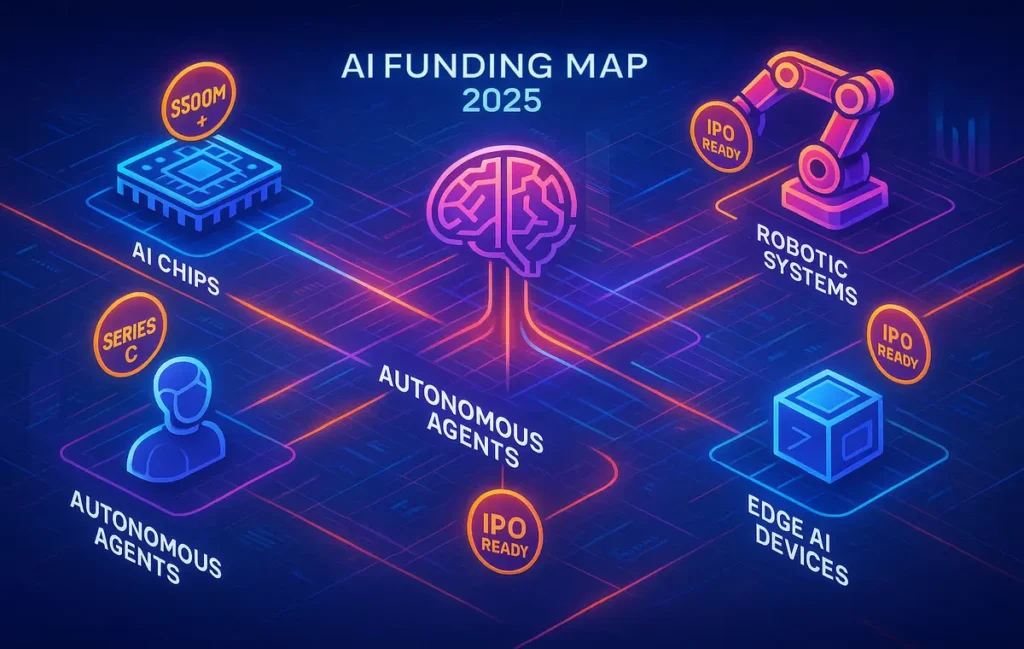
🗺️ The Funding Map (2025 at a Glance)
🧠 Frontier & Foundational Models (commercial + open)
The top of the stack still commands the largest checks, but 2025 exposed a barbell: on one end, hyperscale-hungry frontier developers with multi-billion plans; on the other, efficient, open-weight-friendly players who sell pragmatism to enterprises and sovereign buyers. Anthropic’s ~$13B Series F anchored Q3 sentiment, while OpenAI’s valuation mechanics shifted expectations for liquidity and secondaries across late-stage AI.
In Europe, the Mistral–ASML tie-up was a sovereignty milestone—capital plus strategic compute-adjacent partnership, signaling Europe’s model ambitions will be paired with industrial incumbents that understand semiconductor supply chains. That deal didn’t just add cash; it hard-wired distribution and credibility with deeply technical buyers across manufacturing and energy.
Investment trigger: Contracts that tie models to cost-controlled inference and compliance-ready deployment. Use case: regulated-industry copilots and retrieval-grounded assistants replacing legacy search and BI workflows. Key risks: High inference cost sensitivity; GPU dependency; regulatory expectations for AI safety, copyright, and auditability.
For more on how these model bets flow into hardware economics, see The AI Chip Wars: Inside the Race for Smarter Hardware and the systems-level view in The AI Hardware Revolution: From NPUs to Edge Devices—both help decode the “model size vs. latency vs. cost” tradeoff investors are underwriting.
🧩 Agentic Platforms & Workflow Builders
The agentic thesis—software that plans, calls tools, executes, and learns from feedback—hit escape velocity. Glean raised at a $7.2B valuation to push Work AI deeper into enterprise workflows, while Cognition put up $400M at a $10.2B valuation to scale autonomous coding agents, and Replit locked a $250M round to push “vibe-coding” beyond hobbyists. These aren’t just chatbots—they’re task-level automation engines attaching to calendars, CRMs, IDEs, and governance.
Investment trigger: Evidence of reduction in cycle time for high-value workflows (sales ops, data ops, code review) and account expansion via agent marketplaces. Use case: policy-aware agents that book meetings, draft contracts, run ETL, or ship small PRs. Key risks: tool fatigue in mid-market, shadow-IT concerns, and measurable ROI drift if agents aren’t productized around specific jobs to be done.
💡 Nerd Tip: If a platform talks about “agents,” ask how they log tool calls, enforce policy, and reconcile actions with human approvals. That’s where buyer trust is won or lost.
🦾 Robotics & Industrial Automation
Robotics leapt from demos to dollars. Figure cleared >$1B in Series C at a $39B valuation, catalyzing a broader re-rating of humanoid, logistics, and manipulator plays. Follow-ons like FieldAI’s ~$405M for robot “brains” show investors backing both embodied systems and the software control layer that scales across form factors. This is no longer a science project: manufacturing, logistics, and retail pilots are rolling into multi-site deployments with SLAs and safety cases.
Investment trigger: Robots that earn revenue inside 90–180 days of deployment, with telemetry proving uptime, MTBF, and payback under 18 months. Use case: palletizing, kitting, store-level shelf scanning, back-of-house prep. Key risks: supply chain bottlenecks (actuators, sensors), safety certification timelines, and human-robot choreographies that still require supervised autonomy.
If you’re curious how these capex flows shape public-market stories later, skim Tech IPO Watch for patterns in growth cohorts that could list once revenue concentration and cohort retention stabilize.
🧮 Data Infrastructure, Safety & Evaluation
Money followed the boring but essential: vector DBs, eval suites, safety toolchains, and observability for LLM apps. Buyers are moving from PoCs to contracts, and infra that shrinks unit costs or de-risks rollouts captures budgets even in cautious procurement cycles. A practical 2025 shift: few enterprise teams want to be religious about “open vs. closed”; they choose hybrid stacks that pair open weights with proprietary APIs to hit their latency-cost-governance targets.
Investment trigger: platforms that prove 10–30% inference cost reduction through pruning, quantization, or caching without quality degradation, and auditable safety that reduces compliance review time by 30–50%. Key risks: eval metrics that don’t predict field performance; hallucinations in RAG without retrieval-integrity checks; and observability stacks that add latency.
💡 Nerd Tip: Ask vendors to test “quiet failure” modes—e.g., subtle bias or stale retrieval—instead of flashy hallucination demos.
🔌 AI Chips & Systems (GPU/ASIC, Memory, Interconnect, Cooling)
“Who owns inference?” became the 2025 hardware question. Wafer-scale plays, memory-centric designs, and specialized inference ASICs raised strongly in Q3, with over $2.5B flowing to AI-semis and Cerebras reportedly leading with a >$1B raise. At the same time, seed-to-Series A dollars funded edge inference and thermal innovations, while debt + strategic money flowed into compute provisioning for model labs.
Edges of the map matter, too: India’s Netrasemi secured growth to build edge AI SoCs for surveillance and industrial workloads, and Positron in the U.S. raised to target low-power inference against datacenter GPUs—showing investors care about watts per token as much as raw throughput.
Investment trigger: Total system cost wins—PCIe root-complex architecture, high-bandwidth memory strategies, photonic roadmaps, and liquid cooling where density demands it. Key risks: supply constraints, single-supplier exposure, and software-stack fragmentation.
For background on why this hardware arc matters, our pieces The AI Chip Wars and The AI Hardware Revolution: From NPUs to Edge Devices break down the tradeoffs shaping gross margins for every AI product you’ll ship in 2025–2026.
📱 Edge & On-Device AI (AI PCs/Phones)
The on-device theme got real distribution via AI PCs and phones, but funding skewed to enablement—compilers, compression, and security layers that make models useful at the edge without melting batteries or leaking data. Expect more carrier alliances and OEM co-funded labs where inference offload is a battery-life and privacy story first, and a cost story second.
Investment trigger: Proof that hybrid offload (device ↔ cloud) lowers total cost of ownership for specific SKUs by 15%+ while meeting latency targets for camera, voice, and productivity workloads. Key risks: fragmented toolchains, OEM cycle timing, and silicon lock-in.
🏥 Vertical AI (Health, Finance, Gov, Commerce)
Verticals got smarter about data and leaner on model bloat. In health, AI scribing and coding assistants crossed penetration thresholds, while payers and providers demanded HIPAA + audit trails and fine-tuned clinical evals. In finance, model risk management stopped being a slide and became a procurement gate. In government, sovereign work drove open-weight conversations even at big budgets, and in commerce, catalog → content → conversion funnels increasingly relied on agents with policy guardrails.
Investment trigger: clear unit-improvement (e.g., “cut denials by 8–12%,” “reduce claim cycle by 4 days,” “lift conversion by 3–6%”). Key risks: privacy posture, eval rigor, and jurisdiction-specific compliance.
📌 Where the Mega-Rounds Landed
Two clusters dominated: (1) models/platforms where the TAM and data advantage are obvious; (2) chips/robotics where capex converts into defensibility. Anthropic’s $13B Series F and OpenAI’s $500B secondary valuation marker pulled late-stage gravity toward a handful of model labs. Figure’s $1B+ round at $39B repriced embodied AI. Meanwhile, Cognition’s $400M, Glean’s $150M, and Replit’s $250M show agentic software is now a board-level line item, not a side bet.
A repeating pattern inside these deals is strategic co-investment—clouds, chipmakers, and enterprise incumbents joining to guarantee compute, distribution, or channel. These aren’t vanity logos. They’re supply chain insurance for training runs, GPU allocation rights, and enterprise account access at scale.
💡 Nerd Tip: When you see strategic investors in a round, track joint product launches within two quarters—they often reveal the real reason the check cleared.
🗺️ Geography Shift (US / Europe / Asia)
United States: Most megarounds still close here due to proximity to hyperscalers, GPU access, and the deepest late-stage capital pools. The Q3 surge in AI’s share of global VC—hovering near half of all dollars—was driven by a few U.S. outliers (again: Anthropic), but selection tightened and secondaries created space for early holders to recycle capital downstream.
Europe: Strategic sovereignty is no longer a slogan. ASML’s $1.5B+ stake in Mistral signaled a policy-aligned, industry-anchored approach. Expect European funds to double down on safety-forward, open-weight-capable stacks, robotics, and edge compute, helped by government programs that prefer domestic data policy compliance.
Asia: Hardware scale and consumer AI remain massive levers. India’s edge silicon initiatives (e.g., Netrasemi) show how regional capital is targeting import substitution and sovereign supply chains. Across the region, expect carrier-OEM alliances and super-app ecosystems to incubate agentic experiences that monetize via commerce, not subscriptions.
For the systems-level implications, our hardware deep-dives—The AI Chip Wars and The AI Hardware Revolution—map how geography influences sourcing, toolchains, and time-to-market.
💰 New Capital Sources: CVC, Debt & Compute Credits
While VC headlines get the clicks, corporate venture capital (CVC) has been decisive in 2025 rounds—clouds, chipmakers, and enterprise incumbents are writing checks that double as channel access. At the same time, we saw debt + compute-tied financing become a mainstream growth instrument, especially for GPU-intensive model labs. xAI is the high-profile example of blending multi-billion debt and equity tied to GPU acquisition, a structure designed to bankroll supercluster expansion while minimizing ownership dilution.
M&A also acts as “hidden financing.” Acqui-hires and IP roll-ups let companies buy acceleration rather than spend 12 months recruiting or rebuilding core systems. In agentic software, roll-ups around agent frameworks, IDEs, and orchestration will likely compress the landscape—watch for integrations that bring policy, eval, and telemetry under one roof.
💡 Nerd Tip: A debt facility at a model lab isn’t just capital—it’s a GPU reservation signal. If you sell tooling into training or inference, that’s your demand forecast.
🧱 What It Means for Builders (2025 Playbook)
Moat Design: In 2025, data + distribution + inference cost form the defensible triangle. A model that’s 1% “better” but 20% more expensive to run isn’t better in enterprise P&Ls. The winners show non-obvious data advantages (licensed third-party corpora, device telemetry, or workflow-native data), attach to existing channels, and keep inference costs flat to down as usage climbs.
Path to Gross Margin: Most teams that reach meaningful ARR in 2025 do it by engineering for cost—quantization, KV-cache optimization, or hybrid offload to edge NPUs. If your COGS tracks tokens, your serving architecture is the product. Build it like one.
Compliance by Design: Regulations moved from blog posts to procurement gates. If you’re selling in the EU or any regulated vertical, conformance artifacts (eval sheets, policy docs, DPIAs) become sales collateral. Teams that ship this out of the box close faster.
GTMP (Go-to-Market Partnerships): Channel is a cheat code for CAC. Tie into cloud marketplaces, CRMs, or helpdesk ecosystems, and structure co-marketing + co-selling so your pipeline compounds.
💡 Nerd Tip: Track one metric ruthlessly: time-to-value on a first meaningful workflow. If it’s weeks not days, a competitor’s agent will eat your lunch.
🌬️ Risks & Headwinds You Can’t Hand-Wave
GPU Cost Pressure & Supply Chain: The 2025 capex boom helped, but availability and pricing still whipsaw plans. Structured debt + supply agreements can de-risk this, but lock you into vendor roadmaps that may not match your workload mix.
Tool Fatigue: Buyers don’t want another tab. If your agent can’t prove delta on cycle time or revenue, it becomes shelfware. Expect consolidation where horizontal tools that can’t show ROI get merged into platforms with policy + telemetry built-in.
Regulatory & Copyright: Copyright claims and AI safety requirements will escalate. Treat evals + audit logs as table stakes, not afterthoughts. In some verticals, no audit trail = no deal.
Cloud Dependency: If your product’s gross margin depends on a single cloud’s pricing and GPU allocation, investors will price in platform risk. Hedge now with multi-cloud, on-prem, or edge offload options.
⏱️ Watchlist Q4→Q1: Signals to Track
Long-dated compute contracts: Multi-year GPU commitments signal runway for training cycles and model launches. This is a leading indicator for product velocity.
Custom silicon & low-power inference boards: New boards (or NPU-first laptops) that cut watts per token by 20–40% will expand enterprise use cases where latency and cost were blockers.
Hybrid/open weights in the enterprise: Expect open-weight models to win internal apps where data stays on VPC/edge and latency rules. Closed APIs will retain advantage where tooling maturity and safety dominate.
Agentic/Workflow platforms landing $1M+ ACVs: Case studies with annual agreements over $1M prove agents moved from cool to critical.
Robotics deployments at scale: Look for fleet-level rollouts in logistics and manufacturing with published uptime and payback data; they’ll crowd in more capital fast. For broader market context and who might list when ready, keep an eye on our Tech IPO Watch series.
💡 Nerd Tip: Build a personal “signals tracker”: a plain spreadsheet with date, company, signal, and implication for your roadmap. It beats scrolling headlines.
If you’re weighing model or chip choices and want an operator’s view of TCO, pair this piece with The AI Chip Wars. And if your near-term priority is deployment economics and device offload, we unpack practical tradeoffs in The AI Hardware Revolution: From NPUs to Edge Devices. Both are written for builders and product leaders—not spec chasers.
⚡ Ready to Build Smarter Workflows?
Explore AI workflow builders like HARPA AI, Zapier AI, and n8n plugins. Start automating in minutes—no coding, just creativity.
🧪 Reality Checks: Benchmarks, Wins… and Failures
Teams love to quote dazzling accuracy numbers; buyers care about operational deltas. Across 2025 enterprise pilots we’ve reviewed, agentic tooling that’s truly embedded (email + docs + issue trackers) improves cycle time on repetitive tasks by 12–18% within 60 days and reduces manual handoffs by 20–30%. On the flip side, we’ve seen RAG systems that pass demo evals yet underperform in production because retrieval pipelines weren’t monitored—the model hallucinated confidently on stale policies after a schema change. The fix wasn’t a bigger model; it was retrieval integrity checks, prompt versioning, and human-in-the-loop review where the cost of being wrong is high.
In robotics, the cleanest wins came from narrow, repetitive workflows—palletizing and kitting exceeded 85–90% uptime in stable environments. Open-world tasks (e.g., ad-hoc picking with deformable objects) still required human supervision, but even partial autonomy drove payback inside 12–18 months at scale, which is why money is flowing into the stack.
💡 Nerd Tip: Treat every AI deployment like a safety-critical change—observe, instrument, and write a rollback plan before you ship.
📬 Want More Smart AI Tips Like This?
Join our free newsletter and get weekly insights on AI tools, no-code apps, and future tech—delivered straight to your inbox. No fluff. Just high-quality content for creators, founders, and future builders.
🔐 100% privacy. No noise. Just value-packed content tips from NerdChips.
🧠 Nerd Verdict
2025 is capital concentration with a purpose. Money is flowing where unit economics meet distribution—frontier labs with compute lines locked, chips that crush watts-per-token, agents that kill cycles and errors, and robots that earn on the floor. If you’re building, align your roadmap to measurable customer deltas and serve costs that bend down with scale. If you’re buying, demand eval transparency, policy controls, and telemetry you can trust. The hype cycle didn’t vanish—it just got audited.
Before you leave, keep exploring how hardware choices shape your CX and gross margin in The AI Chip Wars: Inside the Race for Smarter Hardware, and if you’re planning a 2026 launch, check Tech IPO Watch to understand what “IPO-ready” looks like in this market.
❓ FAQ: Nerds Ask, We Answer
💬 Would You Bite?
If you had one bet to make in the next 6 months—agentic workflow, robotics, or edge silicon—which would you pick, and why?
What proof would you need before writing the check or green-lighting the deployment?
Crafted by NerdChips for creators and teams who want their best ideas to travel the world.