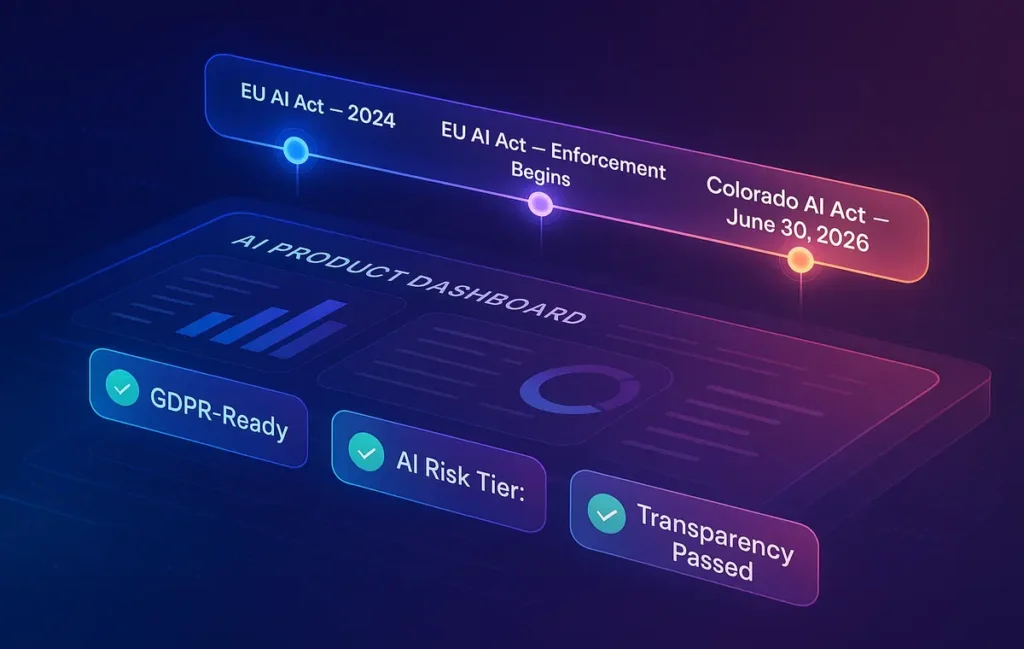
🧭 Introduction: 2026 Turns “Ship Fast” Into “Ship Compliant”
The era of shipping an AI feature and backfilling the paperwork later is over. In 2026, regulation catches up with product velocity. The EU Artificial Intelligence Act (EU AI Act) completes its staged rollout, US states move from talk to enforcement, and countries tighten privacy and provenance rules around deepfakes, model transparency, and data rights. For AI-tool builders—SaaS teams, vertical AI startups, marketplaces—this isn’t just a legal footnote. It’s a product requirement: the way you collect data, explain model behavior, monitor risk, and grant user rights must be designed into the experience, not stapled onto it.
This piece is a future preview, not a generic overview. We’ll pin down the 2026 deadlines that matter, outline how they interact with privacy, and translate them into product work you can start now. If you want a deeper foundation on today’s frameworks, keep our explainer on AI Regulation on the Rise: Understanding the EU AI Act and More open in another tab; this article assumes you know the basics and need a plan.
💡 Nerd Tip: Treat compliance as a feature. Done right, it becomes a trust moat that wins enterprise accounts while slower rivals scramble.
🌍 Why 2026 Matters for AI Tools & Privacy
2026 is when staggered obligations converge. In the EU, the AI Act’s earliest bans on prohibited practices arrive first, followed by general-purpose model duties, and then high-risk system obligations that bite hardest—creating a two-year pipeline that lands squarely in 2026. Official EU guidance confirms the cadence: entered into force August 1, 2024; some bans apply from February 2, 2025; general-purpose AI (GPAI) duties from August 2, 2025; fuller application and market enforcement across much of the Act by August 2, 2026.
Beyond the EU, governments are aligning or reacting. Colorado’s AI Act—the first comprehensive state law aimed at discrimination risks in “high-risk” AI—now takes effect June 30, 2026 (moved from February 1, 2026), and creates concrete duties for developers and deployers. Other US states are close behind, with 2025 seeing AI bills introduced in all 50 states and roughly 100 measures adopted or enacted. Expect a patchwork, not a single federal rule.
The UK is continuing its pro-innovation, regulator-led approach rather than a single statute, but sector regulators are sharpening expectations, and interoperability with the EU is a practical necessity for vendors selling on both sides of the Channel.
All of this lands on top of privacy regimes already in force (GDPR and its global cousins). The result is layered obligations: privacy rights (lawful basis, minimization, erasure) plus AI-specific duties (transparency, technical documentation, risk management, human oversight). For teams eyeing the EU or US enterprise, “we’ll fix it later” will not survive 2026.
💡 Nerd Tip: Budget for compliance engineering like you budget for infra. A rule of thumb we see in the field: 10–15% of roadmap capacity in 2025–2026 goes to trust & safety, logging, and explainability.
🗓️ Key Regulatory Milestones (Global, EU-Led)
The AI Act is the world’s pacing item. Knowing its calendar lets you sequence your builds.
| Date | What Happens | Why It Matters for Tools |
|---|---|---|
| Aug 1, 2024 | EU AI Act enters into force | Clock starts; phased obligations scheduled by law. |
| Feb 2, 2025 | Prohibited practices & AI literacy duties start (e.g., certain manipulative or social-scoring uses) | If you’re anywhere near risky features, sunset or redesign now. |
| Aug 2, 2025 | GPAI obligations begin; AI Office operational; penalties framework live | Model docs, training-data summaries, security, incident reporting start to bite. |
| Aug 2, 2026 | Full application across much of the Act; high-risk system duties broadly enforced; member-state regulatory sandboxes in place | If you sell into the EU with high-risk use cases, audits & post-market monitoring must be production-ready. |
| Jun 30, 2026 (US-CO) | Colorado AI Act effective (anti-discrimination duties for developers & deployers of high-risk AI) | “Reasonable care,” documentation, and notice obligations become enforceable; signals where other states may head. |
Two additional dynamics matter. First, the EU’s penalty regime is real: violations (especially banned practices) can draw fines up to €35M or 7% of global turnover. Second, EU guidance keeps arriving—e.g., practical pointers for models with systemic risk, and clarifications that there will be no blanket delays to the 2025/2026 dates. Plan for the law you see, not the grace period you wish for.
💡 Nerd Tip: If you’re an early-stage team, sandbox participation can de-risk launches and speed feedback from regulators ahead of 2026.
⚡ Ready to turn compliance into a sales advantage?
Use our Trust-by-Design checklist to map your AI features to 2026 duties—model registry, logs, user notices, and human-in-the-loop controls.
⚖️ What This Means for AI Tool Providers (Product, Legal, and Business)
Product & Data: You’ll need transparent feature flows where AI is used, consent or legitimate-interest reasoning for inputs, and user rights handling (access, deletion, contestation) built into UI and APIs. High-risk contexts (e.g., hiring/education/credit/health) will require risk management, human oversight controls, and post-market monitoring that captures incidents and user harm reports. That means instrumentation, not just policy docs.
Models & Monitoring: Expect to provide technical documentation, training-data summaries (for GPAI), model cards, and to run adversarial testing and bias/robustness evaluations at defined intervals. Build a living model registry—versioned models, datasets, evaluation suites, owners, and change logs—to make audit trails routine instead of panic projects.
Business & Market Access: Selling into the EU likely requires local representation and readiness for regulator queries; in the US, procurement teams—especially in regulated industries—will map your compliance posture against state requirements like Colorado’s. Budget matters: founders who ignore compliance until Q3 2026 will face launch slips or market exclusion, and fines at EU scale can be existential.
NerdChips’ take: the winners will pitch privacy-first, auditable AI—clear documentation, fast DPIA hand-offs, and dashboards that prove oversight. That turns compliance from cost center to sales enablement.
💡 Nerd Tip: Add “Compliance Definition of Done” to AI tickets: logging, user notices, evaluation run IDs, and rollback plans must be checked before shipping.
🧩 Practical Steps to Be 2026-Ready (A Builder’s Roadmap)
Start with classification: map your features to AI Act buckets—prohibited (shouldn’t ship), high-risk (strict controls), limited-risk (transparency duties), or GPAI obligations if you ship a general-purpose model or rely on one upstream. Maintain the map in your architecture docs so product and legal share a single truth.
Run a gap analysis against your current stack: what data you ingest, how it’s labeled, how you handle minors, what user notices exist, and how model outputs may create algorithmic discrimination risks (Colorado’s language). Tie each gap to a ticket with an owner and a “lands by” date aligned to the 2025–2026 calendar.
Build governance workflows that are boring and repeatable: an AI risk review before launch, red-team drills for abuse and safety, and post-market monitoring hooks that funnel complaints and model incidents into Jira with severity tags. Rotate a “responsible release” role per team—someone who signs off that logs, notices, and evals are in place.
Update policies and UX: privacy policy addenda for AI, in-product explanations (“how this feature makes decisions”), and contest channels. For education and campus pilots, align with duty-of-care expectations and be ready to demonstrate learning-safety guardrails—useful context alongside our forward look at AI in Education.
Finally, track clocks by market in your roadmap. A practical sequence we’re seeing:
-
By Aug 2025: GPAI obligations—model documentation, training-data summaries, incident reporting practices.
-
By early 2026: complete your high-risk controls if applicable; finish sandbox trials; stage DPIAs and vendor attestations.
-
By Aug 2026: enforcement-ready posture in the EU; by Jun 30, 2026: Colorado compliance if you touch “consequential decisions.”
💡 Nerd Tip: Put your EU, UK, and US compliance clocks into one calendar view, alongside product releases and customer renewals. It prevents last-minute collisions.
For context on how competition policy may intersect with AI platform power (access to data, self-preferencing), our analysis on Big Tech Antitrust can help you anticipate 2026–2027 pressures on marketplaces and model providers.
🪤 Risks & Pitfalls We’re Already Seeing (So You Can Avoid Them)
Betting on delays. Despite industry lobbying, Brussels has reaffirmed that the timetable stands. If your plan assumes a pause, you’ll be late.
Under-scoping costs. Teams underestimate observability needs for AI: feature flags, audit logs tying inputs to outputs, and long-term storage for regulator queries. Factor infra + headcount.
“EU only” mindset. The US patchwork means Colorado could be your first enforcement touchpoint even if you don’t sell in the EU. Build a base layer that satisfies both.
Ambiguity around GPAI and high-risk. If you don’t know which you are, you can’t scope work. Use the EU’s guidance for systemic-risk models and the law’s annexes to categorize now.
Deepfake & provenance blind spots. Countries are moving toward labeling obligations and penalties for unlabeled synthetic content (Spain’s 2025 proposal is a bellwether). If you render or host media, plan for labeling and provenance APIs.
💡 Nerd Tip: Your trust dashboard should show model version, last eval score, incidents open, last DPIA date, and top three mitigations—in one glance for account execs and auditors.
🔗 Where This Touches the AI Ecosystem (Strategy Notes)
Hardware matters because on-device AI can shrink data flows and reduce privacy exposure. NPU-equipped laptops and phones are getting strong enough to run local inference, shifting some risk from cloud to edge. For teams exploring this path, our primer on the AI Hardware Revolution highlights when edge helps with latency, cost, and compliance.
Sectors will feel different heat. Education and public sector pilots will prioritize transparency and bias posture—tie your product story to learning outcomes and safeguarding, not just automation speed. Our look-ahead on AI in Education shows how to frame that conversation so procurement doesn’t stall.
And yes, even gaming is in scope where AI shapes rewards, matchmaking, or moderation. If that’s your world, skim The AI Revolution in Gaming to see how design choices intersect with fairness and user rights.
💡 Nerd Tip: Compliance is a go-to-market asset. Include one slider in your deck: “What we comply with by when.” It shortens procurement cycles.
📬 Want weekly briefings on AI compliance & product?
Join the NerdChips newsletter for practical checklists, case studies, and tooling that make 2026 compliance your competitive edge.
🔐 100% privacy. No noise. Just value-packed content from NerdChips.
🧠 Nerd Verdict
2026 is the year AI products must prove they are safe, explainable, and accountable—not just clever. Teams that ship model documentation, risk controls, user rights flows, and clean logging will sell faster and sleep better. Those that stall will face bans, fines, or slow-motion churn from enterprise customers who can’t buy unmanaged risk. At NerdChips, we see a competitive edge in doing this early: it signals maturity and opens doors in regulated markets.
❓ FAQ: Nerds Ask, We Answer
💬 Would You Bite?
Which piece of your trust stack is least ready: model registry, risk testing, user rights UX, or post-market monitoring?
Tell us where it hurts—we’ll help you blueprint it. 👇
Crafted by NerdChips for creators and teams who want their best ideas to travel the world.