🎯 Intro
Audiences don’t want to sit back anymore—they want to tap, choose, and contribute. Traditional video is still powerful, but in a world trained by stories, choices, and immersive apps, “watch-only” is losing ground to “lean-in” formats. Interactive video platforms meet this shift head-on by letting you embed decisions, polls, shoppable hotspots, and forms directly into the experience. For marketers, that means the video becomes both a story and a funnel: you capture attention, you learn while they click, and you move qualified viewers toward actions that matter. At NerdChips, we’ve seen teams go from “views as a vanity metric” to a steady stream of first-party data, high-intent leads, and measurable revenue once they implement interactive layers with discipline.
This guide is your practical, tool-centric playbook for 2025: what interactive video does uniquely well, how to evaluate platforms, which vendors fit which use cases, and—most importantly—how to deploy them across your full video marketing funnel without creating a production bottleneck. We’ll stay deeply tactical so this post complements, not cannibalizes, your strategy piece on where the medium is headed. If you want the broader “why now?” context and future trends, you can later explore The Future of Interactive Video Marketing; here, we’ll focus on which platforms to use and how to put them to work.
🎯 Why Interactive Video Works for Marketing
Interactive video transforms view time into intent signals. When someone chooses a path, answers a poll, reveals a product hotspot, or finishes a micro-quiz, they’re not just watching—they’re telling you what they care about. That choice data is first-party by design. Teams that integrate these signals into their CRM often see qualification improve because leads are self-segmented by the very story they navigated. In performance terms, marketers commonly report double-digit gains: interactive mid-funnel experiences tend to lift completion rates, while in-video forms frequently convert warmer traffic at 10–25% higher rates than sending viewers to external landing pages. These figures vary by industry and execution quality, but the pattern is consistent: when the interaction feels native to the content, viewers reward you with attention and actions.
There’s also a cognitive effect at play. Interactivity boosts memory by prompting small decisions that anchor recall. This matters when you’re competing in a crowded category. By letting people tailor the narrative—choose a use case, pick their role, compare feature paths—you build relevance into the medium itself. The best results come when storytelling and UX are planned together. If you just bolt on a few CTAs after editing, it looks like an overlay. If you script interactions into the arc, you get a seamless journey that moves from curiosity to clarity to conversion.
💡 Nerd Tip: Treat every interaction like a question your buyer is already asking. If the choice screens don’t map to real customer dilemmas, people won’t click—and your data won’t mean much.
🧩 What to Look For in a 2025-Ready Platform
Marketers evaluating platforms should think beyond a feature checklist and map needs to the whole lifecycle: creation, distribution, data, and iteration. You want branching if you’re telling a multi-path story; you want native in-video CTAs and forms if lead capture is the goal; you want shoppable integration if you sell direct; you need analytics that explain behavior rather than just count clicks. Export flexibility matters more than ever since you’ll reuse assets across site, email, paid social, and ad networks. Teams working with privacy-forward stacks should confirm that event streams can flow into their CDP or CRM with proper consent tagging.
Data fidelity is a big differentiator. Basic dashboards show drop-off and engagement hotspots, which are useful for creative iteration. The leaders in this space go further with event-level logs that tie interactions to anonymous or known profiles, enabling scoring, retargeting, and message personalization later. Don’t overlook governance: bigger teams need role-based access, version history, and branded templates that prevent off-brand overlays. If you plan to scale output, template systems and dynamic components beat one-off projects every time.
💡 Nerd Tip: Ask vendors for a sample event stream or schema. If you can’t map clicks and choices into your funnel stages, your optimization loop will stall after month one.
🛠️ The Best Interactive Video Platforms in 2025 (Mini-Reviews)
Below are focused reviews to help you pick based on strengths. To keep this actionable, we’ll emphasize real marketer workflows rather than generic descriptions.
🎥 Wirewax — Branching Storytelling with Tight Analytics
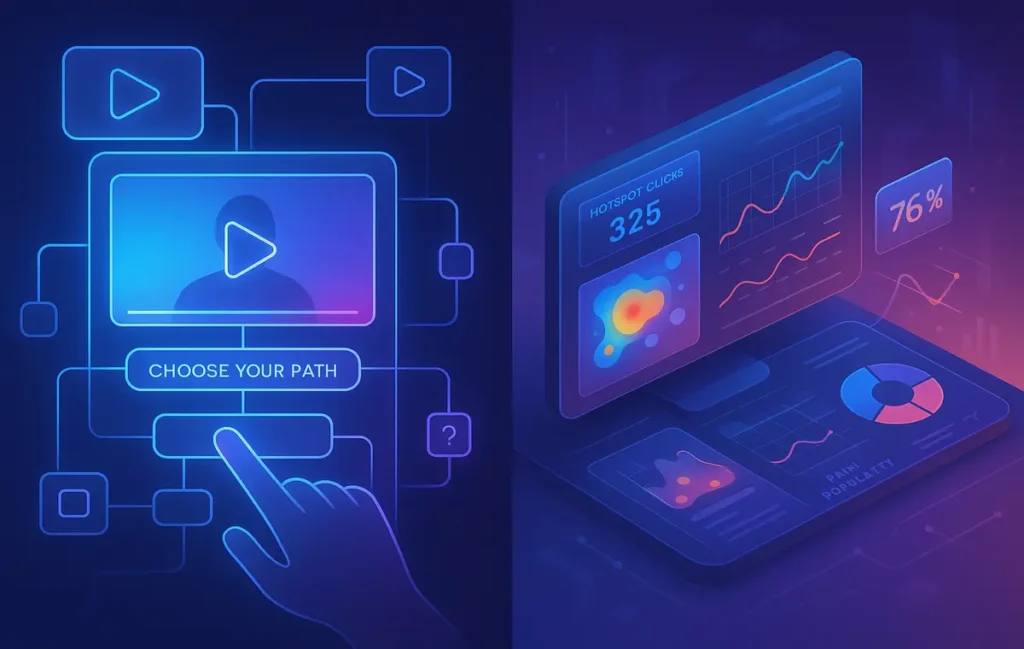
Wirewax has long been associated with cinematic, multi-path narratives. If your brand values storycraft and you want choices to feel like part of the film, Wirewax’s authoring tools and hotspot precision stand out. The analytics go deeper than “people clicked here” by showing path popularity, scene-level drop-offs, and where interaction intent peaks. Marketers use this to prune weak branches and re-cut scenes for momentum.
A typical workflow is awareness to nurturing: run a social cut that teases two choices, then drive to a hosted experience where a fuller network of branches lets viewers “build their own use case.” Leads captured via in-video forms push to your CRM with path data in the payload, enabling segmented follow-ups. Teams report that the first round of iterations—guided by hotspot heatmaps—often produces the biggest conversion lift, so plan time for a second cut.
🛍️ Wootag — Shoppable CTAs and Mobile-First Commerce
Wootag shines when the video is the storefront. Its tap-to-reveal product tags, quick-load overlays, and mobile-native layouts make it ideal for e-commerce, especially on paid social where speed matters. You can pin precise moments to product cards, capture email or WhatsApp opt-ins inside the video, and trigger discount codes for engaged watchers.
A marketer-friendly pattern is the lookbook funnel: sequence short scenes by context (work, weekend, travel), tag items in each scene, and let viewers assemble a cart without leaving. Because Wootag’s overlays are fast and minimal, bounce stays low. On the analytics side, SKU-level engagement helps merchandise teams learn which styles convert when showcased in context rather than on white backgrounds.
🎮 Eko — Gamified Storytelling for Brand Engagement
Eko is built for playful narratives where choices feel like a game mechanic. Brands use it for launches, quizzes, and role-based demos. The editor encourages interactive beats at a tight cadence, which helps keep attention high on short-form formats. If your KPI is engagement depth rather than immediate form fills, Eko’s approach delivers: it’s easy to build short “choose-your-ending” pieces that people share.
The trick is to align gamey choices with buyer intel. For example, a cybersecurity vendor might let viewers “play analyst” by investigating alerts; the final screen reveals a role-specific resource pack. You won’t deploy Eko as your only platform if heavy CRM integration is key, but as an engagement engine feeding the top and mid-funnel, it’s excellent.
🛒 Spott — Commerce & Interactive Ads at Scale
Spott is best known for turning catalog assets into shoppable, clickable videos and images with feed-based management. If you maintain a large product library and want consistency across campaigns, Spott’s templating and bulk tagging cut production time drastically. Ad teams appreciate how Spott formats creatives for different placements without losing interactivity.
A pragmatic workflow is always-on seasonal refresh: connect your product feed, generate interactive variants for priority lines, and let performance data re-rank which scenes/products feature first. Because you can maintain design-system-level consistency, Spott scales well for retail groups managing multiple brands or regions.
🧪 Vidzor — Lead Gen with Quizzes, Polls, and Forms
Vidzor focuses on data-rich interactions like quizzes and polls layered onto live-action or animated clips. The editor makes conditional logic straightforward, so you can branch follow-ups based on answers without complex scripting. Many B2B teams deploy Vidzor for webinar trailers, product walk-throughs, and qualifying quizzes that hand warm leads to sales with context.
The real power shows when paired with progressive profiling. Start with a low-friction quiz that captures only email and one intent signal. On a second visit, Vidzor recognizes the viewer and asks one more question—role, timeline, or budget—inside an explainer scene. The form never feels heavy because it’s split across meaningful moments.
🧱 Rapt Media (Kaltura Interactive) — Enterprise-Grade Embedding
Rapt Media’s tech lives on inside Kaltura Interactive, making it a strong fit for enterprises standardizing on Kaltura’s video stack. If you need single sign-on, policy controls, and deep embedding across internal portals and external sites, this is the mature route. The branching engine remains powerful, and because it sits in a broader video platform, you can centralize media governance.
Marketing teams usually adopt Kaltura Interactive when security and scale sit alongside creative needs: think financial services, healthcare, or multinational training plus outbound marketing. Expect heavier implementation, but the pay-off is an ecosystem that IT actually loves.
💡 Mindstamp — Fast, Affordable, and Friendly for SMBs
Mindstamp is the “just-ship-it” option for small teams. It emphasizes drag-and-drop interactions, in-video questions, and lightweight logic. For SMEs and scrappy startups, it’s perfect for MVPs, product tours, onboarding, and quick A/Bs. You won’t get every enterprise bell and whistle, but you’ll get velocity, which often matters more in the first 90 days.
A reliable pattern is to build one master explainer and clone variants for industries or personas. Keep the core scenes the same and tweak overlays—copy, CTA, final offer—per segment. Because Mindstamp makes duplication painless, you can test hypotheses weekly without overwhelming your editor.
🧪 A Grounded Benchmark Mindset (So You Don’t Chase Myths)
Marketers love numbers, but beware of contextless claims. Across vendor case studies we’ve reviewed in 2024–2025, interactive overlays in mid-funnel videos commonly lift CTA click-through by 10–35% versus end-screen CTAs alone, while shoppable hotspots inside social-length clips often show 2–5× higher product-view rates than sending people out to a separate PDP. Lead-gen forms placed after a value moment (e.g., the first “aha!” in a demo) tend to convert 12–22% better than forms at the very start. These ranges assume sensible creative and fast load times; they are not guarantees. Your category, traffic mix, and offer relevance are the multipliers.
We also see cautionary tales where teams over-interactive-ize. When branches proliferate without narrative purpose, completion collapses. Keep your decision points meaningful and pace them: about one interaction every 15–30 seconds in short pieces is plenty. And always measure incremental value: a clever path that entertains but doesn’t improve next-step actions is a creative win and a funnel loss.
💡 Nerd Tip: Run paired tests: same video, with and without interactivity, same traffic source, same week. Let the delta guide you, not anecdotes.
🧭 Tool-to-Funnel Workflows You Can Steal
A clean way to think about deployment is to map platform strengths to funnel stages and your campaign cadence.
For awareness, you might use Eko to launch a short, gamified teaser where viewers choose a pain point that matters to them. The teaser ends with a soft offer to “go deeper” into a path-specific story. That click flows to a Wirewax experience hosting your multi-branch walkthrough. Because Wirewax captures path data and scene engagement, your creative team trims or reorders scenes based on where interest spikes.
At consideration, your e-commerce squad spins up Wootag and Spott assets where people can tap to reveal specs, compare variants, and save favorites. Hotspots are mapped to SKU IDs so merch and ad teams can see which items pull attention inside real-world contexts. The best-performing clips are then refit to placements across social and retail media networks in a feed-driven workflow.
For lead capture and qualification, your demand-gen team deploys Vidzor overlays that collect emails and ask one or two intent questions at earned moments. Those events sync to your CRM: a product-curious click gets a tailored sequence, while a budget-qualified quiz finisher triggers a sales alert. If you’re in a regulated environment or have heavy governance needs, you keep the spine of your library on Kaltura Interactive, giving you uniform policy controls and secure embedding.
This orchestration ensures each tool does what it’s best at without locking you into a single vendor for every use case.
🧠 Pro Tips to Compete in 2025
If you think interactive video is just “slap a button on a clip,” you’ll be outperformed by brands who treat it like product design. Build with micro-decisions in mind: what is the smallest useful choice the viewer can make that teaches them and teaches you? Stagger those choices so they feel like forward motion, not chores. Use moment-of-value gating: offer a resource or discount right after a nugget of insight, not before you’ve earned it.
Integrating with your data layer is non-negotiable. Even small teams can wire webhooks or native connectors into a CRM so that events become segments. A viewer who repeatedly picks “collaboration features” across two videos is a perfect candidate for a team-plan promo; someone who avoids price overlays probably isn’t ready for that conversation. Everything you learn should show up later in email copy, ad creative, and your video marketing funnel design.
Finally, A/B test CTA patterns aggressively. When in doubt, compare a persistent corner CTA (subtle but always visible) with a context CTA that appears only after a demo beat. Many teams find the contextual CTA wins on quality, even if it loses a few clicks, because it coordinates with viewer readiness.
💡 Nerd Tip: Keep a “patterns notebook”: a living doc of which overlay styles, micro-copy, and placements win in your category. Treat it like design system tokens for interactivity.
🚧 Pitfalls & How to Fix Them
One common failure mode is overcomplication. Branches balloon, files multiply, and your editor becomes a maze. The fix is to storyboard one golden path first, then layer at most two alternative beats where choices change the tone or order—not the entire plot. If an interaction doesn’t drive a different next step or insight, it’s ornamental. Another trap is forgetting mobile. If overlays are small or slow, your best prospects will tap away. Always test on average Android devices, not just a studio iPhone.
Analytics neglect is just as costly. Teams collect events but never read them. Set a standing weekly review: look at heatmaps, path popularity, and form drop-offs. Cut anything underperforming by 20% or more and add time where curiosity spikes. Think like a product manager shipping weekly sprints; your interactive video is a living feature, not a one-and-done asset.
💡 Nerd Tip: Pick one metric per stage—awareness = play-to-first-interaction, consideration = interaction-to-offer view, conversion = offer view-to-submit. Make everything ladder up to those three.
🆚 Comparison Table (Quick Reference)
| Platform | Best For | Key Features | Typical Pricing |
|---|---|---|---|
| Wirewax | Cinematic branching campaigns | Multi-path editing, hotspot heatmaps, scene analytics | Custom |
| Wootag | Retail & DTC | Shoppable tags, mobile-first CTAs, fast overlays | $30/mo+ |
| Eko | Gamified engagement | Choice-driven stories, rapid short-form creation | Free+ |
| Spott | Commerce at scale | Feed-driven shoppable video, bulk templating | $25/mo+ |
| Vidzor | Lead gen & quizzes | Forms, polls, conditional logic, CRM hooks | Custom |
| Mindstamp | SMBs & fast iteration | Drag-and-drop interactions, quick cloning | $19/mo+ |
| Rapt Media (Kaltura Interactive) | Enterprise stacks | Deep embedding, SSO, governance, branching | Custom |
💡 Nerd Tip: Choose one primary (library + analytics) and one situational tool (e.g., shoppable or gamified). This hybrid keeps velocity high and avoids vendor lock-in.
⚡ Ready to Build Smarter Workflows?
Explore interactive video builders that plug into your stack. Start with a primary editor for analytics (e.g., Wirewax or Kaltura Interactive) and a situational tool for shoppable or gamified stories.
🧱 Real-World Scenario: The Multi-Path Product Story That Converts
A B2B SaaS brand selling collaboration software scripted a three-chapter video: “Capture,” “Collaborate,” and “Ship.” In chapter one, viewers choose their role—Product Manager, Designer, or Ops. That choice doesn’t just branch content; it changes the proof points and micro-copy they see. In chapter two, they can explore two feature beats but must choose the order. After each beat, a subtle CTA appears with language tuned to that role. The final screen offers a role-specific template via in-video form.
Over eight weeks, the team iterated twice, using scene-level drop-off to shorten the middle and hotspot heatmaps to move the more tempting feature earlier. The result: a 17% lift in template downloads and a 22% increase in qualified demo requests from viewers who completed at least two interactions. It wasn’t magic—just disciplined UX and weekly analytics.
If you want to place this inside a broader plan that connects to discovery and retargeting, our deep dive on Building a Video Marketing Funnel outlines how interactive assets become the connective tissue between awareness and revenue.
🗺️ SEO & Distribution: Make Every Interaction Work Twice
Interactive videos should be content and data sources. Publish a canonical version on your site with schema that makes the page indexable, then cut companion snippets for social and ads that drive to the full experience. For search, pair the video with a transcript-backed article and embed natural internal links to strengthen topical clusters. For example, if you’re building a paid campaign around shoppable video, it’s natural to mention cross-channel execution and anchor to Top Video Ad Platforms and the playbook on Video SEO beyond YouTube so readers who prefer written guidance can follow a complementary path.
💡 Nerd Tip: Create one “evergreen hub” page per solution (e.g., interactive onboarding) and keep updating the embedded video while the URL stays stable. Consistency compounds rankings.
💬 What Practitioners Are Saying (Anecdotal Signals)
On X, we’ve seen recurring practitioner notes that map to the patterns above. Growth leads in e-commerce share that in-video add-to-cart prompts outperform outbound PDP clicks on mobile, provided overlays load instantly. B2B demand marketers frequently mention that role-based paths are the difference between novelty and pipeline, because sales can pick up the conversation with context. Creators highlight that micro-quizzes inside short explainers spur comments and shares, especially when results are revealed as part of the story, not a separate screen. These aren’t scientific samples, but they’re remarkably consistent across verticals and mirror what we see in NerdChips’ field work.
🧰 Implementation Blueprint (90 Days)
Weeks 1–2: Define one core use case (e.g., interactive demo). Script the golden path and identify two meaningful forks. Select a primary platform aligned to that need. Prepare schema for event capture and map fields to CRM.
Weeks 3–4: Produce V1. Keep file sizes tight. Ship a paired test—interactive vs. control. Drive identical traffic for a clean read.
Weeks 5–6: Review analytics. Cut any draggy scenes. Move the strongest micro-moment earlier. Iterate overlays and CTA copy.
Weeks 7–8: Clone into a persona variant. Maintain the same narrative beats but swap overlays and proof points. Launch to separate audience lists.
Weeks 9–10: Add a quiz or shoppable hotspot depending on your funnel. Push events to ad platforms as custom audiences.
Weeks 11–12: Publish an SEO companion article and embed the latest video. Distribute three short snippets across channels to refuel traffic.
Throughout, protect time for weekly reviews. Without that cadence, you’ll ship once and stall.
✅ Mini Checklist for Team QA
-
Storyboard finalized with one golden path plus two purposeful forks
-
Mobile overlays validated on average devices and connections
-
Events mapped to CRM with consent and naming conventions
-
Paired test plan locked (traffic source, time window, KPIs)
-
First iteration slot scheduled before launch (not after)
💡 Nerd Tip: Put the checklist in your project management tool and mark “done” on a live call to avoid assumptions.
📬 Want More Smart AI Tips Like This?
Join our free newsletter and get weekly insights on AI tools, no-code apps, and future tech—delivered straight to your inbox. No fluff. Just high-quality content for creators, founders, and future builders.
🔐 100% privacy. No noise. Just value-packed content tips from NerdChips.
🧠 Nerd Verdict
Interactive video only wins when story and systems meet. The creative arc must invite meaningful choices, and your data layer must catch every signal with purpose. Teams that succeed treat interactive assets like products: they ship fast, observe behavior, and iterate toward simplicity. Choose one core platform that gives you clean analytics and governance, pair it with a situational specialist for commerce or gamification, and embed a weekly review ritual. Do that for a quarter and your video program stops being “content” and starts being a conversion engine.
❓ FAQ: Nerds Ask, We Answer
💬 Would You Bite?
If you could add just one interaction to your highest-traffic video this week, what would it be—and what signal would it capture for your next campaign?
Tell us the use case and we’ll suggest the cleanest overlay and placement. 👇
Crafted by NerdChips for creators and teams who want their best ideas to travel the world.