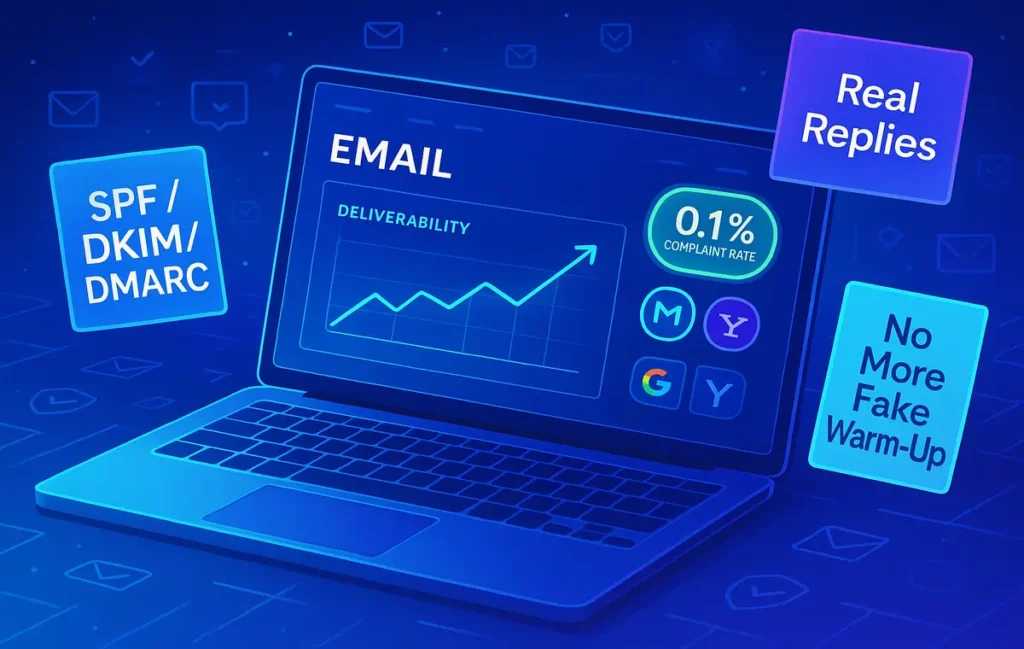
After the 2024–2025 Gmail and Yahoo policy changes, classic automated warm-up networks are risky because they generate artificial engagement. Compliant alternatives focus on authenticated infrastructure (SPF, DKIM, DMARC), slow volume ramp-up, real human engagement, and clean lists that keep spam complaints below the 0.3% threshold—ideally under 0.1%.
📬 Intro — Automated Warm-Up Is Dead. Deliverability Is Not.
For years, “email warm-up” meant plugging a fresh inbox into a warm-up tool, joining its private network, and letting bots open, star, reply to, and rescue your emails from spam. It felt like a cheat code: in a few weeks you could ramp a cold domain to hundreds of daily cold emails and still land in the inbox.
Then Google and Yahoo tightened the screws. On 1 February 2024, both providers began enforcing new bulk-sender rules: mandatory SPF and DKIM, DMARC alignment, one-click unsubscribe and—crucially—spam complaint rates kept under 0.3%, with best practice around 0.1%. At the same time, Google started cracking down on API abuse and manipulative behaviour, forcing some warm-up products to shut down parts of their service for “dodging spam filters” and inflating reputation artificially.
What didn’t change is the underlying physics of deliverability. ISPs still reward authenticated mail from domains with low complaint rates and strong engagement. What changed is the tolerance for fake engagement. Networks where thousands of inboxes auto-open and auto-reply purely to manufacture positive signals are now far more detectable—and in some cases explicitly out of bounds from a policy point of view.
So leaders are asking a new question: how do we warm up domains and inboxes in 2025 without tripping compliance wires? That is exactly what this NerdChips guide covers. We will recap what changed, why the old warm-up shortcuts are fragile, and how to build a post-policy warm-up stack that is slower, more human, and dramatically more resilient. If you already liked our breakdown of Email Deliverability: Authentication, Warming, and Monitoring, think of this as the “post-2025 edition” focused specifically on alternatives to classic warm-up tools.
💡 Nerd Tip: The new game is not “find a warm-up tool nobody has detected yet.” It is “design a sending pattern that would look healthy even to a suspicious human analyst reading your logs by hand.”
🧭 What Exactly Changed? (2024–2025 Policy Recap)
To understand why your old warm-up playbook is creaking, you need a clear view of the rules it now lives under.
Google and Yahoo’s 2024 updates focused on three pillars: strong authentication, acceptable spam complaint rates, and subscriber-friendly unsubscribes. Bulk senders (5,000+ messages per day to Gmail in particular) must authenticate with SPF and DKIM, align their DMARC “From:” domain, and keep complaint rates reported in Google Postmaster Tools under 0.3%. Industry guidance now strongly recommends staying closer to 0.1%: one complaint per 1,000 messages. Above that, you enter a “danger zone” where filtering tightens; at 0.3% you risk aggressive spam routing and mitigation being denied.
There are also stricter expectations around one-click unsubscribe and list hygiene. Mailbox providers have been explicit: they expect senders to regularly suppress inactive subscribers and reduce “ignored” mail, because low engagement over time is treated as a negative signal, even if it is not outright spam.
Importantly, Google clarified that its sender guidelines are enforced primarily for consumer Gmail accounts, not Google Workspace-to-Workspace traffic. But if you are doing cold outreach or newsletters, you almost certainly hit personal mailboxes somewhere in your funnel, so the rules still matter.
Parallel to these public guidelines, a quieter enforcement wave hit vendors that were using Gmail’s APIs and infrastructure in ways that violated terms of service. Some warm-up products were explicitly told to disable features that “dodged spam filters” or pushed accounts to Gmail’s limits using artificial traffic. On X, deliverability consultants began joking that “warm-up networks are the new PBNs”—they work until they don’t, and once platforms catch up, they become a liability.
💡 Nerd Tip: Think of bulk-sender rules as forcing alignment: DNS says you’re legit, complaint rates say people want your mail, and content behaviour says you’re not gaming the system. Automated warm-up networks sit right in the crosshairs of that last point.
🧨 Why Old Warm-Up Tools No Longer “Just Work”
Classic warm-up tools tried to brute-force the engagement part of the puzzle. They plugged thousands of inboxes into a private network, sent machine-generated emails between them, auto-opened, auto-replied, and pulled messages out of spam. On a metrics dashboard, that looked great: open rates appeared high, spam rates low, and new domains “earned” a positive sender reputation in weeks.
But from the mailbox provider’s point of view, this traffic has a fingerprint. The same domains interact in tight clusters. Messages have repetitive, low-substance content. Opens and replies follow suspiciously consistent patterns of timing and volume. Providers increasingly run anomaly detection across these signals. Vendors themselves admit that they now need to use “realistic interaction patterns” with time-zone awareness and varied content to avoid detection as artificial traffic.
Several things follow from this:
-
Engagement generated inside an artificial network doesn’t match real subscriber behaviour. Complaint rates from actual campaigns still drive your reputation.
-
If a warm-up vendor’s network is flagged, all accounts participating in it may inherit that stigma. In the worst case, you are paying to join a suspicious cluster.
-
Some methods directly violate API policies or provider terms. When Google tightened API enforcement, warm-up vendors using those channels to “game” reputation were forced to shut down features or close entirely.
One deliverability expert interviewed in 2024 summed it up bluntly: there is no “one weird trick” that makes email magically land in the inbox; the unpleasant work of good data, strong authentication and relevant content still has to be done.
In 2025, purely automated warm-up is not “dead” in the sense that it no longer exists—there are still plenty of tools promoting it. But it is fragile and increasingly misaligned with both the spirit and the letter of sender policies. Smart teams are moving away from relying on synthetic engagement as their primary warm-up mechanism and toward strategies that would stand up even if everyone knew exactly what they were doing.
📈 The New Deliverability Model (Engagement > Automation)
Post-policy, the model for stable deliverability looks more like an engineering system and less like growth hacking. You assume that Gmail, Yahoo and Microsoft can see three main planes of data:
-
Technical trust: DNS authentication (SPF, DKIM, DMARC), alignment, and whether you follow protocols correctly.
-
Complaint & spam signals: how often users say “this is spam” and how often your mail triggers hard bounces or spam-trap hits.
-
Engagement quality: opens, clicks, replies and long-term behaviour—do people keep interacting, or do they ignore you into oblivion?
The 2024–2025 changes simply turned the dials on these. Authentication is now table stakes. Spam complaints have explicit thresholds. And deliverability studies across 2024–2025 repeat the same conclusion: your best long-term predictor of inbox placement is consistent, real engagement from people who actually opted in.
That means warm-up in 2025 is less about “fooling” filters and more about deliberately engineering your early engagement profile. Instead of a warm-up tool simulating interest, you design flows where:
-
Early sends go to people who are extremely likely to open and reply.
-
Volume is ramped slowly enough that spikes look natural.
-
Lists are aggressively cleaned so that complaint and bounce rates stay below 0.1–0.2%, never flirting with the 0.3% red zone.
This is where NerdChips-style systems thinking shines. If you already structure your campaigns using the deliverability foundations in Email Deliverability: Authentication, Warming, and Monitoring and write better cold copy using frameworks in 21 Cold Email Tips That Still Work, you are halfway to a post-policy warm-up strategy. The last step is aligning how you ramp volume with who you send to and what they do with those emails.
💡 Nerd Tip: If your domain warm-up plan assumes a 20–30% open rate early on, you are planning to lose. Google’s bar is not “opens”; it is “complaints and long-term engagement.” Design around those, not dashboard vanity metrics.
🧑🤝🧑 Alternative #1 — Manual Warm-Up Using Internal Lists
The simplest and most compliant warm-up alternative is also the most boring: send real emails to people who actually know you. Internal staff, partners, friendly customers, beta testers and brand advocates are ideal for this.
You start by creating a small, vetted list of internal contacts across different providers—Gmail, Yahoo, Outlook, corporate domains. Instead of sending nonsense messages, send genuinely useful updates: short check-ins, product feedback requests, links to internal resources. Ask recipients to reply when relevant, star important emails, and move anything that lands in Promotions or spam back into the primary inbox for the first few weeks.
Because these contacts are genuinely connected to your brand, engagement will be naturally high and complaints effectively zero. You can then gradually expand outward: first to your warmest existing subscribers, then to new opt-ins from high-intent forms, and only later to colder segments. The key is that every email in this phase has a real reason to exist beyond “feeding the warm-up engine.”
One CMO on X described their experience after abandoning automated warm-up: “We went back to old-school internal warm-up—staff, partners, a VIP customer circle. It took four weeks instead of two, but our new domains have stayed clean for a year with no weird deliverability cliffs.” That’s exactly the tradeoff you want in 2025.
🫱🏻🫲🏽 Alternative #2 — Engagement Pods (Human-Only, Non-Automated)
“Pods” got a bad reputation in social media, but small, human-only engagement pods for email can work if you keep them honest. The idea is simple: a handful of founders, agencies or creators agree to run live inboxes on different providers and occasionally interact with each other’s early campaigns.
The rules that keep this compliant are straightforward. Everyone uses real inboxes they actively maintain, not skeleton accounts created just for the pod. No automation scripts are allowed: opens, clicks and replies are done manually and only when the content passes a basic sniff test. Volume stays tiny—dozens of pod addresses, not thousands. And participation is time-limited: you might use a pod to help a new domain cross its first 30–60 days, then phase out the extra support as real subscriber engagement takes over.
This approach works best when layered on top of internal warm-up. Internal contacts give you reliably strong engagement, while the pod adds diversity of mailbox providers and inbox histories without looking like a private botnet. Because everything is human-driven, it is much closer to “a bunch of small businesses mutually testing each other’s sequences” than to the kind of artificial traffic clusters Google is trying to shut down.
💡 Nerd Tip: If a pod member’s messages look spammy to you, they probably look spammy to Gmail too. Only join pods where you would be comfortable receiving the other participants’ campaigns organically.
🌱 Alternative #3 — Triggered Engagement via First-Party Channels
Instead of thinking “warm-up campaign” vs “real campaign,” you can bake warm-up into your first-party growth engine. Every time someone downloads a lead magnet, signs up for a webinar, starts a free trial, or abandons a cart, that is a chance to send a high-intent, engagement-friendly email that trains inbox providers to see your domain as trustworthy.
This is where your broader automation stack matters. Smart sequences built on top of marketing automation platforms can segment by behaviour—visited pricing, watched a video, added to cart—and trigger small, relevant emails rather than blasting cold lists. When those flows are designed with good copy and clear CTAs, engagement naturally rises. That in turn feeds the positive loops described in many 2025 deliverability guides: higher engagement, lower spam, better inbox placement.
For e-commerce, this aligns neatly with what you are already doing in Marketing Automation for E-commerce Stores: Smarter Sales and Best Email Personalization Tools for E-Commerce. When your pre-warm sequences are driven by onsite behaviour and personalization instead of generic nurture drips, they warm your domain while actively moving revenue, not just “prepping” for some later cold outreach campaign.
From a policy standpoint, this is the safest warm-up you can run, because every email goes to someone who raised their hand. You are not trying to sneak under the radar; you are giving mailbox providers exactly what their guidelines want: authenticated, permission-based email with consistent engagement.
📊 Alternative #4 — Smart Ramp-Up Schedule (Compliant Volume Curves)
Even with perfect authentication and great content, volume spikes can still stress your reputation. That is why ESPs and infrastructure providers publish detailed warm-up schedules showing how to ramp sending over days and weeks. A 2025 high-volume warm-up guide from one SMTP provider, for example, still emphasizes gradual volume increases over 3–8 weeks depending on your goals, combined with careful monitoring of placement and complaints.
The shape of your curve matters less than its smoothness and feedback loops. You might start at 25–50 emails per day for a few days, double every few days if engagement looks healthy, and pause or slow down whenever spam complaints or bounces tick up. The decision-making here is closer to performance marketing than to “set-and-forget” growth hacks.
To make this practical, you can build a simple progression plan like this:
| Phase | Day Range | Daily Volume Target | Audience Focus | Checkpoint Metrics |
|---|---|---|---|---|
| 1 — Seeding | 1–7 | 25–75 emails/day | Internal + closest relationships | Spam complaints ≈ 0%, opens very high |
| 2 — Warm Opt-ins | 8–21 | 100–300 emails/day | Recent sign-ups, engaged subscribers | Spam <0.1%, bounces minimal |
| 3 — Core Audience | 22–35 | 300–800 emails/day | Main list, filtered by recent activity | Maintain <0.3% spam, no sudden dips |
| 4 — Expansion | 36+ | Scale toward full sending goals | Carefully reintroduced colder segments | Strict sunset policy for low engagement |
Your exact numbers will vary, but the principle is non-negotiable: never jump from near-zero to full volume overnight on a new domain. The Providers are watching your curves.
💡 Nerd Tip: If you are impatient, spin up more domains instead of forcing one to ramp too quickly. Just remember that every domain needs its own warm-up journey; there are no shortcuts around reputation per identity.
🌐 Alternative #5 — DNS Reputation Boosting (Authentication as a Warm-Up Lever)
Post-2024, DNS configuration is no longer “nice to have.” SPF, DKIM, and DMARC aligned with your From: domain are explicitly required for bulk senders to Gmail and Yahoo, and recommended for everyone else.
This is why DNS-first deliverability work is a warm-up alternative in itself. A domain with clean DNS records, a clear DMARC policy, and even BIMI (Brand Indicators for Message Identification) logo support is sending a powerful pre-bounce signal: this is a legitimate brand investing in the right things.
A strong DNS reputation stack typically includes:
-
Correct SPF record that authorizes your ESPs and infrastructure.
-
DKIM keys per sending platform, rotated periodically.
-
DMARC with at least a monitoring policy (p=none) at first, tightened over time.
-
For larger brands, BIMI setup with VMC so logos display in supported inboxes.
When you combine this with careful volume ramp-up and engagement-focused audiences, you move from “warming up an inbox” to “building a brand-level identity that inbox providers can trust.” That’s a different league from trying to hide in a generic warm-up network.
If DNS and deliverability terminology feel intimidating, that’s where a structured guide like NerdChips’ Email Deliverability: Authentication, Warming, and Monitoring earns its keep. The more you treat DNS as a strategic asset instead of a one-time setup task, the less you depend on hacks later.
💬 Alternative #6 — Reply-Boosting Framework (Human Replies Only)
One signal mailbox providers consistently reward is genuine conversation. Transactional emails with near-100% opens and frequent replies—password resets, MFA codes, real support threads—tend to sail through filters. Your goal is not to fake this with bots but to design campaigns that naturally elicit replies.
That means writing first-touch emails that feel like a human trying to start a conversation, not a broadcast blasting a pitch. Soft CTAs like “Does this workflow match how you’re doing it today?” or “Quick sanity check: are you the right person for this?” nudge people toward a one-line response, which is gold for reputation. Many cold email practitioners on X are now openly sharing that their best-performing sequences are “ask a tiny question, shut up, and listen” rather than long monologues.
Reply-boosting warm-up can layer on top of internal lists and early opt-ins. If your first 100–300 outreach messages are intentionally crafted to trigger quick replies from people who know you, you are feeding mailbox providers the exact pattern they want: a domain that sends targeted, human messages and gets human responses. That reputation then carries into later, more scalable flows.
🧱 Alternative #7 — Deliverability Infrastructure Setup
Behind all of this sits your infrastructure: which SMTP you use, how you monitor spam rates, how you test inbox placement, and what you do when something breaks. 2025 deliverability playbooks increasingly emphasize a continuous cycle rather than a launch event: authenticate, warm, monitor, adjust.
A healthy setup usually includes:
-
A reputable ESP or SMTP provider with good relationships to inboxes.
-
Google Postmaster Tools and Yahoo Sender Hub accounts watching spam complaints and domain-level health.
-
Periodic seed-list testing using small, diverse seed addresses—not giant synthetic networks—to spot placement issues early.
-
Aggressive list hygiene and sunset policies: suppressing chronically inactive users, as recommended in recent 2025 deliverability best-practice guides.
If this sounds like a lot, remember that automation works with policy here. Once you design your flows and monitoring, tools can help you execute them consistently instead of fighting the inboxes. That is why deeper strategy content like Email Marketing Automation Hacks pairs so well with a post-policy warm-up mindset: automation stops being a shortcut and becomes armour.
Eric’s Note:
Whenever I see a tool promise “guaranteed inboxing” or “instant warm-up,” I assume it’s selling short-term relief at the cost of long-term risk. The tools I trust the most are the ones that insist you still have to write good emails and respect the rules.
🏷️ When to Use Subdomains vs New Domains (2025 Rules)
Finally, domain strategy. After the 2024–2025 changes, more senders started experimenting with outreach-specific domains and subdomains, hoping to isolate risk. The idea is sensible, but the details matter.
A subdomain like news.yourbrand.com inherits some of the trust and suspicion of your root domain. If your main brand domain has great reputation and sends mostly permission-based mail, using a subdomain for promotions and light cold outreach gives you a head start—but also means bad behaviour can stain your parent brand. An ESP-focused analysis in 2025 noted that providers increasingly look at reputation at multiple levels: IP, subdomain, root domain and even entire organizational patterns.
A completely new domain offers cleaner separation. It is useful when you want a “sacrificial” outreach identity that can be wound down without touching your main domain. But new domains start with no reputation and often face heavier scrutiny. If you do not warm them carefully with the alternatives above, you are more likely to fall into spam during those fragile first weeks.
As a rule of thumb:
-
If you are a brand with existing, healthy email programs, start with subdomains and treat them as part of your holistic reputation system.
-
If you are an agency or outbound shop managing many clients, using distinct domains per client is safer than squeezing all traffic through one umbrella name—but each still needs proper warm-up and authentication.
💡 Nerd Tip: Domain strategy is not a magic shield. Sending bad, non-permission-based email from ten domains just gives you ten ways to get into trouble. Policy changes pushed the industry toward respect, not toward more masks.
📬 Want More No-BS Deliverability Playbooks?
Join the free NerdChips newsletter and get weekly breakdowns on email deliverability, warm-up alternatives, and automation tactics that actually survive Google & Yahoo’s 2025 rules.
🔐 100% privacy. No noise. Just calm, practical marketing systems from NerdChips.
🧠 Nerd Verdict — Warming Up Domains in a World That Hates Shortcuts
Email warm-up did not disappear in 2025; it grew up. The hacks that relied on synthetic traffic and API abuse are being squeezed out by policy and detection. But the fundamentals—gradually ramping volume, focusing on delighted early recipients, and building a technically solid identity—are not going anywhere. In fact, they are being rewarded more consistently as Google, Yahoo and Microsoft refine how they read engagement and complaints.
If you reframe “warm-up” as training inbox providers to recognize you as the kind of sender their users actually like, the path forward becomes obvious. You combine internal lists, real micro-engagement, lead-driven sequences, authentication, smart ramp-up curves and infrastructure monitoring into one coherent system. It is slower than flipping on a warm-up bot, but it also survives audits, policy shifts and the inevitable next wave of anti-abuse changes.
From the NerdChips perspective, that is where serious marketers want to be: not chasing the next loophole, but building deliverability that compounds like an asset. Warm-up becomes something you design once, refine quarterly, and rely on—rather than something you’re always worried might break tomorrow.
❓ FAQ: Nerds Ask, We Answer
💬 Would You Bite?
If you had to redesign your warm-up process this month with zero automated engagement networks allowed, what would stay—and what would disappear overnight?
And second: which of the alternatives in this guide (internal lists, first-party triggers, DNS-first, reply frameworks) are you actually ready to implement in the next 30 days to protect your domain before your next big campaign? 👇
Crafted by NerdChips for marketers who want their emails to survive every policy update and still land in the inbox.