🔔 Intro
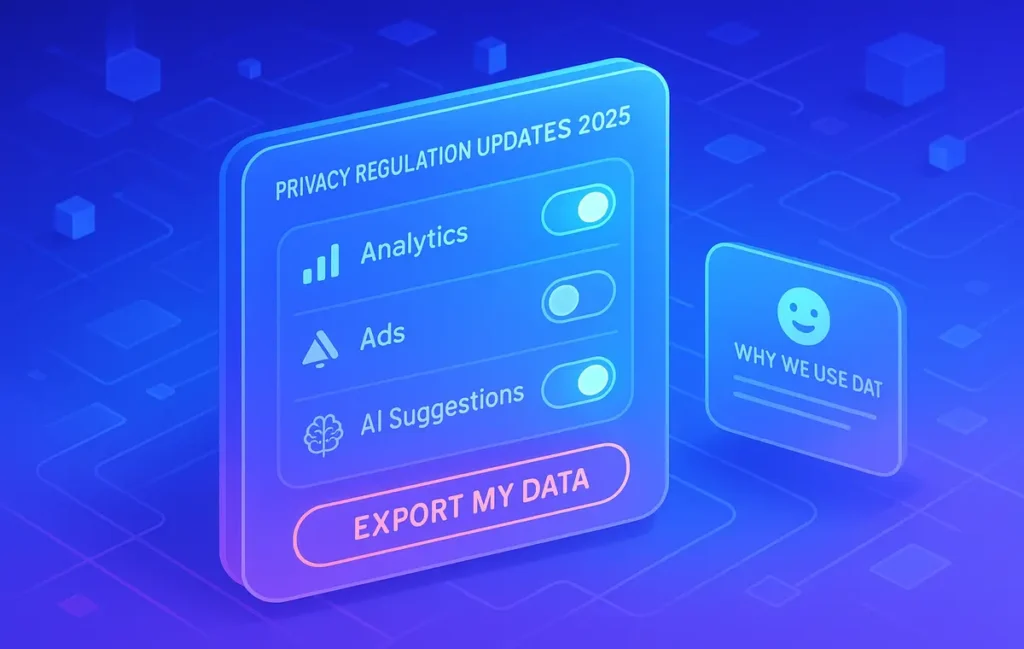
In 2025, privacy rules are evolving faster than product roadmaps. What used to be a yearly policy update is now a rolling wave of new obligations, regional amendments, and AI-specific requirements that tighten how data is collected, processed, transferred, and audited. Companies that don’t adapt face real exposure—legal, financial, and reputational—while users who understand their rights can demand better, safer digital experiences. On NerdChips, we’ve covered the tension between surveillance technology and civil liberties in Big Brother AI – Surveillance Tech vs. Privacy and the ongoing Privacy vs. Security: Encryption Under Debate Again, but 2025 marks a different kind of turning point: privacy-by-design stops being a slogan and becomes an operational standard.
💡 Nerd Tip: Treat privacy like uptime. If it goes down, everything else—trust, conversions, retention—goes down with it.
👥 Context — Who This Is For
This guide is for founders, product managers, marketers, security leads, compliance teams, and privacy-conscious users who want clarity without legalese. If you work with data—customer analytics, ads, personalization models, fraud detection, or AI assistants—this article gives you the plain-English view of what’s changing in 2025 and how to stay ahead. If you’re a user, this roadmap helps you understand what you can reasonably expect from services you use daily, and how to assert your rights with confidence.
To complement the legal angle with a security lens, read Cybersecurity in 2025: AI-Powered Defenses and Emerging Threats—because privacy and security are inseparable in practice, even when the policy debates try to split them apart.
🌪️ Why 2025 Is a Turning Point for Privacy Regulations
Three forces converge in 2025:
-
AI everywhere: Generative AI and automated decision-making systems ingest immense volumes of text, images, voice, and behavior logs. They increase value—but also risk—because they can memorize, infer, and leak. Organizations suddenly need model-level governance, from training data provenance to prompt logging and red-teaming. If you read our deep dive on governance in AI Ethics & Policy: The Future Tech Debate, you know alignment isn’t only a research problem; it’s a compliance problem.
-
Regulatory harmonization (with sharp edges): Regions are borrowing each other’s best ideas—lawmakers in one market reference clauses from another—yet they implement them with local nuances. The result is a patchwork that feels familiar but still demands per-region treatment, especially for consent, dark patterns, age gating, and cross-border transfers.
-
User expectations have matured: People now expect control toggles that actually work, dashboards that explain data use in human language, and real consequences when companies fail to protect them. A well-designed privacy experience (clear choices, visual feedback, explainable AI decisions) acts like an invisible feature—until it’s missing. Then churn rises.
In other words, 2025 is when privacy shifts from compliance cost to growth infrastructure: a foundation that earns trust, unlocks higher-fidelity data (willingly shared), and reduces incidents that derail roadmaps.
💡 Nerd Tip: Say “no” to data you don’t need. Minimization reduces attack surface, legal scope, and compute spend.
🌍 Key Global Updates at a Glance (2025)
🇪🇺 EU — GDPR Evolves + AI-Related Privacy Clauses
Across Europe, expect tightened expectations for:
-
Purpose limitation and transparency for AI features: If you’re enriching profiles or training models, you must be explicit about what data flows into what systems and why. “Improve our services” no longer passes as an explanation when the real action is model fine-tuning.
-
User-level controls for automated decision-making: Clear opt-outs for profiling, and meaningful explanations when AI influences pricing, eligibility, or ranking.
-
Data minimization meets model governance: Collect less, retain for less time, and prove you can delete or mask training data upon request where technically feasible (yes, you’ll need a realistic approach to “machine unlearning” or compatible alternatives like data redaction at ingestion).
-
Vendor accountability: If your product relies on third-party analytics, ads, content moderation vendors, or model APIs, you’re responsible for their behavior, not just your own DPA paperwork.
💡 Nerd Tip: Build a “model bill of materials” (MoBoM) akin to SBOM in software. Track datasets, checkpoints, safety tests, and handlers. You can’t govern what you can’t inventory.
🇺🇸 US — State-Level Expansion + Federal Proposals
The US continues its state-by-state expansion of privacy statutes while federal proposals circulate. For businesses, assume:
-
Stronger opt-out mechanics: Selling, sharing, and cross-context behavioral advertising often fall under heightened consent and disclosure requirements. You’ll need a Consent Management Platform (CMP) that supports granular toggles and regional logic.
-
Sensitive data gates: Precise location, biometrics, children’s data, and health-adjacent information (e.g., certain app usage patterns) are carving out stricter consent standards.
-
Data portability and deletion SLAs: Self-serve portals for access, export, and deletion requests reduce support load and demonstrate good faith—plus they keep you inside statutory timelines.
Marketing teams should be ready to switch audience construction strategies from third-party cookies to first-party data and privacy-preserving cohorts. If that sounds familiar, we unpack targeting trade-offs in AI Regulation on the Rise: Understanding the EU AI Act and More—use it to pressure test your roadmap.
🌏 Asia — India’s DPDP Momentum, China Tightens Controls, Regional Specifics
-
India: Data Privacy efforts emphasize consent, purpose limitation, and safeguards for cross-border flows while seeking interoperability with global standards. Translate this into practice by implementing clear consent prompts for each new use case, not just generic “agree to all.”
-
China: Expect ongoing scrutiny on cross-border transfers, security assessments, and stricter treatment of personal information in AI workloads. Local data residency and vendor selection matter as much as technical controls.
-
Southeast Asia: Multiple markets are maturing frameworks with familiar pillars: consent, rights requests, breach notification, and AI transparency. The details differ—don’t assume a one-size-fits-all notice will pass.
🌍 Middle East & LatAm — Emerging, Accelerating, Localized
Governments are rolling out or refining personal data laws with increasing references to algorithmic transparency, children’s data protections, and cross-border guardrails. The lesson for global products: build configurable compliance—a single codebase with regional switches for notice text, toggles, data routing, and retention defaults.
💡 Nerd Tip: Map your data flows on one page. Sources → processing → storage → sharing → deletion. If you can’t summarize it, you probably can’t defend it.
🧭 What Businesses Need to Do Now (Practical Playbook)
1) Strengthen consent management. A modern CMP is non-negotiable. You need geo-aware banners, purpose-level toggles, and auto-documentation of user choices. Avoid dark patterns—confusing toggles and pre-checked boxes are risk multipliers and erode trust.
2) Make data use transparent. Replace generic policy text with clear, contextual just-in-time notices. When launching an AI feature, explain what data it uses, how it improves the experience, and any sharing with vendors. Put these disclosures inside product flows, not just in a dusty policy page.
3) Engineer for deletion and portability. Rights requests shouldn’t require manual hunts in half a dozen systems. Standardize identifiers, centralize event logs, and automate deletion/exports where possible. Train your team on how model data is handled when a user asks to delete their profile.
4) Prepare for cross-border compliance. Define where your data lives, how it moves, and under what legal basis. Work with cloud providers that offer regional controls and auditability. If you use CDNs and analytics, document their endpoints and retention windows.
5) Align privacy and security. Encrypt defaults, role-based access, anomaly detection, and breach playbooks are privacy controls too. Share telemetry between security and privacy teams—silos create blind spots that regulators (and attackers) exploit.
6) Build explainability into AI features. Offer concise, human-readable summaries of how a model influences outcomes. When feasible, provide a reason code (e.g., “recent engagement” vs “demographic profile”) and a path to dispute or opt out.
To see how policy rubs against practice in AI risk, our editorial AI Ethics & Policy: The Future Tech Debate captures the frontline arguments product teams face every week.
💡 Nerd Tip: Your privacy UI is part of your brand. Make it fast, legible, and reversible. “Undo” builds confidence.
🟢 Opportunities & 🔴 Risks in 2025
The Upside: Trust Is a Growth Engine
Companies that make privacy tangible—crisp controls, honest defaults, real choice—experience measurable upside. Users who feel respected share data more willingly, respond to personalization better, and stick around longer. Even a modest lift in retention compounds over quarters into significant revenue. Privacy-first startups can differentiate on compliance posture, regional readiness, and transparency as a product feature (think audit dashboards for enterprise clients).
The Downside: Fines, Lawsuits, and Reputation Drag
Failing to meet obligations risks investigations, consent decrees, and costly re-platforming under pressure. Dark patterns become liabilities. Data lakes that were once celebrated morph into breach magnets. The worst cost isn’t the fine; it’s roadmap disruption, lost focus, and brand erosion that makes every future launch harder.
💡 Nerd Tip: Treat audits like chaos engineering. Schedule internal drills: “A user from Region X requests deletion. Can we execute and verify in 24 hours?”
🔮 Future Outlook (2025 → 2030)
Convergence, not uniformity. Expect a gravitational pull toward shared principles—transparency, minimization, rights requests—implemented with regional spice. Tooling will catch up: CMPs, privacy APMs, and model governance suites will integrate with CI/CD, so privacy checks run like tests.
AI + privacy by design. Model architectures will make it easier to segregate PII, tokenize at ingestion, and minimize instance-level memorization. Retrieval pipelines will learn to gate by policy in real time (e.g., “no PII retrieval for this prompt scope”).
Decentralized identity & verifiable claims. Wallets that let users reveal only what’s needed (“over 18,” not birth date) will mature. For some flows (KYC, age checks, ticketing), this reduces data collection while improving trust. Adoption will be slow until UX becomes invisible—but the direction is clear.
To keep your bearings in the broader AI policy landscape, cross-read AI Regulation on the Rise: Understanding the EU AI Act and More and revisit the civil-liberties dimension in Big Brother AI – Surveillance Tech vs. Privacy. Together, they frame the stakes that privacy rules are trying to balance.
💡 Nerd Tip: Design for data expiration the same way you design for feature sunsets. Old data is risk—build auto-archive and auto-delete.
⚡ Turn Privacy Into a Product Advantage
Explore privacy-first tools—modern CMPs, consent API gateways, data mapping automation, and AI governance dashboards. Ship compliant features faster and earn trust by design.
🧩 Mini Case Study — Trust as a Retention Lever
A mid-market European SaaS startup rolled out three changes: (1) a purpose-level consent banner with fast toggles; (2) an in-product “Why am I seeing this?” explainer for recommendations; (3) a one-click data export and deletion portal. They made no changes to their pricing or core features. Over the next two quarters, they observed higher opt-in rates for product analytics (because the value was clearly explained) and a lift in churned-user reactivation after trust-building emails highlighted the new controls. Net effect: a ~20% improvement in 90-day retention for new cohorts. The lesson isn’t that banners sell products; it’s that clarity sells trust, and trust sells everything else.
🛠️ Troubleshooting & Pro Tips (Real-World Friction → Practical Fixes)
Problem: Multi-region compliance feels impossible.
Fix: Adopt a CMP with geo-aware policies and purpose-level toggles. Back it with a policy engine that can be called in real time from your services (e.g., “is marketing-analytics allowed for user X in region Y?”). Cache decisions at the edge to avoid latency spikes.
Problem: Legal costs balloon with every new market.
Fix: Use privacy automation tools that generate records of processing, map data flows, and standardize DPIA/LIAs. Build templated impact assessments for AI features so teams can ship with confidence.
Problem: Users think you’re hiding something.
Fix: Build a privacy dashboard that explains what you collect, why, and how to change it. Keep it snappy—sub-second loads, friendly language, undo options.
Problem: Deleting data across systems is brittle.
Fix: Build deletion as an event in your architecture, not a cron job. A “delete” event fans out to services and confirms completion. Include model-data handling: mask training logs, purge cached embeddings, and scrub reprocessing queues.
For a defense-first complement to these strategies, pair this read with Cybersecurity in 2025: AI-Powered Defenses and Emerging Threats—because breach response is where privacy promises get tested.
💡 Nerd Tip: Create a “consent sandbox” environment where product teams test UI copy, toggle layouts, and load times. If it’s confusing in dev, it’ll be worse in the wild.
📬 Want More Smart AI & Privacy Playbooks?
Join our free newsletter for weekly deep dives on AI governance, privacy UX, and secure growth strategies—built for creators, product teams, and founders.
🔐 100% privacy. No noise. Just value-packed insights from NerdChips.
🧠 Nerd Verdict
Privacy in 2025 is no longer a compliance checkbox—it’s growth infrastructure. Teams that invest in clear consent, explainable AI, and deletion/portability as first-class features will out-compete rivals who treat privacy like a quarterly chore. The winners don’t just “meet the standard”; they make trust feel effortless.
❓ FAQ: Nerds Ask, We Answer
💬 Would You Bite?
If a product gave you granular control over how your data powers its AI features—plus an instant way to undo that choice—would you choose it over a cheaper alternative with vague policies?
Does trust change your conversion calculus? 👇
Crafted by NerdChips for creators and teams who want their best ideas to travel the world.