🛰️ Intro: Why 2025 Is a Pivot Year for Satellite Internet
The story of satellite internet used to be a tale of heroic engineering and spotty service. In 2025, it’s morphing into a pragmatic, planet-scale utility. Several forces converged: low-Earth-orbit (LEO) constellations scaled beyond early coverage maps, direct-to-device (D2D) standards matured from demos into commercial pilots, and multi-orbit strategies finally began operating like a real network—not a patchwork of sky hardware. Add mounting demand from remote work, edge AI, and cloud gaming, and the result is a market that’s shifting from “alternative access” to “core backbone,” especially where fiber won’t reach in time or at a viable cost.
What changed most is the product surface. Until recently, satellite connections meant bulky terminals and a tolerance for dropouts. Now, mobile-friendly hardware, smarter beamforming, and ground network upgrades are shrinking latency windows and stabilizing throughput. Even consumer phones are becoming viable endpoints as D2D evolves from SOS-only to messaging and limited broadband features. For creators and teams who already rely on cloud workflows, that’s not just convenience—it’s resilience. If you’re interested in where mobile connectivity goes next, our breakdown of 5G vs. 6G: what’s next in wireless tech helps you weigh terrestrial gains against what satellites will shoulder in the background.
The pivot in 2025 is also about expectations. People now ask less “Is satellite good enough?” and more “Where does satellite make the most sense?” Rural last-mile? Disaster recovery? Mobile teams? Cloud gaming on the go? The answer isn’t binary anymore; it’s a portfolio of options. NerdChips sees the next two years as the moment satellite becomes an invisible layer in the world’s connectivity stack—still imperfect, but finally indispensable.
🚀 Constellation Race: Starlink’s Scale, Project Kuiper’s Ramp, and IRIS²’s Shape
Every satellite network evolves through three gates: launch cadence, ground architecture, and service activation. 2025 is the year these gates align at scale. Starlink’s second-generation sats expanded capacity and coverage, and the company’s cadence has normalized enough to support new service tiers—fixed, mobility, and D2D pilots. What matters for users isn’t the raw number of satellites; it’s the capacity per cell, how often beams are reshuffled as spacecraft move overhead, and how the ground network backhauls traffic into the public internet. The pragmatic takeaway: your real-world experience depends as much on peering and core routing as it does on the number of shiny birds in orbit.
Amazon’s Project Kuiper has progressed from design and prototypes into phased commercial rollout. Kuiper’s execution focus is less “be first” and more “be predictable”—capacity planned by region, integration with AWS-adjacent workloads, and an emphasis on enterprise and government reliability. For industries that already pipe workloads into AWS, Kuiper’s promise is attractive: think bundled SLAs plus smoother data gravity into cloud workflows.
Europe’s IRIS², meanwhile, is moving the public-private model forward, aiming to guarantee sovereign capacity for critical infrastructure and governmental needs while opening doors to commercial partners. Expect IRIS² to prioritize resilience, security, and compliance—particularly relevant for cross-border operations that need predictable governance.
💡 Nerd Tip: Don’t think of constellations as “winners and losers.” Think “fit for purpose.” Kuiper’s enterprise-friendly posture, Starlink’s velocity, and IRIS²’s sovereignty emphasis are different answers to different constraints.
If you’re curious how these space-side moves ripple through ground-level industries, our look at the global chip supply dynamics touches the hardware pipeline—from phased-array antennas to the ASICs that make beam steering feasible at consumer price points.
⚠️ Major Setback & Reliability Test: The Starlink 2.5-Hour Outage—What It Exposed
No network is perfect. A high-profile outage in global services—roughly a couple of hours of degraded or lost connectivity across multiple regions—was a stress test that surfaced two truths. First, satellite networks are still software-defined at the edges: link scheduling, inter-satellite routing, and ground backhaul orchestration are deeply intertwined. When orchestration falters, issues cascade fast. Second, customer experiences now depend on blended redundancy. Users with a cellular failover or a secondary backhaul felt a hiccup; single-path satellite users saw full stops.
The practical lesson is resilience by design. If connectivity uptime is a business-critical dependency, you’ll want to architect redundancy—either a dual-WAN router with cell backup or a satellite-to-terrestrial hybrid service tier. Some users also learned the nuance between throughput and reliability: the former is speed under good conditions; the latter is predictable minimums under bad ones. One cloud-gaming enthusiast on X put it bluntly during the event: “I can live with 10–20 Mbps if it’s stable; I can’t live with zero.” That sentiment mirrors a broader trend we’ve seen among remote teams and streamers—latency spikes are annoying, but total dropouts are existential.
For mobile creators and gamers, context matters. If you’re exploring streaming strategies under constrained or variable networks, our deep dive into the rise of cloud gaming platforms breaks down how adaptive bitrate and smart buffering can make marginal links feel usable—especially when the network behaves “well enough” most of the time.
📈 Market Growth & Real-World Use-Cases: From Rural Lines to Planet-Scale IoT
The satellite connectivity market in 2025 is no longer a niche. It’s expanding across three fronts: rural broadband for households and micro-businesses, mobility for vehicles and maritime, and IoT for industrial edge. Households are the most visible story—new activations in underserved regions often deliver a step change from single-digit Mbps to workable broadband. But the less visible (and arguably bigger) story is industrial IoT: remote mining, precision agriculture, environmental monitoring, and maritime logistics. These sectors prize wide-area reach and predictable telemetry more than headline speeds, and satellites—especially narrowband links—fit that brief.
We’re also seeing demand from pop-up operations: live events, film sets, humanitarian camps, and construction sites. The “time to first packet” matters here. A portable terminal that lights up a site in minutes is immensely valuable, and this is where LEO’s lower latency—often sub-70 ms in the real world—lets cloud tools feel responsive enough for collaborative work. Remote work patterns compound the effect. Teams decouple from office-centric networks, and business continuity becomes a hybrid of fiber-first in town and satellite-first in the field.
One revealing data point from enterprise pilots in 2024–2025: when teams layer satellite as a backup to their primary circuit, unplanned downtime windows shrink enough to measurably protect revenue events—think checkout systems, live broadcasts, or logistics handoffs. While ROI varies by sector, several case studies report double-digit reductions in incident-related losses once a secondary path is installed. That’s not “speed”; that’s insurance.
If you’re thinking about the mobility side of this equation, keep an eye on Starlink’s phone-direct initiatives and similar D2D moves by competitors. Our recent overview of self-driving and aerial mobility touches on how resilient connectivity becomes a prerequisite for autonomy at scale—terrestrial and non-terrestrial networks will share that load.
📡 Technology Trends: D2D, Hybrid Networks, and Multi-Orbit Architecture
Direct-to-device (D2D) is the headline because it collapses the equipment stack—your phone becomes the terminal. Early implementations focus on messaging and low-bandwidth functions, but the trajectory is clear: phones will negotiate with satellites the way they already roam across cell towers, with standardized handshakes and operator partnerships. The key constraint is link budget; handheld antennas are tiny, so expect conservative bandwidth and careful duty cycles at the start. The breakthrough is not raw speed; it’s omnipresent fallback.
Hybrid terrestrial/satellite models are also maturing. Picture a router that blends fiber, 5G, and LEO in software, choosing the best path per packet. When properly tuned, this can smooth out latency spikes and protect upstream streams (video calls, broadcast, game sessions) from transient losses. The enabling tech is intelligent path control: forward-error correction, bonding, and traffic-aware policy. For teams who orchestrate live content or remote production, hybridization delivers fewer heart-stopping frames.
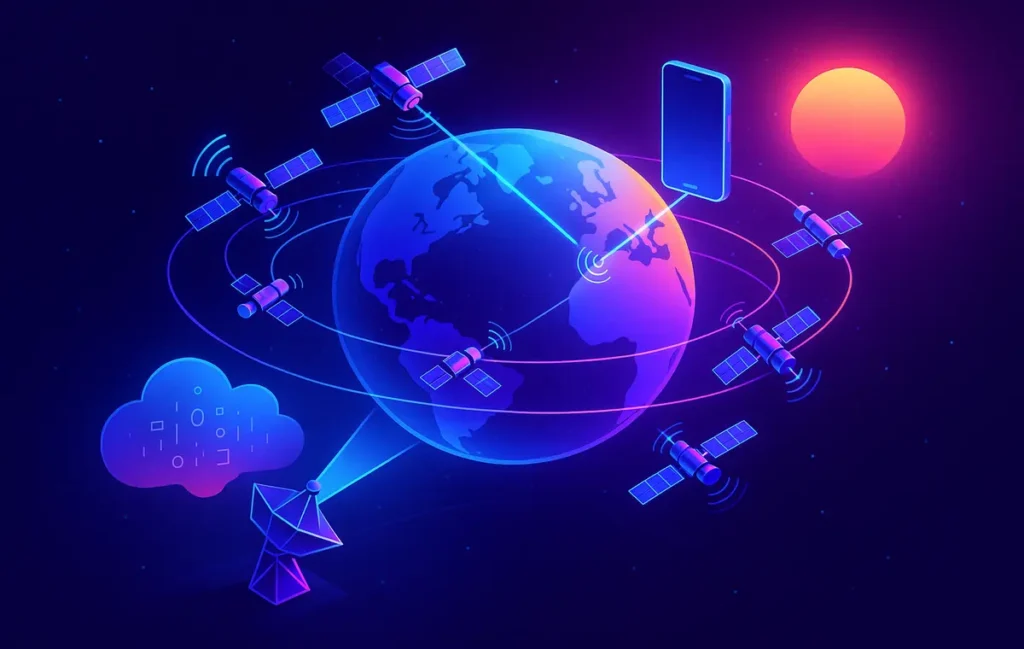
Multi-orbit (LEO/MEO/GEO) strategies are the quiet revolution. GEO still wins on sheer coverage with stable beams; MEO balances coverage and latency; LEO minimizes latency but moves fast and needs smart orchestration. Multi-orbit terminals and service plans that can hop or blend across orbits give enterprises the dials they’ve wanted for years—latency targets, cost ceilings, and availability policies. It’s the difference between “a satellite link” and “a satellite network.” For creators deciding how to adapt to changing networks, our piece on the future of wireless explains how these layers will interoperate with next-gen terrestrial standards.
| Orbit | Typical Latency | Strengths | Best For |
|---|---|---|---|
| LEO | ~30–80 ms | Low latency, growing capacity, D2D path | Interactive apps, mobile deployments, backup WAN |
| MEO | ~100–150 ms | Balanced coverage vs. performance | Regional backhaul, maritime, enterprise networks |
| GEO | ~500–650 ms | Wide coverage, mature ground footprint | Broadcast, bulk download, remote areas without LEO density |
💡 Nerd Tip: Latency is not the whole story. Packet loss and jitter determine call quality and gaming fluidity. Ask vendors for 95th-percentile metrics, not just averages.
🌍 Geographies & Coverage Gaps: Who’s Getting Connected Now?
The rollout map in 2025 reflects both physics and policy. Polar and remote maritime routes benefited from LEO coverage expansion and new ground stations. Rural regions in the Americas and parts of Africa saw household signups improve where local ISPs remain capacity-constrained. Dense urban cores, ironically, don’t see the same relative gain—fiber and 5G already serve them well—but multi-path failover is catching on even there, particularly for businesses with no tolerance for downtime.
Regulatory wins also unlock markets. Spectrum coordination and landing rights are the make-or-break for service commencement, and the pace is accelerating as regulators publish clearer frameworks for D2D and multi-orbit operations. Expect more countries to formalize D2D within cellular licensing regimes and emergency services mandates. It’s a pattern: first allow limited messaging, then permit broader use cases as interference studies mature.
NerdChips hears one repeated field insight from NGOs and resilience planners: a single pallet of satellite gear now stands up a command-and-control network for disaster zones in hours, not days. The friction moved from “how to get online” to “how to prioritize traffic,” which is a far better problem to have.
🧩 Partnerships, Ecosystem, and the New Reseller Playbook
The commercial satellite story is increasingly an ecosystem story. Hardware partners push smaller, smarter terminals. Cloud providers offer edge ingress points close to ground stations to minimize backhaul costs. Resellers bundle capacity into vertical solutions—agriculture kits with soil telemetry, maritime packages with weather routing, mining deployments with safety monitoring. The market is maturing beyond raw Mbps sales into outcome-driven services.
This is also where reliability and SLAs show up with more nuance. Enterprises want multi-path guarantees, not single-provider promises. That’s creating demand for managed connectivity platforms that abstract the provider behind policy: “keep latency under 120 ms for this app,” “never drop this stream,” “cap cost per gig in roaming zones.” Think of it like CDNs for the sky—multi-provider, policy-driven, and application-aware.
For founders, creators, and small teams, the practical shift is that satellite is becoming subscription-addressable. You don’t need to be a telco to design a robust workflow. Pair a compact terminal with your streaming or collaboration stack, and you’re in business—even on a mountain ridge. If you need workflow design ideas, our guide to cloud gaming’s future doubles as a blueprint for low-latency streaming setups under variable links.
⚡ Ready to Build Smarter Workflows?
Explore AI workflow builders like HARPA AI, Zapier AI, and n8n plugins. Start automating in minutes—no coding, just creativity.
🛠️ Challenges Ahead: Cost Curves, Regulation, Debris & Sustainability, and the Physics Ceiling
Progress doesn’t erase constraints. Cost is still the lead domino. While consumer plans have become more accessible in many regions, enterprise-grade SLAs and mobile maritime/aviation packages remain premium. Expect a gentle downward slope as scale improves, but budget planning should assume variability by region and use case.
Regulation is both a throttle and a guardrail. Spectrum coordination and interference management, especially for D2D inside licensed mobile bands, requires real discipline. The good news: clearer frameworks are emerging; the challenge: they differ by country, so cross-border operations need legal ops built in.
Space debris is more than a headline—it’s an operational risk. Constellation operators must continue to demonstrate safe deorbiting, collision avoidance, and transparent tracking. Sustainability is now a procurement checkbox; governments and large enterprises increasingly ask for lifecycle evidence, not just performance specs.
Finally, physics still matter. LEO reduces latency, but not to fiber-like single-digit milliseconds across continents. Throughput per cell is finite and must be shared. That is why network planning, fair-use policies, and traffic shaping exist. The win in 2025 is that these limits are better managed—and more honestly communicated—than in the hype cycles of the past.
👩💻 What It Means for You: Creators, Teams, and Field Operations
If you’re a solo creator or a small team, satellite is a resilience play and a freedom play. Resilience: failover keeps your stream, client call, or checkout alive. Freedom: you can work from genuinely remote places and still ship. For cloud-first work, set expectations right: upload windows may be the constraint; plan batch uploads and lean on sync tools that tolerate variable connectivity.
For businesses with distributed operations, satellites let you standardize minimum connectivity across sites. That’s vital for compliance monitoring, telemetry, and incident response. Design workflows around “good enough, consistently,” not peak speed. And consider hybrid bonding for truly live-critical workloads. If you’re mapping all this into your broader network strategy, our explainer on next-gen wireless evolution clarifies what satellite offloads—and what it can’t.
And yes, phones joining the party matters. As D2D expands, your handset becomes a thin lifeline even when towers are down or absent. It won’t replace broadband; it will prevent blackouts.
💡 Nerd Tip: Treat satellite like a UPS (uninterruptible power supply) for your internet. You still plug into the wall when you can—but when the power blinks, you don’t lose the file you were saving or the stream you’re broadcasting.
🔭 Conclusion & Outlook: The Next 12–24 Months to Watch
Watch for three signals. First, stable D2D messaging that quietly expands into richer data types—think asynchronous media before real-time. Second, multi-orbit service plans with policy-driven routing that ordinary IT teams can manage without bespoke integrators. Third, enterprise bundles where connectivity, edge compute, and security ship as one service line.
If those unfold as expected, the satellite layer fades into the background—exactly where utilities belong. You won’t brag about your link. You’ll just trust it. And for a world that runs on video calls, sensor data, and cloud render queues, that trust is the story.
For a grounded look at how connectivity enables new user experiences at the edge of mobility, our take on the future of transportation shows how resilient links underpin autonomy and aerial logistics. And for mobile devices and last-mile economics, the tension between terrestrial and non-terrestrial networks in 5G vs. 6G is the perfect companion read.
📬 Want More Smart AI Tips Like This?
Join our free newsletter and get weekly insights on AI tools, no-code apps, and future tech—delivered straight to your inbox. No fluff. Just high-quality content for creators, founders, and future builders.
🔐 100% privacy. No noise. Just value-packed content tips from NerdChips.
🧠 Nerd Verdict
Satellite internet just graduated from “backup link” to “strategic layer.” The maturation of LEO capacity, the rise of multi-orbit orchestration, and the slow-but-sure arrival of D2D change how we plan networks at every scale—from a solo filmmaker’s van to a multinational’s remote sites. The winning mindset isn’t “satellite versus terrestrial”; it’s “policy-driven connectivity that blends the best path at any moment.” If you design for that reality now, you’ll find that satellite quietly eliminates the riskiest 1% of your downtime and unlocks the 10% of places you previously wrote off as “offline.”
❓ FAQ: Nerds Ask, We Answer
💬 Would You Bite?
What’s the one workflow you’d move to a satellite-backed setup tomorrow if reliability were guaranteed—your live stream, your checkout, or your field sensors?
Tell us how you’d use it, and we’ll help blueprint the stack.👇
Crafted by NerdChips for creators and teams who want their best ideas to travel the world.