🚗 Introduction: The Car Is Becoming a Computer—With Wheels
The modern automobile is no longer a metal shell with a motor—it’s a rolling stack of compute, sensors, and software that learns. In 2025, the most important decisions in automotive won’t come from the engine bay; they’ll be made in model training pipelines, edge inference stacks, and over-the-air (OTA) release rooms. That’s the shift: from horsepower to model power.
Why this matters now is simple. AI has crept into every layer of the vehicle lifecycle: upstream in design (simulation, synthetic data), on the factory floor (vision-guided quality control), inside the cabin (voice assistants, driver monitoring, personalization), on the road (ADAS and higher levels of autonomy), and downstream in service (predictive maintenance). You can already feel the ripple effects in consumer expectations: buyers now ask whether a car “gets better” after purchase. In other words, will your 2025 hatchback learn faster than your phone?
To keep the story reader-first and practical, we’ll look at what three camps are doing this year:
-
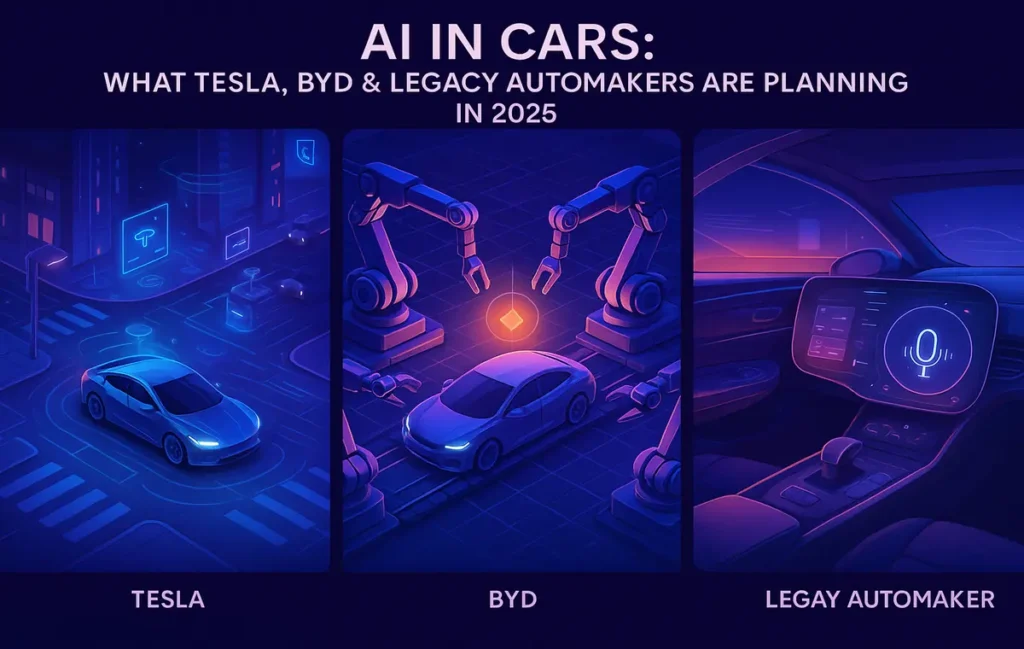
Tesla, the autonomy-first, software-defined pioneer, doubling down on camera-only perception, end-to-end learning, and OTA velocity.
-
BYD, the scale engine, blending cost discipline with AI-assisted manufacturing and smart-driving features that target the mass market.
-
Legacy automakers (think GM, Volkswagen, Toyota, BMW and friends), who are re-architecting their vehicles and org charts to become software companies—often while wrestling with supplier stacks, model risk, and regulation.
Along the way, we’ll highlight what this means for drivers, developers, and policymakers—and where the real moats are likely to form. If you’re new to how AI quietly shapes your everyday gadgets, you’ll recognize the same pattern from consumer tech; our explainer on AI in Everyday Life: The Smart Devices You Already Use sets the stage for why cars are the next frontier. 💡 Nerd Tip: Keep an eye on compute: who controls the AI hardware roadmap often dictates the pace of features. For a deeper primer, scan The AI Chip Wars: Inside the Race for Smarter Hardware.
⚡ Tesla in 2025: End-to-End Autonomy, Voice, and the Robotaxi Flywheel
Tesla’s AI strategy in 2025 revolves around a single conviction: vision is enough when scaled with data and training. The company’s approach to autonomy is to unify perception, planning, and control in end-to-end networks trained on a reservoir of fleet data. Rather than hand-coding heuristics for edge cases, Tesla leans into automated data engine loops—mine hard examples from the fleet, iterate on model architectures, re-train at scale, and ship. That “collect-train-deploy” loop, stitched together with aggressive OTA cadence, is the heartbeat of the product.
On the road, that philosophy shows up as increasingly “natural” driving behavior. Instead of decomposing driving into brittle modules, Tesla’s networks learn latent representations that encode semantics such as lane intent, pedestrian motion, or yield etiquette. When these models improve, behavior feels less robotic: merges become smoother, unprotected turns less tentative, and interventions drop in frequency. The risk—always present with end-to-end learning—is that regressions can sneak in; Tesla counters by gating releases with shadow mode telemetry, staged rollouts, and rollback levers.
Inside the cabin, Tesla is turning voice into a primary interface. A car generates micro-tasks every minute—navigation edits, climate tweaks, media search, windshield wiper timing, glove-box PINs. A responsive assistant collapses those taps into a sentence. Expect localized wake words, on-device ASR for snappy latency, and LLM-powered intent routing that’s robust to accents and road noise. As LLMs run more efficiently at the edge (NPUs, quantization, speculative decoding), more of that intelligence stays in the vehicle. If you want a fast refresher on why edge compute is spiking across devices, skim AI Hardware Revolution: From NPUs to Edge Devices.
The long arc, of course, points toward robotaxi economics. Autonomy-as-a-service depends on three levers: miles without a driver, utilization per vehicle, and operating cost per mile. Tesla’s bet is that an end-to-end stack plus a massive fleet data advantage compounds these levers faster than rivals. The open questions are regulatory alignment and long-tail safety. Even with better planning networks, autonomy must prove reliability not just on sunny arterials but in rain-slicked construction zones with ambiguous signage. Expect 2025 to focus on expanding operating design domains (ODDs), improving driver monitoring to reduce misuse, and deepening partnerships with local regulators.
From a software business perspective, Tesla treats the car as a platform. Features are unlocked via software, monetization blends hardware margin with post-sale software revenue, and the product narrative is velocity: a vehicle that meaningfully improves every few weeks. That pattern will feel familiar to gamers watching AI reinvent their industry; our analysis in The AI Revolution in Gaming: How Artificial Intelligence Is Leveling Up Video Games explains how iterative content pipelines drive engagement—cars are adopting a similar loop.
💡 Nerd Tip: Watch for end-to-end planner breakthroughs that collapse multiple networks into a single large model with tool use. When planning, map priors, and control talk to one another directly, behavior becomes both simpler to ship and trickier to debug—observability tooling becomes a moat.
🔋 BYD in 2025: Scale, Smart-Driving for the Mass Market, and AI-First Factories
Where Tesla optimizes for frontier autonomy, BYD optimizes for scale. In 2025, BYD’s story is vertical integration meets AI-assisted operations. The company’s control over batteries (blade architectures), power electronics, and final assembly gives it cost elasticity that most brands can’t match. AI folds into this equation in two places: manufacturing and smart-driving.
On the factory floor, computer vision models check weld quality, paint consistency, and pack assembly. Anomalies that once relied on periodic sampling are now flagged in real time. The outcome isn’t just fewer defects; it’s a virtuous circle where data feeds process tweaks that then generate better data. In battery production, predictive models adjust temperature and pressure windows on the fly, aiming for longer cycle life and more consistent yields. Even if you never peek at a confusion matrix, you feel the result as quieter cabins, tighter panel gaps, and fewer service visits.
On the road, BYD emphasizes accessible ADAS that feels premium without premium pricing. Think lane centering that resists ping-ponging, highway merges that don’t spook passengers, and urban assists that are cautious without being paralyzed. Rather than chasing full autonomy in one leap, BYD’s roadmap saturates the mid-market with features that 80% of drivers use 80% of the time. That approach builds data volume while sidestepping the steep regulatory cliff of driver-out scenarios. Inside the cockpit, BYD’s infotainment leans into responsive UIs and voice that plays nicely with Mandarin and English (and increasingly more locales), with smart routing, cabin controls, and media that reduce tap-fatigue.
The speed advantage is real. BYD’s tight hardware-software loop and manufacturing scale let it run short iteration cycles—even model-year changes can arrive as software discretely, avoiding costly re-tooling. In a market where perception models and planners age quickly, cycle time is strategy. For consumers, that shows up as a stream of polish: better parking assists in Q1, smarter energy routing in Q2, and a quieter AC compressor tune in Q3. None of these is splashy alone; together they compound into a car that feels more refined at month twelve than at delivery.
Brand-wise, BYD pairs the rational (value, reliability, range) with the modern (connected, personalized, updatable). That balance matters in markets where first-time EV buyers want the tech but fear complexity. If you need a framework for evaluating the chips and accelerators behind these experiences, bookmark The AI Chip Wars: Inside the Race for Smarter Hardware—it explains why the cost of inference per mile can decide which features make the cut.
💡 Nerd Tip: Mass-market AI wins by reducing cognitive load, not by dazzling with features. The best systems default to safe, predictable behavior and let power users opt into advanced modes.
🏛️ Legacy Automakers in 2025: Re-Platforming to Software-Defined Vehicles
Legacy automakers enter 2025 in a sprint to re-platform. They’re reorganizing around software-defined vehicles (SDVs)—vehicles where features are abstracted from hardware and delivered through services, not just trims. The shift sounds clean on paper; in practice, it triggers changes in everything from procurement and supplier contracts to firmware signing and incident response.
The first challenge is architecture. Traditional vehicles sprawl with dozens of electronic control units (ECUs) from different vendors. SDVs consolidate compute into a handful of domain controllers and, increasingly, a central high-performance computer. This reduces wiring, cuts latency between perception and actuation, and—crucially—makes software updates tractable. But it also forces a supplier culture shift: who owns the APIs? who is on the hook for security patches? which models run on which accelerators?
The second challenge is talent and tooling. Building safe, adaptive driving software requires not only ML engineers but also data ops, simulation teams, high-fidelity map pipelines, and test automation at an unprecedented scale. Many legacy players are hiring aggressively, setting up software hubs in tech regions, and partnering with chipmakers and cloud providers. Expect mixed strategies: some will build core autonomy in-house; others will integrate partner stacks for ADAS while focusing on branded UX layers, voice, and services.
Third: time-to-feature. Historically, a new feature might wait for a model-year refresh. In an SDV world, customers expect improvements monthly. The re-tooling needed to go from quarterly releases to weekly OTA cycles is non-trivial—validation pipelines must broaden, homologation teams must coordinate with software release trains, and customer support must adapt to a world where “have you updated?” is the first troubleshooting step. When transitions are choppy, you see it as delayed features or cautious rollouts; when they work, the car feels alive.
Finally, regulation and liability force careful framing. Driver-assist features are increasingly scrutinized for clarity of marketing (driver-assistance vs. autonomy), driver monitoring, and data retention. Legacy automakers will likely lean conservative on naming, invest in robust hands-on detection, and emphasize supervised use cases. They’ll also integrate with public-sector initiatives as cities become more instrumented; if you want a sense of how that tapestry is evolving, read our primer on How Governments Are Using AI for Smart Cities.
💡 Nerd Tip: For SDVs, observability is oxygen. If a model regresses, teams need instant visibility into when, where, and why. The brands that ship internal telemetry platforms with precise reproduction tools will recover faster—and win trust.
🧭 What Changes for Drivers in 2025: From Features to Feel
The best way to evaluate AI in cars is to stop thinking in checklists and start thinking in feel. Here’s what the shift means in practice:
-
Driving feel improves subtly, then suddenly. Upgraded planners smooth out lane changes, locally-aware navigation avoids last-minute darting, and articulation at low speeds (parking, roundabouts, construction) becomes less fidgety. Many drivers won’t be able to name the feature; they’ll just say the car feels calmer.
-
Voice takes friction out of the cabin. “Add a charging stop with at least 150 kW,” “shrink my cabin temp two degrees,” or “open the camera for the right mirror” are second-nature commands when microphones, beamforming, and on-device LLMs converge. You shouldn’t have to look away from the road to run a search or tune a setting.
-
Safety becomes both proactive and personal. Driver monitoring recognizes fatigue patterns, adjusts alert thresholds, and suggests a coffee stop when micro-corrections spike. Collision avoidance taps into richer environmental priors, relying less on rules and more on generative predictions of other actors.
-
Maintenance goes predictive. Models forecast when cabin filters need changing, when coolant performance is drifting, or when a pack’s thermal profile hints at imbalance. Service visits shift from reactive appointments to planned micro-touches, squeezing downtime.
If you enjoy watching other industries adopt similar loops, our deep-dive on The AI Revolution in Gaming: How Artificial Intelligence Is Leveling Up Video Games shows how iterative updates change player behavior—drivers aren’t so different.
🔬 Data, Benchmarks & Real-World Signals to Watch
Benchmarks in automotive are tricky: public datasets rarely capture the messy edge cases that matter, and private metrics—intervention rates, miles between disengagements, false-positive braking—can be cherry-picked. Still, here are signals that genuinely correlate with real-world progress:
Intervention Density (Private Fleet Telemetry). Teams track how often a system requests driver takeover per 100 kilometers across ODDs (city, highway, night, rain). A healthy trajectory is double-digit improvement quarterly in like-for-like conditions—sustained over a year.
OTA Velocity and Regressions. A brand that ships frequent updates with low rollback rates has strong validation pipelines. Watch for patterns: are updates monthly? are they featureful or just bug fixes? does behavior measurably improve after each release?
Driver Monitoring True-Positive/False-Positive Balance. If hands-on detection is too lax, misuse spikes; too strict, and drivers hate the nagging. The best systems hold a high true-positive rate while minimizing nuisance alerts, especially at night or with sunglasses.
Perception Robustness Under Occlusion. In challenging conditions (rain, night glare, partial occlusions), modern vision models should keep detection and tracking stable without overreacting. Look for stable lateral control and fewer phantom brakes.
Factory Yield & Field Failure Rates. While not always public, strong brands whisper consistent pack yields and low early-life failure claims. That suggests strong upstream AI QC.
💡 Nerd Tip: If a brand talks about autonomy but never publishes meaningful change-logs or engages on failure modes, treat the marketing with caution. Mature teams share limitations—because they have plans to fix them.
🧪 A Quick Reality Check: Failure Modes You Should Expect
No stack is perfect. Even the best AI-driving systems will stumble in scenarios where data is sparse or labels are ambiguous.
Ambiguous Construction Lanes. Temporary lane markings that intersect with old faded paint can confuse lane geometry estimators. Good stacks learn to mistrust low-confidence geometry and rely on drivable-space priors and vehicle-to-vehicle context.
Unmapped Private Roads With Novel Obstacles. Think warehouse yards or pop-up street markets. Without the crutch of high-definition priors, planners must infer intent from first principles, which is still hard.
Reflective Surfaces and Glare. Bright sun on wet asphalt can trigger false positives. Modern models are better, but this remains a frontier for robust segmentation.
Human Weirdness. A pedestrian who changes their mind mid-crossing; a cyclist signaling late; a driver rushing a yellow. Stacks that learn behavior distributions—rather than rules—cope better, but outliers will always exist.
The takeaway: judge systems not by whether they ever fail (they will), but by how they fail and recover—do they degrade gracefully, alert clearly, and hand control back without panic?
🧩 Strategy Comparison at a Glance
| Dimension | Tesla | BYD | Legacy Automakers |
|---|---|---|---|
| Core Thesis | End-to-end learning + fleet data advantage | Scale + cost + accessible smart-driving | Re-platform to SDV; mix build/partner strategies |
| Hardware/Compute | Centralized high-perf computer; camera-first | Cost-optimized controllers; pragmatic sensor sets | Consolidating ECUs into domain/central compute |
| Voice & UX | LLM-driven assistant as primary UI | Local-first voice with multi-language focus | Partner voice stacks + branded UX layers |
| Autonomy Path | Robotaxi ambition; expanding ODDs | Widespread ADAS; cautious autonomy claims | Supervised assistance; selective autonomy pilots |
| OTA Cadence | High frequency, behavior-changing | Steady cadence across trims | Acceleration in 2025; variability by brand |
| Factory AI | Process control & QC with fleet feedback | Heavy emphasis; yields & throughput focus | Scaling vision QC; supplier integration hurdles |
| Key Risks | Regulatory friction; end-to-end debuggability | Global expansion/regulatory variance | Legacy tech debt; supplier lock-in; talent gaps |
💡 Nerd Tip: The winner isn’t who promises the highest “level” of autonomy. It’s who compounds deployment learning the fastest—data in, model out, behavior better.
⚡ Ready to Build Smarter Auto-AI Workflows?
Prototype voice commands, telemetry dashboards, and OTA content flows with AI workflow builders. Connect your data, ship faster, and iterate like the best car teams.
🧠 Building the AI Car Stack: Hardware Really Matters
All of this sophistication depends on affordable, efficient compute—both in the cloud for training and at the edge for inference. As LLMs and vision transformers mature, they get better at compressing intelligence into smaller footprints. That means cars can run richer perception and dialog models on-device without round-tripping to the cloud for every ask. For a guided tour of why NPUs, sparsity, and quantization are changing the math here, hop over to AI Hardware Revolution: From NPUs to Edge Devices. In plain terms: if the cost per inference drops, more features survive the cost-cutting meeting—and your car gets smarter without getting pricier.
🧩 Practical Buyer Guide for 2025 (Mini-Checklist)
When you sit in a dealer lot or hover on a configurator this year, evaluate AI like a pro:
-
Does the brand publish detailed change-logs for OTA updates?
-
How transparent is the driver-assist branding about supervision?
-
Is voice fast and reliable offline (tunnels, rural areas)?
-
Do driver-monitoring alerts feel fair or naggy on longer trips?
-
What’s the track record on post-sale feature additions versus promises?
💡 Nerd Tip: Ask for a test route with roundabouts, unprotected turns, and a construction detour. Don’t accept a perfectly groomed demo loop.
🗺️ Geopolitics & Ecosystem: Why Context Shapes Cars
Automotive AI now lives inside a web of export controls, data-localization rules, and safety standards that vary by region. China’s industrial scale accelerates both hardware and software learning curves; the U.S. prioritizes innovation plus safety accountability; the EU foregrounds regulation and consumer data rights. Brands planning global robotaxi networks must reconcile standards on driver monitoring, camera use, and mapping. City partnerships also matter: curbside management, V2X pilots, and charging infrastructure policy can speed or stall rollouts. For the civic layer behind the scenes, see How Governments Are Using AI for Smart Cities.
💡 Nerd Tip: Watch municipal sandbox programs. The cities that publish clear playbooks for AV pilots become magnets for deployment—and for talent.
📬 Want More Smart AI Tips Like This?
Join our free newsletter and get weekly insights on AI tools, no-code apps, and future tech—delivered straight to your inbox. No fluff. Just high-quality content for creators, founders, and future builders.
🔐 100% privacy. No noise. Just value-packed content tips from NerdChips.
🧩 Read Next
You’ve seen how autonomy hinges on model power; if you want a friendly on-ramp to the invisible AI already in your home, start with AI in Everyday Life: The Smart Devices You Already Use. The performance envelope in cars is gated by silicon, so it’s worth understanding the landscape in The AI Chip Wars: Inside the Race for Smarter Hardware; that background helps you decode why some features trickle to mid-range models and others don’t. And because vehicles are becoming edges on a city-scale computer, city policy in How Governments Are Using AI for Smart Cities will quietly define your charging stops and traffic flows. For a broader sense of how edge devices are suddenly capable of on-device intelligence, AI Hardware Revolution: From NPUs to Edge Devices is your quick explainer. Finally, if you enjoy watching fast iteration cycles, the dynamics in The AI Revolution in Gaming: How Artificial Intelligence Is Leveling Up Video Games feel uncannily similar to OTA-driven cars.
🧠 Nerd Verdict
The automotive AI race in 2025 isn’t a single showdown—it’s three overlapping games. Tesla optimizes for frontier autonomy and OTA velocity with a belief that data plus end-to-end learning beats hand-built stacks. BYD optimizes for scale, cost, and accessible smart-driving that quietly improves the daily trip for millions. Legacy automakers optimize for reinvention, migrating decades of know-how into SDV architectures while balancing safety, regulation, and partner ecosystems.
The differentiator won’t be who demos the fanciest stunt; it will be who compounds deployment learning the fastest while keeping customers informed and safe. Cars that learn are here. The brands that learn how to ship learning—reliably, transparently, repeatedly—will own the decade.
❓ FAQ: Nerds Ask, We Answer
💬 Would You Bite?
If you could choose only one AI superpower for your next car—flawless voice control, smoother highway autonomy, or predictive maintenance—which one would actually improve your daily life? And why?
Crafted by NerdChips for creators and teams who want their best ideas to travel the world.